
You are not the only one who is confused about fare better or fair better. This is among the most popular English errors in writing and speaking. The two phrases are equally pronounced yet one is right.
You will soon know how to use it correctly, what it means, actual examples and a trick that will help you never use it again in this guide. The idea is that you should end up with clear answers that will assist you in writing and speaking properly.
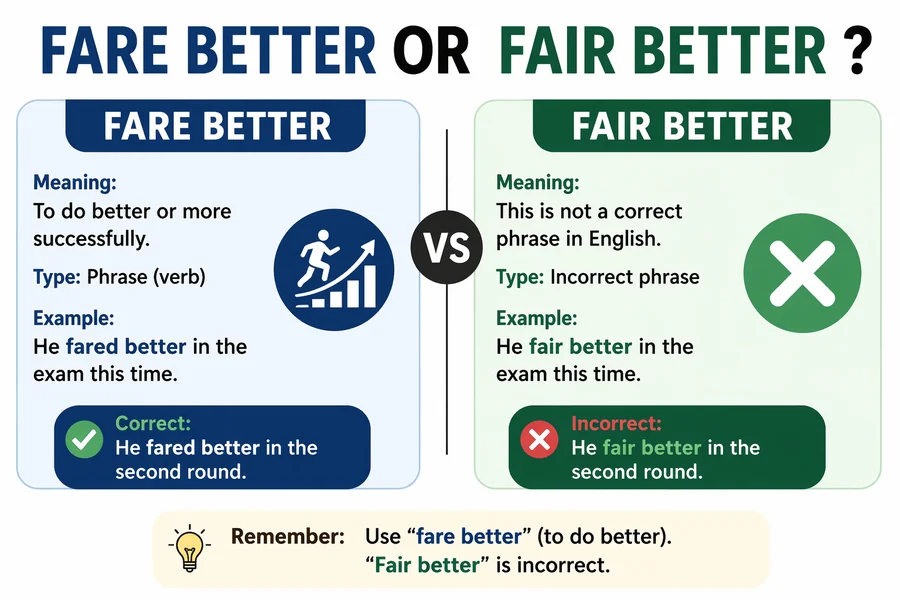
Fare Better or Fair Better: Quick Answer
“Fare better” is correct English.
It means to perform better or achieve a better result.
“Fair better” is incorrect in this context and should not be used.
Fare Better or Fair Better: What Is the Difference?
The difference between fare better or fair better is simple:
- Fare better → ✅ Correct phrase
- Fair better → ❌ Incorrect phrase
Fare better is used when talking about performance or outcomes.
Fair better does not work grammatically in this meaning.
What Does “Fare Better” Mean?
Simple Definition
Fare better means to do better in a situation or achieve improved results.
Easy Explanation
If someone improves their performance or outcome, we say they fare better.
Real Examples:
- Students who revise regularly fare better in exams.
- Businesses with strong planning fare better in competition.
- She fared better after changing her approach.
What Does “Fair Better” Mean?
Fair better is not correct English in this context.
Here’s why:
- “Fair” means just, equal, or reasonable
- It is not used as a verb for performance
- It does not fit with “better” in this structure
Incorrect Examples:
- He will fair better next time ❌
- They fair better under pressure ❌
Correct Versions:
- He will fare better next time ✔
- They fare better under pressure ✔
Fare Better vs Fair Better: Key Difference Table (Quick Scan)
| Feature | Fare Better ✅ | Fair Better ❌ |
| Correct usage | Yes | No |
| Meaning | Perform or do better | No valid meaning |
| Grammar type | Verb phrase | Incorrect form |
| Usage in English | Common and correct | Not used |
| Example | You will fare better with practice | Incorrect usage |
Why People Confuse Fare vs Fair
This mistake is very common for a few simple reasons:
- Both words sound exactly the same
- English spelling is not always logical
- “Fair” is more familiar in daily language
- Fast typing leads to automatic errors
So people often write fair better without realizing it is wrong.
Read Also: Vallies Or Valleys: Which Is Correct? Easy Rule, Examples & Common Mistakes
When Should You Use “Fare Better”?
Use fare better when talking about:
- Performance improvement
- Exam results
- Work outcomes
- Life situations
- Competition or comparison
More Real-Life Examples:
- Athletes who train daily fare better in competitions.
- Employees with experience fare better in interviews.
- You will fare better if you stay consistent.
Grammar Insight: Understanding “Fare”
The word fare is a verb.
Meaning:
- To perform
- To progress
- To turn out
Forms:
- Present: fare better
- Past: fared better
Example:
- Present: Students fare better with guidance
- Past: Students fared better last year
Easy Trick to Remember It Forever
Here is a simple memory trick:
👉 Fare = Perform
So if you can replace the phrase with “perform better,” use fare better.
Example:
- You will perform better → You will fare better
This trick helps avoid confusion instantly.
Fare Better in Real Life Usage
You will commonly see fare better in:
- News articles
- Academic writing
- Business reports
- Self-improvement content
Example in context:
“Companies that adapt quickly fare better in changing markets.”
Why Correct Usage Matters for Writing
Using correct English is important because:
- Search engines understand correct phrases better
- Readers trust accurate content more
- It improves content clarity and ranking potential
- It reduces bounce rate in SEO content
👉 Always use fare better for better visibility and authority.
Common Mistakes to Avoid For Using Fair vs Fare
1. Writing Based on Sound
People write what they hear, not what is correct.
2. Mixing “fair” and “fare”
They sound identical but mean completely different things.
3. Ignoring Context
Always check if the sentence is about performance or fairness.
Read Also: Smoothe Or Smooth: Which Is Correct? (Clear Answer + Examples)
Fare Better or Fair Better: Example Comparison
Correct Usage
- You will fare better with preparation.
- She fared better after practice.
- Teams fare better with strategy.
Incorrect Usage
- You will fair better with preparation ❌
- She fair better after practice ❌
Origin of the Word “Fare”
The word fare comes from Old English.
Originally it meant:
- To travel
- To go
- To behave or get along
Later, it evolved to mean:
👉 How someone performs or turns out in a situation
Where You See “Fare Better” in Real Life
This phrase is used in:
- Education advice
- Career guidance
- Health tips
- Financial discussions
Example:
“Investors often fare better with long-term planning.”
Fare Better or Fair Better: Quick Recap
- Fare better = correct
- Fair better = incorrect
- It refers to performance or improvement
- Always use “fare better” in writing
Final Thoughts
The confusion between fare better or fair better is common but easy to fix. Once you understand that fare means perform, the mistake disappears.
Use fare better in all cases when talking about results or improvement. This small correction makes your writing clearer, more professional, and SEO-friendly.
FAQs:
Is it fare better or fair better?
“Fare better” is correct English. It means to perform or do better in a situation.
“Fair better” is incorrect and not used in standard English.
Is “fair better” correct English?
No. It is incorrect and not used in standard English.
What does “fare better” mean?
It means to perform better or achieve better results.
Why do people confuse fare vs fair?
Because they sound the same when spoken.
Can I use fare better in formal writing?
Yes. It is correct and widely accepted.
What is the past tense of fare better?
The past form is “fared better.”
Read More Articles: Ladder Vs Latter: What’s The Difference? Simple Meanings, Examples & Easy Tips