

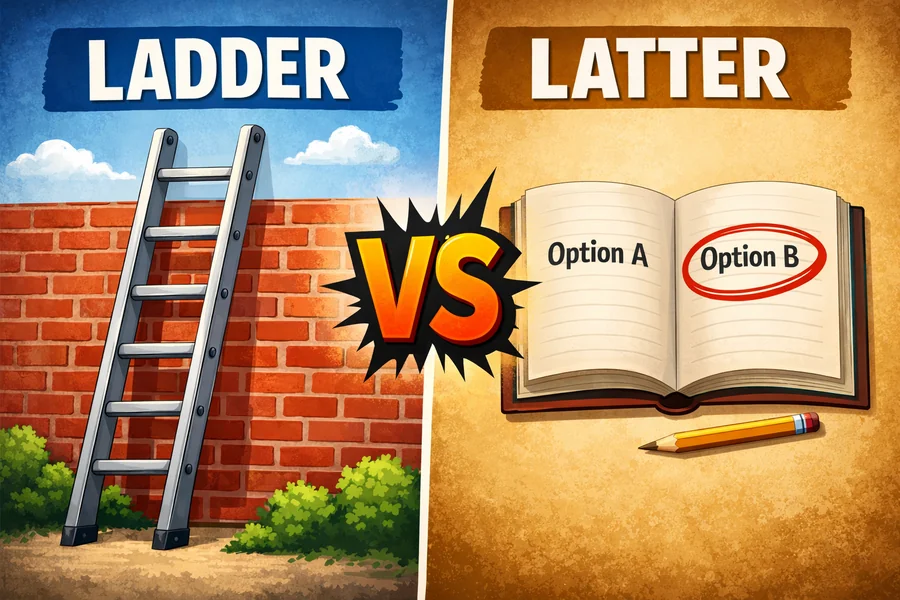
Confused with the terms ladder vs latter? These two words resemble each other but have a lot of difference in their meaning. This guide will get you to know the difference. You will remember it easily. You can use both words with confidence in your writing and speech.
Ladder vs Latter
The misunderstanding between ladder vs latter occurs due to the similarity between the words as far as they are spelled nearly identically and sound similar. Their meanings, however, have nothing to do with each other.
- Ladder is a noun. It refers to a tool used for climbing.
- Latter is a term to discuss the second out of two things or the last-mentioned thing.
Being aware of this distinction will make it easier to prevent the pitfalls.
What Is a “Ladder”?
A ladder is a physical object. It helps people climb up or down.
Key points:
- It is a noun
- Used in daily life
- Has steps or rungs
Examples:
- He climbed the ladder to fix the roof.
- The firefighter carried a long ladder.
- She stood on a ladder to paint the wall.
You can picture a ladder. That makes it easy to remember.
What Is “Latter”?
Latter is not a physical object. It is used in language to refer to the second item in a list of two.
Key points:
- It is not a noun in most cases
- Refers to order
- Used in comparisons
Examples:
- I had tea and coffee. I prefer the latter.
- Between walking and driving, I chose the latter.
- We discussed two ideas. The latter was better.
The word helps you avoid repeating the second item again.
Key Difference Between Ladder vs Latter
The main difference in ladder vs latter is simple:
- Ladder = something you climb
- Latter = the second of two things
This is the fastest way to remember it.
Ladder vs Latter Quick Answer
What is the difference between ladder and latter?
Ladder is a tool used for climbing, while latter refers to the second item in a pair or list of two. Ladder is a physical object. Latter is used in language to show order.
Read Also: Seperate Or Separate Correct Spelling: Simple Guide With Examples
Ladder vs Latter: Comparison Table (With Example)
| Feature | Ladder | Latter |
| Meaning | A tool used for climbing | The second of two items |
| Type | Noun | Determiner / Pronoun |
| Usage | Physical object | Refers to order in a sentence |
| Memory Tip | Has steps like a ladder | Comes later → latter |
| Example Sentence | He climbed the ladder. | I chose the latter option. |
Example Comparison:
- Correct: She climbed the ladder to reach the shelf.
- Correct: I had two choices. I picked the latter.
Common Mistakes In Ladder vs Latter
Many people mix up ladder vs latter in writing. Here are some common errors:
Mistake 1:
❌ I prefer the ladder option.
✔️ I prefer the latter option.
Mistake 2:
❌ He used a latter to climb.
✔️ He used a ladder to climb.
Mistake 3:
❌ The ladder of the two ideas is better.
✔️ The latter of the two ideas is better.
Small spelling changes can change the meaning completely.
Easy Trick To Remember Ladder vs Latter
Here is a simple memory trick:
- Ladder → Think of climbing. It has “dd” like steps.
- Latter → Think of “later”. It means second or last.
This trick works well in exams and daily writing.
When To Use Ladder
Use ladder when talking about something physical.
Situations:
- Construction work
- Home repairs
- Climbing tasks
Sentences:
- The worker carried a ladder.
- He fell off the ladder.
- The ladder was too short.
When To Use Latter
Use latter when comparing two things.
Situations:
- Writing essays
- Making choices
- Giving opinions
Sentences:
- Between cats and dogs, I like the latter.
- We had two plans. The latter worked better.
- I read two books. The latter was more useful.
Ladder vs Latter In Everyday English
In daily life, you will see both words often.
- Ladder appears in physical tasks and descriptions
- Latter appears in conversations and writing
Understanding ladder vs latter helps improve clarity.
Read Also: Smoothe Or Smooth: Which Is Correct? (Clear Answer + Examples)
Why People Confuse Ladder vs Latter
There are three main reasons:
- Similar spelling
- Similar pronunciation
- Fast reading habits
But once you know the meanings, the confusion goes away.
Ladder vs Latter In Writing
In professional writing, using the wrong word can confuse readers.
Example:
- Wrong: The ladder option is better.
- Right: The latter option is better.
Clear writing builds trust. Small errors can reduce clarity.
Ladder vs Latter In Exams
This topic is common in tests.
Tips:
- Read the sentence carefully
- Check if it is physical or logical
- Replace with meaning to test
Practice:
- If you can climb it → ladder
- If it shows order → latter
Ladder vs Latter: Real-Life Examples
Scenario 1:
You see a worker fixing a light.
✔️ He is using a ladder.
Scenario 2:
You choose between two phones.
✔️ I prefer the latter.
Scenario 3:
You describe tools.
✔️ The ladder is strong.
Scenario 4:
You compare ideas.
✔️ The latter idea is better.
Quick Recap Of Ladder Vs Latter
- Ladder = tool for climbing
- Latter = second of two items
- Ladder is physical
- Latter is logical
This is the core idea.
Final Thoughts
The difference between ladder vs latter is simple once you understand it. One is something you can see and touch. The other is a word which will allow you not to repeat ideas.
Talk about climbing, use a ladder. The latter is used when you draw comparisons between two things. You can never confuse them again, with a little practice.
FAQs:
What does ladder mean?
Ladder is a tool with steps used for climbing up or down.
What does latter mean?
Latter refers to the second item in a pair or list of two.
Is ladder and latter the same?
No. Ladder is a physical object. Latter is used in language to show order.
How do I remember ladder vs latter?
Think ladder = climb. Think latter = later or second.
Can latter be used for more than two items?
No. Latter is used only when referring to two items.
Read Also: Thier Or Their Correct Spelling: How To Always Get It Right


![Ten Things: My Boss is a [Censored] – What Do I Do?!](https://thoughtgenic.com/wp-content/uploads/2026/02/ten-things-my-boss-is-a-censored-–-what-do-i-do-1-768x403.jpg)