
Have you ever sat down half way through a sentence and wondered afterward or afterwards? The two words appear correct. Both sound natural. but which one shall you use?
This guide divides it into a plain and simple manner. You will find out what exactly is the difference between them, when to apply one or another & how to prevent the typical errors. At the end, you will be assured that you can use both forms in any situation.
Afterward or Afterwards: Quick Answer
- Afterward and afterwards mean the same thing.
- Both are correct.
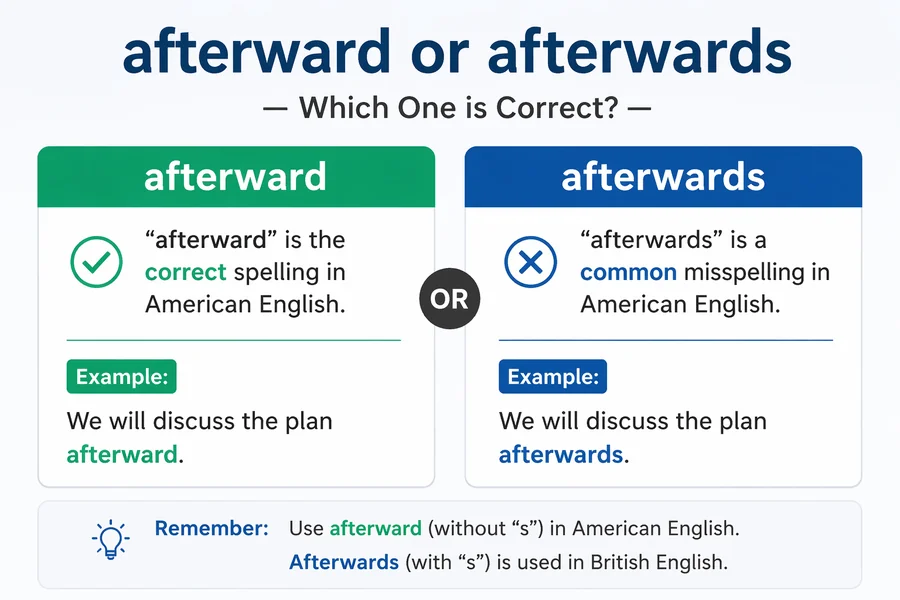
- The difference comes down to regional preference:
- Afterward → American English
- Afterwards → British English
Quick example:
- We went out for dinner. Afterward, we watched a movie. (US)
- We went out for dinner. Afterwards, we watched a movie. (UK)
What Does “Afterward” Mean?
Afterward is an adverb. It means at a later time or after something else happens.
It helps connect events in a sequence.
Examples:
- She finished her work. Afterward, she relaxed.
- We spoke briefly and afterward left the room.
It is short, direct, and widely used in American writing.
What Does “Afterwards” Mean?
Afterwards has the same meaning as “afterward.” There is no change in definition.
The only difference is style and region.
Examples:
- He called me and afterwards sent a message.
- They had lunch and afterwards went shopping.
This version is more common in British English and some international contexts.
Read Also: Publically Or Publicly: Correct Spelling, Usage & Examples
Afterward or Afterwards: Key Difference Explained
Here is the simple truth: there is no difference in meaning.
The only real distinction is usage preference.
- Afterward = preferred in the United States
- Afterwards = preferred in the United Kingdom and other regions
Both forms are grammatically correct in all English contexts.
Afterward vs Afterwards: Comparison Table
| Feature | Afterward | Afterwards |
| Meaning | At a later time | At a later time |
| Grammar | Adverb | Adverb |
| Usage Region | American English | British English |
| Formality | Neutral | Neutral |
| Example Sentence | We talked. Afterward, we left. | We talked. Afterwards, we left. |
Key takeaway: Choose based on your audience, not grammar rules.
When Should You Use Afterward?
Use afterward if:
- You are writing for a US audience
- You want a slightly shorter word
- You are following American style guides
Example sentences:
- I completed the report. Afterward, I emailed it.
- The meeting ended. Afterward, we discussed plans.
It works well in both formal and informal writing.
When Should You Use Afterwards?
Use afterwards if:
- You are writing for a UK or international audience
- You prefer traditional British spelling
- Your content follows British English rules
Example sentences:
- She left early. Afterwards, she called me.
- We had tea and afterwards went for a walk.
Afterward or Afterwards in Sentences
Let’s look at side-by-side examples to make things clear.
American style:
- He finished the task. Afterward, he took a break.
British style:
- He finished the task. Afterwards, he took a break.
Notice how nothing changes except the spelling.
Common Mistakes to Avoid
Even though afterward or afterwards is simple, people still make small errors.
1. Mixing styles in the same text
Avoid using both forms in one article.
❌ Incorrect:
- We went home. Afterward, we ate. Afterwards, we slept.
✅ Correct:
- Stick to one version consistently.
2. Confusing with “after”
“After” and “afterward(s)” are not the same.
- After → shows sequence
- Afterward(s) → shows time later
Example:
- After dinner, we talked.
- We had dinner. Afterward, we talked.
3. Using in the wrong position
Both words usually come at the start or middle of a sentence.
Correct:
- Afterward, we left.
- We left afterward.
Afterward or Afterwards: Grammar Rules
There are no strict grammar rules separating the two. But here are some helpful tips:
- Both are adverbs
- Both describe time
- Both can start or end a sentence
- Both can follow a comma for clarity
Examples:
- Afterward, she called me.
- She called me afterward.
Afterward and Afterwards in Formal Writing
In formal writing, consistency matters more than the choice itself.
- Academic papers (US) → use afterward
- Academic papers (UK) → use afterwards
If you are unsure, follow your style guide or audience location.
Read Also: Elfs Or Elves: Which Is Correct? Clear Guide With Examples
Afterward or Afterwards in Everyday Conversation
In casual speech, most people don’t notice the difference.
Both sound natural and are widely understood.
Examples:
- Let’s talk afterward.
- Let’s talk afterwards.
Choose whichever feels natural to you.
Afterward or Afterwards: Style Guide Insight
Many style guides recommend choosing one form and sticking with it.
- AP Style (US journalism): afterward
- British publications: afterwards
Consistency improves readability and professionalism.
Examples in Real Context
Here are more natural examples to help you understand usage better.
Work setting
- We had a meeting. Afterward, we shared notes.
Social setting
- They watched a movie and afterwards went for dinner.
Academic setting
- The experiment ended. Afterward, results were recorded.
Quick Memory Trick
If you struggle to remember afterward or afterwards, use this simple trick:
- Think US = shorter → afterward
- Think UK = longer → afterwards
That’s all you need.
Final Thoughts
The debate over afterward or afterwards is not about right or wrong. It is about preference.
Both words:
- Mean the same thing
- Are grammatically correct
- Work in all contexts
Your choice should depend on your audience and writing style.
Pick one and stay consistent. That’s the key.
FAQs:
Is afterward or afterwards correct?
Both are correct. The difference is regional. “Afterward” is American English, while “afterwards” is British English.
Which is better: afterward or afterwards?
Neither is better. Choose based on your audience and stay consistent.
Do afterward and afterwards mean the same thing?
Yes. Both mean “at a later time” or “after something happens.”
Is afterward more formal than afterwards?
No. Both have the same level of formality.
Can I use afterward in British English?
Yes, but “afterwards” is more common in British usage.
Should I use afterward in academic writing?
Use “afterward” for American academic writing and “afterwards” for British formats.
Read More Articles: Ladder Vs Latter: What’s The Difference? Simple Meanings, Examples & Easy Tips