

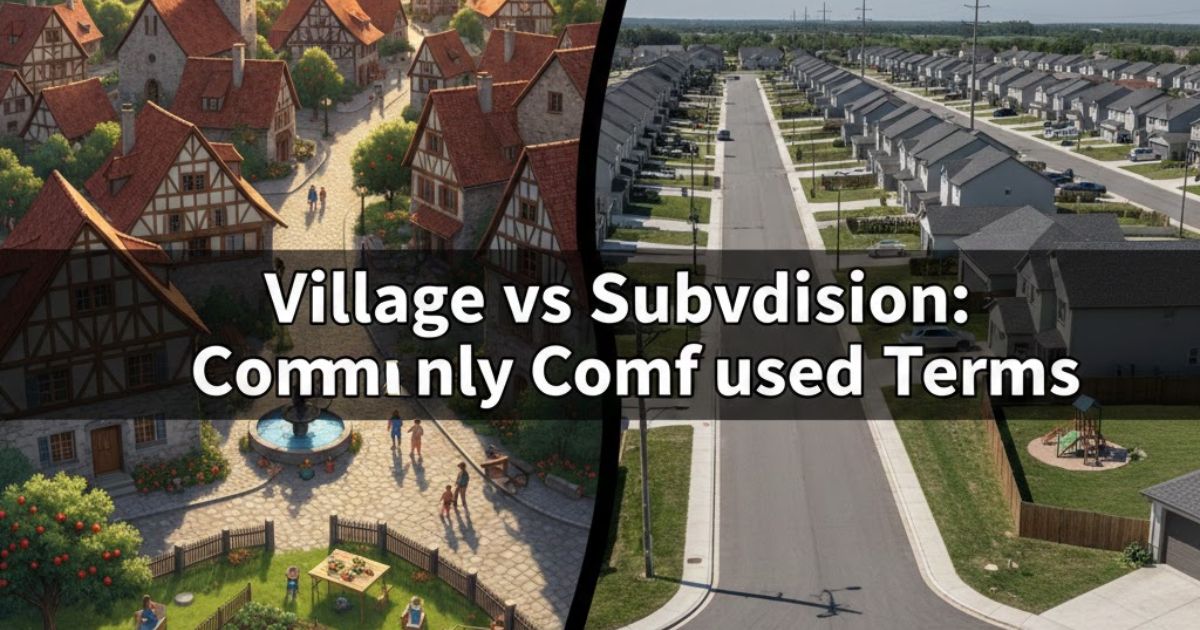
Many people feel confused when they hear the terms village and subdivision. They often think both words mean the same thing. However, these communities are different in size, planning, and lifestyle. Understanding the difference helps you choose better.
When we compare village vs subdivision, we notice clear contrasts. A village usually grows naturally over time and has a small population. A subdivision, however, is carefully planned by developers and often includes modern homes and shared amenities.
In this article, we will explain the difference between village and subdivision in simple words. We will explore their features, lifestyle, and structure. By the end, you will clearly understand how each community type works and why the distinction matters.
Define Village
A village is a small community usually found in a rural area. People live close to nature and share strong social bonds. It often grows naturally over time and keeps local traditions alive.
Moreover, a village has a close-knit community with simple homes and shared spaces like a town square. Unlike a residential development, it develops slowly and values history, culture, and community spirit.
Define Subdivision
A subdivision is a planned residential development where builders divide large land into smaller housing lots. Developers design the area carefully before construction begins. As a result, homes often follow similar styles and layouts within the neighborhood.
Unlike a small community that grows naturally, a subdivision follows structured planning rules. Streets usually follow a grid pattern, and houses sit close together. Therefore, this type of housing development supports higher population density than rural settlements.
Most subdivisions include modern features and shared spaces. For example, they may offer parks, playgrounds, or a community pool. In many cases, a homeowners association (HOA) manages rules and maintenance to keep the residential area organized and attractive.
| Village | Subdivision |
| Small community | Residential development |
| Rural area | Urban or suburban area |
| Close-knit community | Higher population density |
| Self-sufficient | Modern amenities |
Furthermore, subdivisions are commonly located in urban or suburban areas near schools, shops, and workplaces. This setting gives residents comfort and convenience. Because of this planning, people often choose subdivisions for modern living and easy access to amenities.
How To Properly Use The Words In A Sentence
When you write about a small community in a rural area, use the word village correctly. However, when you describe a planned residential development in an urban or suburban area, use subdivision instead. This clear word usage improves communication and avoids confusion.
How To Use “Village” In A Sentence
Use the word village when you describe a small community in a rural area. It fits places with tradition, history, and strong local bonds. This correct word usage keeps your writing clear.
- The village sits near the river in a peaceful rural area.
- She grew up in a quiet small community with friendly neighbors.
- The village celebrates its harvest festival every year.
Moreover, always use villages for places that grow naturally and value tradition. Do not use it for a planned residential development. This careful choice improves grammar, strengthens clarity, and prevents confusion in everyday writing.
How To Use “Subdivision” In A Sentence
Use the word subdivision when you describe a planned residential development in an urban or suburban area. It refers to organized housing built by developers with modern features and shared amenities.
- They bought a home in a new subdivision near the city.
- The residential development includes parks and a playground.
- A homeowners association (HOA) manages the subdivision rules.
Moreover, use subdivision for neighborhoods created through careful planning and land division. Do not use it for a natural small community in a rural area. This correct word usage improves clarity and strengthens your writing in real estate discussions.
More Examples Of Village & Subdivision Used In Sentences
Here are more examples showing how to use village and subdivision in sentences. A village has a close-knit community and traditional homes, while a subdivision is a planned residential development with modern houses, parks, and organized streets.
Examples Of Using Village In A Sentence
- The village is surrounded by green fields and hills.
- She spent her childhood in a peaceful small community.
- The village celebrates its annual harvest festival with joy.
- Many people in the village grow their own food.
- The village has a friendly and close-knit population.
- Tourists love visiting the village for its traditional culture.
- The village square is the center of local activities.
- He decided to move to the village to enjoy a calm life.
- The village is famous for its historical monuments.
- Children play safely in the quiet streets of the village.
Examples Of Using Subdivision In A Sentence
- The new subdivision is built on the city’s outskirts.
- She bought a house in a modern residential development.
- The subdivision has parks, playgrounds, and walking trails.
- Residents follow the rules set by the homeowners association (HOA) in the subdivision.
- The subdivision streets are arranged in a neat grid pattern.
- Families enjoy living in a safe and organized subdivision.
- The subdivision includes a community pool and clubhouse.
- Developers designed the subdivision to provide easy access to schools.
- They planned a block party for all neighbors in the subdivision.
- Houses in the subdivision share similar architectural styles and layouts.
Common Mistakes To Avoid
One common mistake is using village to describe a planned residential development. This confuses readers because a village refers to a small community with natural growth, traditions, and local governance, unlike a subdivision.
Another frequent error is calling a village a subdivision. While a subdivision is a residential development with organized streets and modern amenities, a village emphasizes culture, history, and close-knit community life. Correct usage ensures clear and accurate communication.
Mistake #1: Using “Village” To Describe A Subdivision
A common mistake is using village to describe a subdivision. A village is a small community with natural growth, local traditions, and a close-knit population. In contrast, a subdivision is planned and organized by developers.
Using a village for a planned residential development can confuse readers. Subdivisions often have modern amenities like parks, playgrounds, and a homeowners association (HOA), which villages typically do not. Therefore, correct word usage improves clarity in both writing and conversation.
Moreover, a village usually has a rural or semi-rural setting, while a subdivision is often located in urban or suburban areas. Mislabeling can mislead people about lifestyle, population density, and community features, so careful usage is essential.
Mistake #2: Using “Subdivision” To Describe A Village
Another common mistake is using subdivision to describe a village. A subdivision is a planned residential development, while a village is a naturally growing small community with traditions, history, and a close-knit population.
Using subdivision for a village can mislead readers about lifestyle and location. Villages are usually in rural or semi-rural areas with simple homes, unlike subdivisions with modern amenities and organized streets. Correct usage ensures clear communication.
Tips To Avoid Making These Mistakes
To avoid confusing villages and subdivisions, always check the community type, location, and structure. Using the correct term for a small community or a planned residential development ensures clarity and improves your word usage.
- Use a village for a small, rural community with traditions and local governance.
- Use subdivision for a planned residential development with organized streets and modern amenities.
- Research the area before writing to confirm if it is a village or subdivision.
- When unsure, consult reliable sources or local authorities to maintain correct word usage.
Context Matters
The meaning of village and subdivision depends on context. A village usually exists in a rural area with a close-knit small community, while a subdivision is a planned residential development in urban or suburban areas.
Additionally, regional differences affect usage. Some planned communities may look like a village, but legally they remain a subdivision. Understanding context, location, and community features ensures correct word usage and avoids confusion when describing different types of residential areas.
Location
The location of a community plays a major role in distinguishing village and subdivision. A village is usually found in a rural or semi-rural area, surrounded by nature, farms, and a small community lifestyle.
In contrast, a subdivision is typically located in urban or suburban areas. Developers design these residential developments with organized streets, modern houses, and amenities like parks, playgrounds, and schools, providing convenience for families and residents seeking structured living.
Moreover, choosing between a village and a subdivision often depends on proximity to city centers, workplaces, and services. Villages offer calm and tradition, while subdivisions provide easy access to modern facilities. Location greatly impacts lifestyle and daily routines.
Lifestyle
The lifestyle in a village is calm and simple. Residents enjoy a close-knit community with strong social bonds. People often engage in farming or traditional activities, valuing history, culture, and a slower pace of life compared to cities.
On the other hand, a subdivision offers a modern lifestyle with organized streets, parks, and community centers. Families enjoy planned amenities, convenience, and a structured residential development, which provides easy access to schools, shops, and recreational facilities in urban or suburban areas.
Furthermore, lifestyle choice depends on personal preferences. If someone values tradition and social interaction, a village is ideal. Conversely, for comfort, privacy, and modern amenities, a subdivision suits better. Both communities offer unique living experiences and benefits.
Personal Preferences
Personal preferences greatly influence the choice between a village and a subdivision. Some people prefer the calm and tradition of a small community in a rural area, where residents know each other and share strong social bonds.
Others may choose a subdivision for its modern amenities, organized streets, and convenient location. These residential developments provide parks, playgrounds, and easy access to schools or shops, making them ideal for families who value structure, safety, and everyday convenience in urban or suburban areas.
Ultimately, the decision depends on lifestyle goals. If someone values history, culture, and a slower pace, a village is perfect. Conversely, those seeking comfort, privacy, and planned community features often prefer a subdivision with modern homes and shared facilities.
Exceptions To The Rules
Although clear differences exist between a village and a subdivision, exceptions sometimes occur. Some planned communities look like a small community with traditional charm, yet legally remain a residential development, so context and legal status always matter.
1. Historical Villages
Some historical villages keep their name even after they grow larger in size. These places often have cultural importance, preserved buildings, and strong traditions. Although the population increases, people still recognize them as a village because of their heritage.
Moreover, a historical village may function like a town but maintain its identity as a small community. Local authorities often protect its landmarks and traditions. Therefore, history and legal recognition sometimes matter more than size or modern residential development status.
2. Planned Villages
Some planned villages are designed to look like a traditional small community, even though developers build them carefully. They may include a town square, shops, and homes close together to create a friendly and connected environment.
However, despite their design, many planned villages legally remain a residential development or even a type of subdivision. Therefore, structure and legal status matter more than appearance when deciding whether a place is truly a village.
3. Unincorporated Subdivisions
Some unincorporated subdivisions exist outside official city or town limits. These areas function as a residential development, but they do not have their own local government. Instead, county authorities usually manage services like roads and public safety.
Although an unincorporated subdivision may feel like a small community, it does not qualify as a village legally. Therefore, governance structure and incorporation status determine classification, even when the neighborhood offers shared amenities and organized streets.
4. Regional Differences
Regional differences often affect how people use the terms village and subdivision. In some areas, people call any small community a village, even if it functions like a residential development within a larger city.
However, in other regions, officials use strict legal definitions. A village may require local governance, while a subdivision refers only to a planned housing area. Therefore, understanding regional rules helps ensure correct word usage and clear communication.
Practice Exercises
To improve your understanding of village and subdivision, try practice exercises. Filling in blanks and identifying correct terms helps reinforce word usage, strengthens recognition of small communities versus residential developments, and ensures clear communication.
Exercise 1: Fill In The Blank
| Sentence | Word (village or subdivision) |
| The new residential development is being built on the outskirts of town. | subdivision |
| The quaint small community was nestled in the rolling hills. | village |
| Many families enjoy living in a quiet village rather than a busy city. | village |
| The subdivision has a community park and playground for residents. | subdivision |
Answer Key:
- subdivision
- village
- village
- subdivision
Exercise 2: Identify The Correct Word
- The new housing development is a small ___ outside of town.
Answer: subdivision - The ___ had a town square with a fountain.
Answer: village - Many people enjoy the sense of community in a ___ .
Answer: village - The new ___ had strict rules about yard maintenance.
Answer: subdivision
Using the correct words like village and subdivision ensures clear communication. A village refers to a small community with traditions, while a subdivision is a planned residential development with modern amenities. Proper usage improves understanding.
Conclusion
In conclusion, understanding the difference between a village and a subdivision is essential. A village is a small community with traditions, culture, and a close-knit population, often in a rural area. In contrast, a subdivision is a planned residential development with organized streets, modern homes, and amenities like parks or playgrounds.
By recognizing these distinctions, you can use the correct word usage in writing and conversation. Furthermore, considering location, lifestyle, and personal preferences helps choose the right community. Overall, knowing the village and subdivision difference ensures clarity and informed decisions when discussing or selecting a place to live.
Key Takeaways
- A village is a small community with traditions, history, and a close-knit population, usually in a rural area.
- A subdivision is a planned residential development with modern amenities, organized streets, and higher population density.
- Correct word usage is important to avoid confusing a village with a subdivision in writing or conversation.
- Personal preferences, location, and lifestyle influence the choice between a village and a subdivision.
Understanding the village and subdivision difference helps you communicate clearly and make informed decisions. A village offers tradition and community, while a subdivision provides convenience and modern amenities. Recognizing these differences ensures clarity in everyday conversations and real estate discussions.
FAQs
What is a village?
A village is a small community in a rural area with close-knit residents, traditions, and simple homes, emphasizing history and local culture.
What is a subdivision?
A subdivision is a planned residential development in urban or suburban areas, featuring organized streets, modern homes, and shared amenities like parks and playgrounds.
What is the difference between a village and a subdivision?
The village and subdivision difference lies in size, planning, and lifestyle. Villages grow naturally with traditions, while subdivisions are carefully planned residential developments.
Can a subdivision feel like a village?
Yes, some planned villages or subdivisions are designed to mimic a small community, with central squares, pedestrian streets, and a friendly, close-knit atmosphere.
How do I choose between a village and a subdivision?
Consider location, lifestyle, and personal preferences. Choose a village for tradition and community or a subdivision for modern amenities and organized living.
Read More Articles: 101+ Words Related to Space Starting with I