
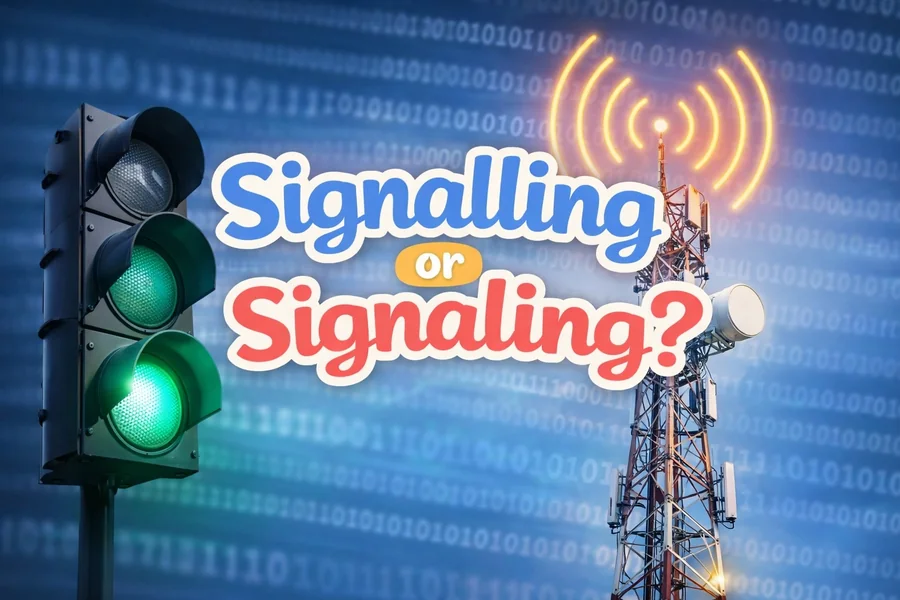
Many writers wonder about signalling or signaling because the words look almost the same. Both are used to mean to provide an indication or message though it is spelt differently depending on your location. Signalling is a British English normative, whereas signaling is an American English normative.
The knowledge of the distinction makes your writing accurate and clear. The inappropriate form can be confusing to the readers particularly in the professional, academic or technical context. This guide explains signalling or signaling in detail, with examples, common mistakes & practical tips.
Define Signalling
Signalling is the British English form of the word. It means giving a sign, message, or indication. This can be done in many contexts:
- Traffic and driving
- Digital communication systems
- Body language
- Biological processes
- Business or strategy communication
Example:
- The driver was signalling before turning.
- She was signalling approval with a nod.
The spelling follows British conventions, where the final “l” is doubled before adding “-ing.” This is standard for verbs ending with a vowel + “l.”
Define Signaling
Signaling is the American English form. The meaning is identical to signalling. The spelling drops the doubled “l” because American English often avoids doubling when the stress is not on the last syllable.
Example:
- The driver was signaling before turning.
- He was signaling that the meeting had started.
This version is preferred in the United States, including in professional, academic, and technical writing.
Signalling or Signaling Comparison Table
| Feature | Signalling | Signaling |
| English Variant | British English | American English |
| Spelling Pattern | Double “l” | Single “l” |
| Meaning | Giving a sign or message | Giving a sign or message |
| Example Sentence | She is signalling for help. | She is signaling for help. |
| Correct in the US? | No | Yes |
| Correct in the UK? | Yes | No |
How To Properly Use The Words In A Sentence
Choosing the right form depends on your audience. Both words mean giving a sign or message. Using them correctly ensures clarity and professionalism.
How To Use Signalling In A Sentence
Signalling appears in British English contexts. Use it for:
- Traffic situations: “The cyclist was signalling left before turning.”
- Business signals: “The CEO is signalling changes to the board.”
- Biological communication: “Cells communicate through chemical signalling.”
- Emergency situations: “The ship was signalling for help.”
It works in any context where someone or something is giving a message or indication.
How To Use Signaling In A Sentence
Signaling is the American English variant. Use it for:
- Traffic: “The driver was signaling right before merging.”
- Business: “The firm is signaling a new marketing strategy.”
- Technology: “The network uses advanced signaling protocols.”
- Biology: “Hormones play a role in cell signaling.”
Remember: context is key, but meaning does not change.
Read More Articles: Eccentric vs Eclectic: Differences And Uses For Each One
More Examples Of Signalling or Signaling Used In Sentences
The difference is made with examples. The words can be used in practice, and the spelling corresponds with your version of English.
Examples of Signalling Usage in A Sentence
- With a flag the ship was signalling distress.
- She was nodding her consent with a smile.
- The hiker called out a signal device to assist him.
- The CEO is making an indicator of a strategic change.
- Cars were being signalled to stop by the traffic police.
- The teacher was indicating students to start.
- Chemical signalling is used by cells.
- On the runway, the pilot was gesticulating that there was an issue.
- The dog was barking to indicate the necessity of eating.
- The demonstrators were communicating discontent using body language.
Examples of Signaling Usage in A Sentence
- The vehicle was honking and changing direction.
- He was marking the commencement of the race.
- The network utilizes signaling protocols.
- The manager is also signaling the new policy.
- The mountaineer was raising an alarm.
- Employees were giving warning signals to the management.
- The body functions are controlled through hormones.
- The guard was waving the support.
- The emergency team was indicating evacuation.
- The child was communicating through body language by signaling fear.
Common Mistakes To Avoid
Many people confuse the two forms, especially when writing for international audiences.
Mistake #1: Using “Signalling” When You Mean “Signaling”
Incorrect for American English:
- “The driver was signalling before turning.”
Correct:
- “The driver was signaling before turning.”
Always match the spelling to your audience.
Mistake #2: Using “Signaling” When You Mean “Signalling”
Incorrect for British English:
- “She was signaling her approval with a nod.”
Correct:
- “She was signalling her approval with a nod.”
Consistency is key. Avoid mixing spellings in the same document.
Tips For Avoiding These Mistakes
- Identify your audience: US vs UK.
- Stick to one spelling per document.
- Review your text for consistency.
- Use a dictionary if unsure.
- Remember that meaning does not change, only spelling does.
Context Matters
Choosing the right word depends on location, industry, and style guides.
Signalling
- Standard in British, Canadian, and Australian English.
- Common in professional, technical, and academic writing.
- Used in everyday contexts, traffic, biology, and business.
Signaling
- Standard in American English.
- Common in US publications, technical manuals, and media.
- Used in everyday contexts, traffic, biology, and business.
Read Also: Pentoxide vs Pentaoxide: Differences And Uses For Each One
Exceptions To The Rules
Even with spelling rules, some contexts may allow both forms.
Exceptions Signalling
- Some international documents may use signalling in American contexts.
- Certain software or tech guides may adopt British spelling globally.
Exceptions Signaling
- Some UK publications may accept signaling for readability.
- Academic papers sometimes allow either form if noted in style guides.
Practice Exercises
Exercise 1: Fill In The Blank
- The hiker was ______ for help in the mountains.
- The CEO is ______ a major shift to investors.
- Traffic police were ______ cars to stop.
- Cells communicate using chemicals ______.
Exercise 2: Sentence Writing
- Write three sentences using signalling for British English.
- Write three sentences using signaling for American English.
Exercise 3: Multiple Choice
- Which is correct in the US?
A) Signalling
B) Signaling ✅ - Which is correct in the UK?
A) Signalling ✅
B) Signaling
Conclusion
Signalling or signaling is easy once you know the rules. The only difference is spelling:
- Signalling → British English
- Signaling → American English
Meaning stays the same. Match the spelling to your audience, stay consistent, and your writing will be clear and professional.
FAQs
What is the difference between signalling or signaling?
There is no difference in meaning. Spelling depends on the English variant.
When should I use signalling?
Use signalling in British, Canadian, or Australian English.
When should I use signaling?
Use signaling in American English.
Is it wrong to mix both spellings?
Yes. Consistency matters. Do not switch forms in the same document.
Does the meaning change in technical contexts?
No. Both mean giving a sign or message, whether in traffic, business, or biology.
Read More Articles: Choosing vs Chosing: Decoding Common Word Mix-Ups