


A floating staircase, a glowing doorway and a tiny figure under a huge sky can illustrate almost any essay. That is exactly the problem. The image creates mood without carrying the article’s particular claim, so readers remember a generic idea of “possibility” instead of the argument on the page.
An abstract illustration earns its space when a reader can translate it back into a sentence close to the thesis. The translation does not need to be exact, but its verb, object and consequence should align. If the article argues that convenience moves hidden work onto users, the picture should show that transfer rather than another beautiful horizon.
The reverse-explanation test gives Nano Banana Pro one clear job: explore composed scenes inside a fixed argument. Kimg AI can vary the visual answer, while the editor remains responsible for asking one precise question.
Replace Mood Words With An Actual Claim
Begin by reducing the essay to one contested relationship. Name who acts, what changes and why it matters. “Technology reshapes society” is not enough. “One-click returns move inspection work from the store to the buyer” can produce visible choices.
Write The Thesis As Verb Object Consequence
Use a plain sentence: a platform hides, a policy shifts, a habit concentrates, a tool separates. Then name the object and consequence. This grammar blocks the prompt from drifting into atmosphere before it has an idea to represent.
Do not send the whole article to the model and ask for a cover. Long context may contain several examples, qualifications and secondary claims. Choose the one relationship the image must hold. Supporting details belong in the page, not all inside one frame.
Turn Each Noun Into A Visible Object. Abstract nouns need concrete equivalents. Hidden work might become a second stack of packages behind a clean button. Concentrated risk might become several narrow paths entering one fragile bridge. The object does not prove the thesis; it gives the reader a visible way to enter it.
Compare Literal Symbolic And Decorative Options
Create three deliberately different directions. A literal image shows the actor and task. A symbolic image compresses the relationship into a visual mechanism. A decorative image supplies tone. Comparing them side by side makes it easier to see when symbolism has become empty.
| Direction | What it keeps | Main failure |
| Literal scene | Actor and task | Looks like a stock illustration |
| Symbolic mechanism | Relationship and consequence | Metaphor becomes too private |
| Decorative mood | Tone and palette | Could fit any article |
Do not automatically choose the symbolic version. A clear literal scene is stronger than a clever metaphor nobody can decode. Decorative mood is acceptable when the image is only a section break, not the main illustration expected to carry the thesis.
Compare the candidates at article width, not only as large artboards. Fine symbolic relationships may vanish after reduction. If the literal option still shows the actor and consequence while the metaphor becomes a pleasant shape, the literal image is doing more editorial work.
Reject Metaphors That Need A Paragraph To Explain
If the art director needs several sentences to connect the image with the essay, the connection is probably too weak. One short caption can identify the editorial interpretation. It should not repair a metaphor that points somewhere else.
Keep One Relationship In Each Visual Composition. A bridge, maze, hourglass, ladder and mirror in the same scene do not make an argument richer. They create five competing readings. Choose the object pair that shows the thesis most directly and remove the rest.
Write a rejection reason for each unused option. “Beautiful but it suggests personal growth” is more useful than “version two feels off.” The reason becomes a guardrail for the next prompt and stops the same empty metaphor from returning in a different palette.
Prompt For A Mechanism Instead Of A Vibe
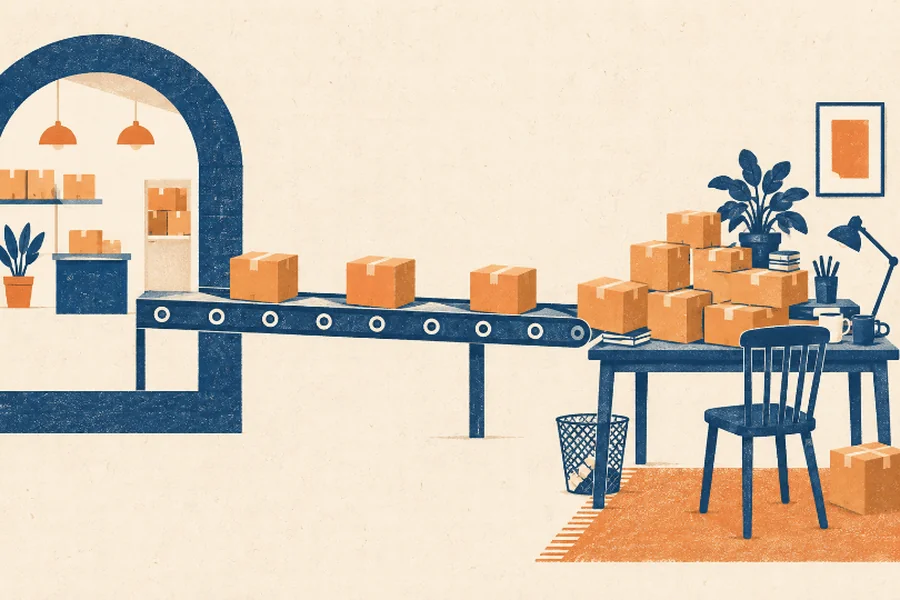
A useful Kimg AI prompt describes the relationship before the style. State the actor, visible action and consequence. Then add medium, framing and palette. “A conveyor moves unopened parcels from a bright storefront into a crowded home workspace” gives the model more editorial direction than “surreal image about hidden labor.”
Add one negative constraint tied to the argument, not a generic banned-object list. If the thesis is about work being shifted rather than eliminated, prohibit vanishing packages and effortless automation imagery. The negative tells the model which tempting visual shortcut would reverse the claim.
Use Composition To Show Cause And Effect. Place cause and consequence in a readable order. A left-to-right transfer, foreground and background contrast or one object casting a changed shadow can show sequence. Avoid arrows or labels unless they will remain editable and are truly necessary.
Google positions Nano Banana Pro for complex visual tasks, advanced composition and precise creative control, with output up to 4K. On Banana AI, that capability can help when a symbolic mechanism needs a careful layout. It does not decide whether the mechanism matches the essay.
Use Style References Without Borrowing Meaning. A reference can define paper texture, line weight or color density. It should not import a subject that changes the claim. Tell Kimg AI which qualities to borrow and which objects to ignore. A clear role for the reference keeps style from becoming a second, accidental argument.
Ask Readers To Translate The Image Back
Show the candidate image without the title and ask three readers to write one sentence about its claim. Do not explain the article first. Compare their verbs, objects and consequences with the thesis map.
Use readers who were not in the pitch meeting. Familiar reviewers unconsciously supply missing context from the draft. A fresh reader exposes whether the composition carries the relationship on its own or depends on knowledge outside the frame.
Look For Shared Verbs Before Exact Wording
Readers may use different nouns and still understand the relationship. If the essay says “shifts inspection work” and readers say “moves the checking burden,” the image is close. If they say “opens opportunity,” the composition has fallen back into generic aspiration.
Revise The Object Pair Before Adding Detail. When the reading misses, change the central relationship. Do not add more texture, rays of light or tiny props. Those details strengthen the existing reading rather than correcting it.
Explore another composition when the reading misses, but keep the test unchanged. Otherwise the team will choose whichever new image looks most finished.
Publish The Image That Returns The Thesis
An abstract essay does not need a literal diagram, yet its main illustration should carry more than mood. The reader should be able to move from image to relationship and from relationship back to the page’s claim.
Kimg AI fits editors willing to define that claim and test the result with fresh readers. It is less useful when the brief asks only for something thoughtful or futuristic. Keep the image whose verb, object and consequence return the essay’s argument.