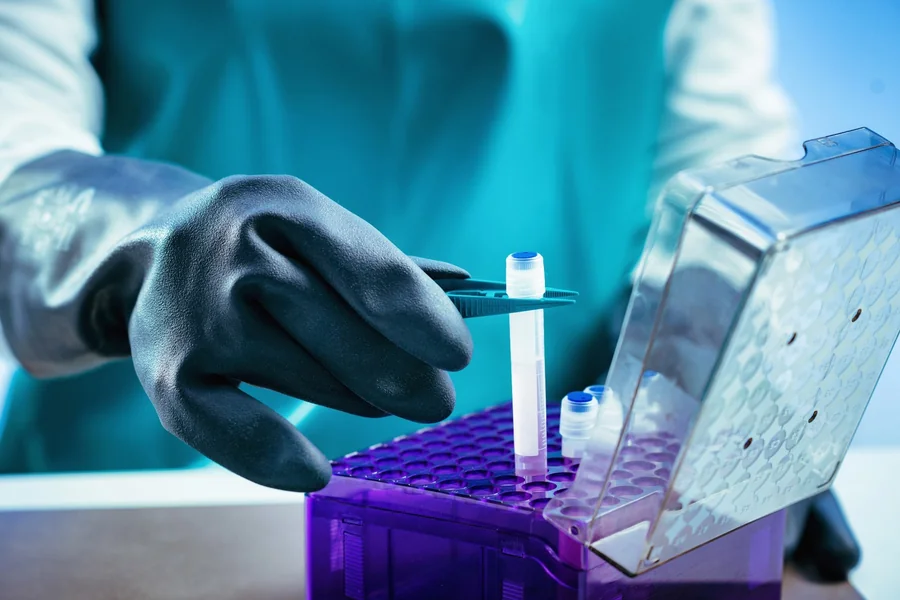
Most people assume a tissue sample is a one-time thing. Cut, stain, look, done. Then they walk into a pathology archive for the first time and see a wall of drawers holding specimens older than most of the staff. A single ffpe block can sit on a shelf for twenty years, get pulled, re-cut, re-stained, and still tell a researcher something new. That is not luck. It is a chain of small decisions made years before anyone asks the question.
So here is what actually happens between the moment tissue leaves a procedure room, and the moment, a decade later, someone slices it again. If you work with biospecimen inventories, or you are just curious how research archives survive the decades, this is the part worth understanding.
Why the wax is the whole trick
Fixation came first. Pathologists in the late 1800s figured out that formalin stops tissue from rotting in place, which sounds grim but is the foundation of modern diagnostic work. Soak a thin piece of tissue in formalin and the proteins lock into a shape close enough to how they sat in the body.
But fixed tissue is still wet tissue. Wet samples do not travel well, do not slice cleanly, and do not last on a shelf. Infiltrating them with paraffin solves that. The wax replaces the water, the block hardens, and now you have something you can store at room temperature for years without a freezer humming in the background.
I think the room temperature part gets undersold. Cold storage is expensive, it fails during power outages, and every freezer is a logistics problem waiting to happen. A wax block just sits there. For smaller labs, that difference decides whether an archive is even possible.
From biopsy to block: the steps that matter
The quality of everything downstream depends on a handful of steps in the first day. Get these right and the block ages gracefully. Get them wrong, and you find out years later when someone needs it.
- A biopsy of a few millimeters is usually enough. Small is fine, and it keeps the process quick for the patient.
- Tissue goes into formalin for a set window, often overnight. Underfix and the center stays raw. Overfix and some tests get harder later.
- Water gets pulled out through a graded alcohol series so the wax can actually penetrate.
- The tissue gets oriented in a mold and covered in paraffin. Orientation is the step people regret skipping, because a badly angled block limits what you can cut forever.
- A microtome shaves slices measured in micrometers. That is where sections come from.
- Slices float onto glass slides, ready for staining whenever someone needs them.
Notice that none of this is exotic equipment. The skill is in the timing and the hands. That is also why two archives with identical protocols can produce blocks of very different quality.
What a block, a section, and a slide actually are
People use these three words interchangeably, and it causes real confusion when ordering or cataloging. Here is the short version.
| Term | What it is | Where it lives
|
| Block | The wax-embedded tissue itself, the source material | Stored in a drawer, at room temperature |
| Section | A thin slice cut from the block with a microtome | Loose, in a tube or on a slide |
| Slide | A section mounted on glass and stained | Filed for microscopy and review |
The block is the asset. Sections and slides are consumables drawn from it. That distinction matters when you are inventorying a collection, because a block can be re-cut dozens of times and a mounted slide cannot be un-mounted.
Why the archive matters more than the original test
A hospital pathology department generates specimens as a byproduct of patient care. A biobank turns those leftovers into a research resource. The sample already exists, which is why archived collections are so valuable: the tissue is real, the outcomes may already be documented, and nobody has to recruit a single new participant.
The National Institutes of Health has long treated biospecimen collections as core research infrastructure, which tells you how much weight the field puts on well kept archives. When a new question comes up, the fastest path to an answer is often a drawer that has been sitting quietly for fifteen years.
The practical side: using an archive without wrecking it
Here is the reasoning I would apply if I were running a small collection. It is a habit, not a rulebook.
- Log everything at the block level.Fixation time, embedding date, and orientation notes. Future you will not remember, and neither will the next tech.
- Check tissue before you commit.Pull a test section first. If the morphology is degraded, you want to find out on one slice instead of burning a precious block.
- Protect the block, spend the slides.Stained slides fade. Blocks keep. Lean on your spares first.
- Cut only what you need.Sections accumulate in a hurry once people get comfortable ordering them. Trim the request list before you trim the block.
One caution on storage records: keep temperature, humidity, and pest history in the same log as the sample data. Physical handling rules for stored materials are well documented by NIST, and the same discipline applies to a tissue archive sitting in a hospital basement.
Common mistakes that shorten an archive’s life
Most damage is boring and preventable. Heat and humidity are the usual suspects, followed by light exposure on mounted slides and repeated freeze-thaw cycles if anything gets moved into cold storage.
Poor labeling is the quieter killer. A block with an unreadable number is a block with no history, which makes it nearly worthless no matter how well the tissue was preserved. And sloppy sectioning wastes material, because every rough cut removes tissue you cannot get back.
Then there is the honest admission every archive faces: no collection stays perfectly cataloged forever. Staff turn over, software changes, and boxes get moved. The collections that survive are the ones where documentation was treated as part of the work, not as paperwork after it.
The question worth asking
Preservation is not a single clever technique. It is a sequence, and each step either buys you future options or quietly spends them. Blocks hold the value, sections and slides deliver it, and the paperwork is what makes any of it findable again.
So the next time a study leans on samples collected before you had a driver’s license, ask the unglamorous question. Who kept the log, and would anyone be able to find that drawer today?