

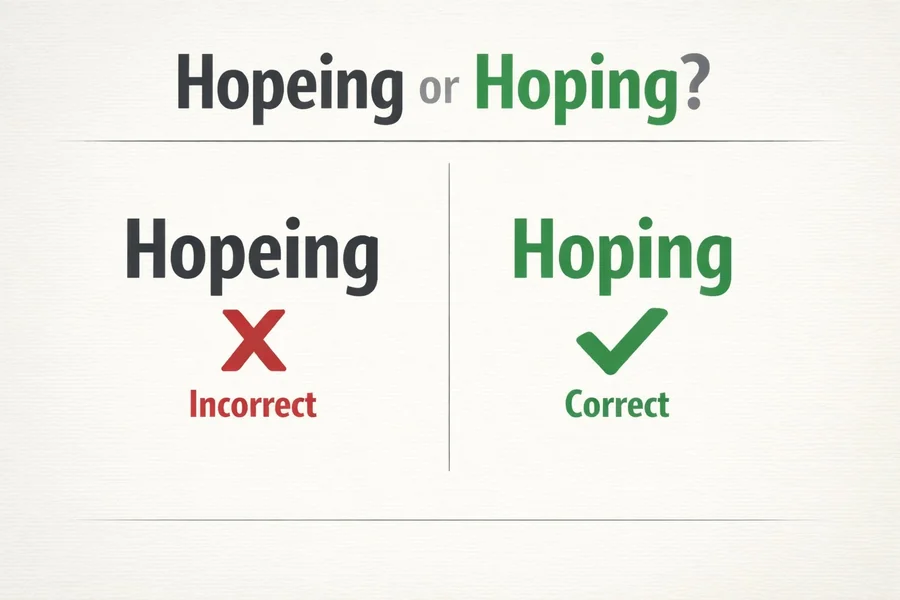
Many people search for “hopeing or hoping” when writing emails, messages, or posts. This confusion is typical of the fact that rules of English spelling may be altered with the addition of -ing to the verbs.
The short answer is simple: “hoping” is correct & “hopeing” is incorrect.
This guide defines the distinction well. You are going to know the reason why it is hoped and how this form is being used in a sentence as well as what you can do to avoid this spelling error in your daily writing.
Define Hoping
The current form of the verb hope is hoping. It talks about a sense of anticipation or longing for a good thing to occur.
When we speak of the word hoping, we tend to speak of desired things, anticipations, or good things.
Examples:
- I am hoping the meeting goes well.
- She is hoping to receive good news soon.
- We are hoping for clear weather tomorrow.
In simple terms, hoping expresses a wish or expectation about the future.
Define Hopeing
The word hopeing is not correct English spelling.
It appears when someone incorrectly adds -ing to the word hope without following spelling rules.
The correct form removes the silent “e” before adding -ing:
- hope → hoping
Because of this rule, hopeing should never be used in formal or informal writing.
Read Also: Inbalance Or Imbalance: How To Spell It Correctly And Avoid Mistakes
How To Properly Use The Words In A Sentence
Understanding the difference between hopeing or hoping is mostly about spelling rules. Only hoping should appear in sentences.
A helpful tip is simple:
- If the base verb ends with a silent e, remove it before adding -ing.
Example:
- hope → hoping
- make → making
- write → writing
Following this rule helps avoid spelling mistakes.
How To Use Hoping In A Sentence
Use hoping when describing expectations, wishes, or positive outcomes.
Examples:
- I am hoping to finish the project today.
- She is hoping to travel next year.
- They are hoping for a quick recovery.
- We are hoping the event will be successful.
In everyday conversation, hoping often appears in casual messages and emails.
Example:
“I’m hoping everything goes well with your interview.”
This usage sounds natural and friendly.
How To Use Hopeing In A Sentence
You should not use hopeing in any sentence.
Incorrect examples:
- ❌ I am hopeing to see you tomorrow.
- ❌ She is hopeing for good results.
Correct versions:
- ✔ I am hoping to see you tomorrow.
- ✔ She is hoping for good results.
Because hopeing is a spelling error, it should always be corrected to hoping.
Hoping Or Hopeing: Quick Comparison Table
Here is a simple comparison to help readers quickly understand the difference between hopeing or hoping.
| Word | Correct or Incorrect | Meaning | Example |
| hoping | ✅ Correct | Expressing expectation or desire | I am hoping to hear from you soon. |
| hopeing | ❌ Incorrect | Spelling mistake of “hoping” | I am hopeing to hear from you soon. |
Key takeaway: Always write hoping, never hopeing.
This simple rule keeps your writing clear and professional.
Read Also: Which Or Wich: What’s The Correct Spelling And When To Use It?
More Examples Of Hoping Or Hopeing Used In Sentences
Looking at examples makes the rule easier to remember.
Examples Of Using Hoping In A Sentence
- Hopefully, the package should be received today.
- She is wishing that she begins a new occupation.
- They also hope that the team will win the match.
- Hopefully, we will do better at the next chance.
- This year he is hoping to acquire some new skills.
- I also want to develop better writing skills.
- The company is looking forward to growth in the business.
- She hopes that her application will be successful.
- The students are hoping that the exam will be easy.
- Now I wish it was all right.
These examples show how hoping appears in everyday communication.
Common Mistakes To Avoid
The confusion around hopeing or hoping often comes from misunderstanding spelling rules.
Mistake #1: Writing “Hopeing” Instead Of “Hoping”
The most common mistake is simply keeping the e in the base verb.
Incorrect:
- I am hopeing to see you soon.
Correct:
- I am hoping to see you soon.
Remember the rule: drop the silent “e” before adding -ing.
Mistake #2: Overthinking The Spelling Rule
Some writers become unsure and hesitate between hopeing or hoping.
A simple memory trick helps:
If a verb ends in e, remove it before adding -ing.
Examples:
- love → loving
- write → writing
- hope → hoping
This pattern appears across many English verbs.
Tips For Avoiding These Mistakes
The following are easy techniques of remembering the right spelling:
- It is always important to take off the silent e and add the -ing.
- Read the sentence and ascertain whether the word is natural.
- Write important texts using spell-check applications.
- Write with hope in sentences.
These are small habits that will make you good at writing.
Context Matters
Even though hopeing or hoping mainly involves spelling, context still affects how hoping is used.
Hoping
The word hoping often appears in situations involving expectations or wishes.
Common contexts include:
- Personal messages
- Emails and communication
- Professional writing
- Social media posts
Examples:
- I’m hoping we can meet next week.
- We’re hoping the event will succeed.
- She’s hoping to receive good news soon.
In each case, hoping describes a positive expectation about the future.
Hopeing
There is no real context where hopeing is correct.
It appears only as a spelling mistake.
Writers sometimes type hopeing quickly without noticing the error. Grammar tools usually correct it automatically.
Exceptions To The Rules
English spelling has many irregular patterns, but the rule behind hopeing or hoping has no exceptions.
Whenever a verb ends with a silent e, the e is removed before adding -ing.
Examples include:
- make → making
- write → writing
- move → moving
- drive → driving
- hope → hoping
Because of this consistent pattern, the spelling rule is easy to apply.
Hoping In Professional Writing
In professional communication, hoping often appears in polite expressions.
Examples:
- I’m hoping we can schedule a meeting soon.
- I’m hoping to hear your feedback.
- We’re hoping to complete the project next week.
These phrases sound natural and friendly while remaining professional.
Practice Exercises
Use these exercises to strengthen your understanding of hopeing or hoping.
Exercise 1: Fill In The Blank
Choose hoping or hopeing.
- I am ________ the results arrive soon.
- She is ________ to finish the project today.
- They are ________ for better weather tomorrow.
- We are ________ the plan works.
- He is ________ to improve his skills.
Answer Key:
- hoping
- hoping
- hoping
- hoping
- hoping
Exercise 2: Sentence Writing
Write sentences using the word hoping.
Example:
| Word | Example Sentence |
| hoping | I am hoping to visit my family this weekend. |
| hoping | She is hoping to receive a scholarship. |
| hoping | They are hoping for good news. |
Exercise 3: Multiple Choice
Choose the correct spelling.
- I am ______ to see you soon.
- A) hopeing
- B) hoping
- She is ______ to travel next year.
- A) hoping
- B) hopeing
- We are ______ the weather improves.
- A) hoping
- B) hopeing
Answer Key:
- hoping
- hoping
- hoping
Conclusion
Understanding the difference between hopeing or hoping is simple once you know the spelling rule.
- Hoping is the correct form of the verb hope in the present participle.
- Hopeing is an incorrect spelling that should not appear in writing.
The rule is clear: drop the silent “e” before adding -ing.
A spelling mistake makes your writing sloppy, incoherent and unclear. It is a little rule that can make a difference whether you write emails, posts on social media platforms, or articles.
Read Also: Clutz Or Klutz: Ultimate Usage Guidelines And Popular Confusions
FAQs:
Is it hopeing or hoping?
Hope is the spelling of hope. Hoping is a wrong word.
Why is “hopeing” incorrect?
The English spelling system eliminates the e without sound, which is preceding -ing, and thus hope becomes hoping.
What is the sentence form of hoping?
Example:
I hope that your project goes well.
What does hoping mean?
Hoping is an anticipation or desire of something positive.
The spelling, how should I forget to spell?
Remember this rule:
Drop the e before adding -ing.
Example: hope → hoping.