


Visiting an eye specialist clinic is often recommended when a routine eye examination is not enough to investigate a specific concern. An eye specialist has training to assess conditions affecting different parts of the eye and determine whether further testing or treatment is needed. LSC Eye Clinic – Eye Specialist Clinic Since 2005 provides specialist eye care for individuals seeking professional assessment and treatment for various eye conditions.
For many patients, the idea of visiting a specialist can feel uncertain because the appointment often involves more than reading letters from an eye chart. Depending on your symptoms, medical history, and reason for referral, several assessments might be performed.
Understanding what happens during an appointment can make the process easier to prepare for and help you know what each assessment is designed to check.
What Happens During the First Consultation?
An appointment usually begins with questions about your vision, symptoms, previous eye problems, and general medical history. You might be asked whether you have noticed blurred vision, eye pain, headaches, flashes, floaters, redness, or changes in your ability to see.
Your current glasses or contact lens prescription can also be relevant. If you have previous eye examination records, bringing them along can give the specialist useful information about changes over time.
The specialist then decides which examinations are appropriate. You will not necessarily need every available eye test during one appointment.
Visual Acuity Testing
Visual acuity testing is one of the most familiar parts of an eye examination. It measures how clearly you see at a particular distance.
You are usually asked to read letters, numbers, or symbols from a chart. Each eye is tested separately, followed by an assessment with both eyes together when appropriate.
The results provide information about your level of vision, although visual acuity alone does not provide a complete picture of eye health. A person can have relatively clear vision while still having an eye condition requiring further investigation.
Refraction Testing
Refraction testing looks at whether glasses or contact lenses are needed to correct focusing problems.
The specialist or optometrist might use equipment to determine how light enters the eye and then compare different lens strengths. You might also be asked to look through different lenses and indicate which option provides clearer vision.
This assessment helps determine whether blurred vision is related to a refractive error such as short-sightedness, long-sightedness, or astigmatism.
Eye Pressure Testing
Eye pressure is often checked using tonometry. The test measures the pressure inside the eye and is commonly included when glaucoma is being considered or monitored.
Different methods exist. Some devices briefly touch the surface of the eye after it has been numbed, while others measure pressure without direct contact.
An eye pressure reading is one part of a broader assessment. A higher or lower reading does not, by itself, establish a diagnosis. The specialist considers the result alongside other findings, such as the appearance of the optic nerve and visual field results.
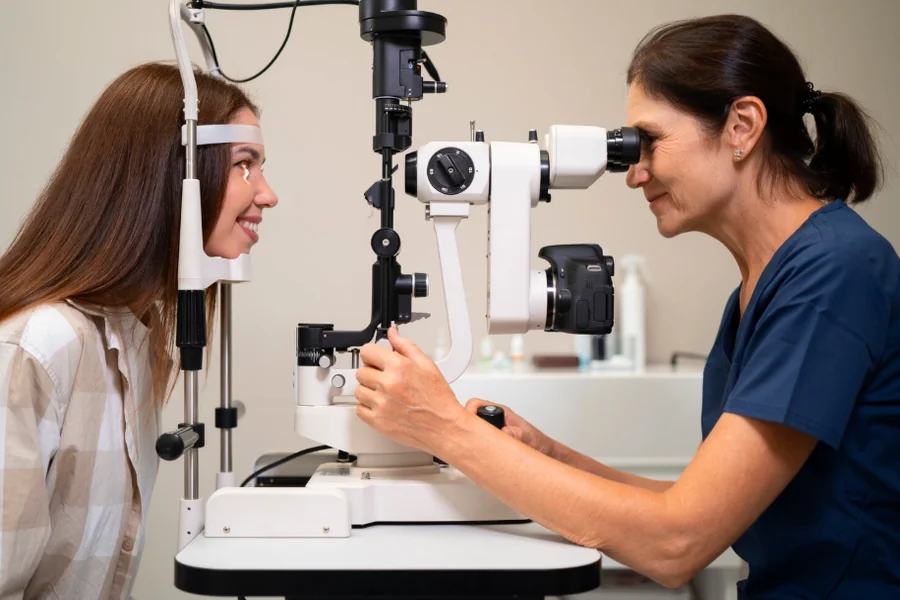
Slit-Lamp Examination
A slit-lamp examination allows the specialist to examine structures at the front of the eye under magnification.
The equipment uses a focused beam of light and magnification to assess areas such as the cornea, iris, lens and other visible structures. It is useful for investigating various eye complaints, including redness, irritation, changes in the cornea and problems involving the lens.
The examination is generally straightforward. You sit with your chin and forehead supported while the specialist directs the light towards your eyes.
Dilated Eye Examination
A dilated examination gives the specialist a better view of the retina and other structures at the back of the eye.
Eye drops are used to widen the pupil. Once the pupils have dilated, the specialist can examine the retina, optic nerve and surrounding structures more closely.
Your vision can remain blurry or light-sensitive for several hours after dilation. Because of this, it is sensible to ask the clinic whether you should arrange someone to drive you home, particularly if you have not experienced dilation before.
Visual Field Testing
Visual field testing assesses how well you see across different areas of your field of vision.
You typically focus on a central point while responding when you notice small lights or other visual signals. The results help the specialist identify areas where peripheral vision appears reduced.
Visual field testing is often useful when assessing or monitoring conditions affecting the optic nerve or visual pathways. The test requires concentration, so results can sometimes be influenced by fatigue, misunderstanding instructions, or inconsistent responses.
Optical Coherence Tomography
Optical coherence tomography, commonly called OCT, uses light to produce detailed cross-sectional images of structures inside the eye.
An OCT scan is particularly useful when the specialist needs to examine the retina or optic nerve in greater detail. It is often used as part of assessment or monitoring when certain retinal or optic nerve conditions are suspected.
The scan itself is generally quick and does not require the eye to be touched. Whether an OCT is needed depends on the reason for your appointment and the specialist’s findings.
Retinal Imaging
Some clinics use retinal imaging to capture photographs of the back of the eye. These images provide a record that the specialist can review alongside other examination findings.
Retinal photographs can also help with monitoring changes over time. They are useful in situations where the appearance of the retina or optic nerve needs to be documented.
Different clinics have different equipment, so the imaging available during an appointment varies.
Why Different Eye Tests Are Used Together
No single eye assessment provides a complete picture of eye health.
For example, visual acuity measures clarity of vision, while tonometry measures eye pressure. A slit-lamp examination focuses on visible structures at the front of the eye, while retinal imaging and OCT provide information about structures further inside the eye.
Combining findings gives the specialist a broader understanding of what is happening. Additional testing is normally selected based on symptoms, risk factors, examination findings, and previous results.
What Happens After the Assessments?
Once the examinations are completed, the specialist usually discusses the findings and explains whether further investigation, monitoring, or treatment is appropriate.
Some patients require a follow-up appointment to monitor changes over time. Others might need additional testing or referral for a particular form of treatment.
If a treatment is recommended, ask about its purpose, expected benefits, possible risks, alternatives, and follow-up requirements. Understanding these details helps you make informed decisions about your eye care.
Conclusion
An appointment at an eye specialist clinic often involves several assessments designed to examine different aspects of vision and eye health. Visual acuity, refraction, eye pressure testing, slit-lamp examination, visual field testing, retinal examination, and imaging are among the assessments used when appropriate.
The exact combination of tests depends on your symptoms, history, and the specialist’s findings. Knowing what to expect can make the appointment less unfamiliar and help you prepare useful information beforehand.