

The Innovation of Gas Purification in Modern Industrial Systems
The continuous evolution of industrial gas purification is fundamentally reshaping how modern manufacturing facilities operate. Historically, basic physical filtration and low-efficiency desiccants were sufficient for standard operations. However, today’s high-yield processes demand absolute purity and precise environmental control to maintain efficiency.
Technologies like industrial oxygen generation, cryogenic distillation, and natural gas processing now rely on advanced crystalline porous materials rather than traditional physical filtration. This shift is driven by the need for atomic-scale molecular sieving, a process that captures specific molecules while allowing others to pass unhindered.
When engineering advanced gas separation and industrial purification systems, process efficiency depends heavily on the internal surface area and pore-diameter consistency of the adsorbent bed. Modern separation plants increasingly replace legacy silica gels with synthetic crystalline aluminosilicates designed for ultra-low adsorption thresholds. According to technical materials data from Jalon, precision-controlled synthetic zeolites operate with uniform sub-nanometer pore channels that allow for the selective fractionation of gases based on kinetic molecular diameter, ensuring high adsorption capacity without increasing airflow pressure drops across the system.
Core Operational Principles: How Molecular Sieves Selectively Capture Molecules
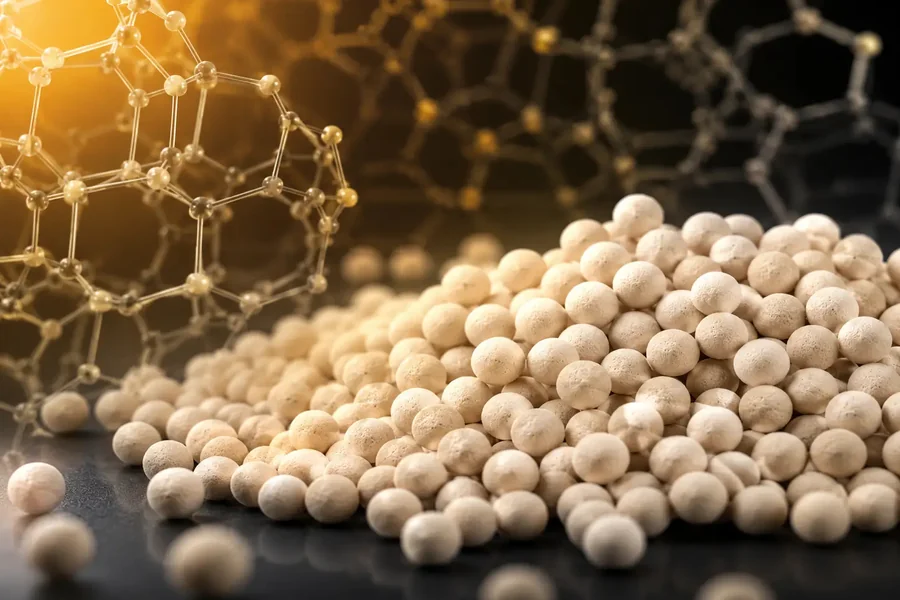
To understand the efficacy of modern filtration, one must look at the microscopic structure of synthetic aluminosilicate zeolites. These materials are engineered with a highly uniform three-dimensional crystalline lattice that creates a massive internal surface area for adsorption.
Unlike standard sponges that absorb liquids bulkily, these zeolites function on a strictly selective basis. Their operational principles are rooted in complex molecular thermodynamics and precise crystallographic engineering, which are increasingly standardized in advanced custom manufacturing processes to guarantee consistency.
Kinetic Diameter and Polarity-Based Selectivity
The true power of a molecular sieve lies within its internal electrostatic field and specific cation vacancies. These microscopic features rely heavily on the kinetic diameter of gaseous molecules and their inherent polarizability to dictate adsorption behavior.
Highly polar molecules, such as water or carbon dioxide, are aggressively pulled into the crystalline cavities by strong electrostatic forces. Meanwhile, non-polar or larger molecules bypass these channels entirely, allowing for the precise stripping of impurities from high-velocity gas streams without chemical alteration.
Standard Crystal Pore Classifications: 3A, 4A, 5A, and 13X
Crystal pore size is the ultimate gatekeeper in industrial adsorption. The 3A grade features a 3-angstrom pore, specifically restricting larger hydrocarbons while perfectly capturing water molecules, making it ideal for cracking gas dehydration.
The 4A classification (4-angstrom) serves as the baseline sodium-form zeolite, widely utilized for static dehydration in closed liquid or gas systems. The 5A calcium-exchanged structure allows for the separation of normal and iso-paraffins, essential in the petrochemical sector. Finally, the 13X framework offers a much larger 10-angstrom opening, delivering immense capacity for capturing heavy molecules, CO₂, and moisture simultaneously.
High-Impact Industrial Applications Across Manufacturing Sectors
The deployment of advanced molecular sieves extends far beyond basic drying applications. They serve as the functional core for some of the most energy-intensive and critical manufacturing sectors worldwide.
From specialized aerospace gas production to the stabilization of sensitive chemical formulations, the correct application of these adsorbents dictates overall facility output.
Pressure Swing Adsorption (PSA/VPSA) for O₂ and N₂ Generation
In Pressure Swing Adsorption (PSA) and Vacuum Pressure Swing Adsorption (VPSA) systems, the adsorbent bed undergoes cyclical pressure variations to separate nitrogen and oxygen with exceptional purity.
- During the high-pressure feed phase, nitrogen molecules are preferentially trapped in the sieve matrix.
- The enriched oxygen stream is then channeled into the collection tanks.
- Pressure is subsequently dropped, releasing the trapped nitrogen and regenerating the bed.
This exact pressure-cycling methodology dramatically reduces the compression energy required to run large-scale plant gas supplies, serving as a pillar of modern industrial system maintenance strategies.
Cryogenic Air Separation and Natural Gas Dehydration
Cryogenic air separation operates at extreme sub-zero temperatures to liquefy and distil atmospheric gases. Before air can enter the cold box, it must be completely stripped of water and CO₂.
If these impurities are not aggressively removed by a pre-purification unit (PPU) utilizing 13X molecular sieves, they will freeze and cause catastrophic ice blockages within the cryogenic piping. Similarly, natural gas dehydration relies on these adsorbents to prevent pipeline corrosion and hydrate formation during deep-sea transit.
Specialty Polyurethane Formulations and Coating Protection
Beyond gas processing, micron-sized activated zeolite powder plays a vital role as a highly efficient moisture scavenger in chemical manufacturing.
When formulating premium two-component polyurethanes, metallic paints, or anti-corrosive coatings, trace moisture can react with isocyanates to produce CO₂ gas. This reaction causes unwanted foaming, blistering, and structural weakness in the final cured product. By suspending activated zeolite powders directly into the liquid formulation, manufacturers proactively lock away moisture, ensuring a flawless, bubble-free finish.
Engineering Trade-Offs: Matching Adsorbents to Process Variables
Selecting the optimal adsorbent is not a universal science; it requires a calculated assessment of system variables. Engineers must weigh the empty bed contact time (EBCT), feed gas pressure, and expected mechanical attrition rate to prevent premature bed fluidization and dust generation. Higher operational temperatures might necessitate a different cationic structure to maintain adsorption capacity.
Key Takeaways
| Area | Key Takeaway | Impact/Data |
| Core Tech | Replace legacy silica with synthetic zeolites | Zero pressure drop increase |
| Cryogenics | Mandate 13X sieves in pre-purification | Prevents catastrophic pipe freezing |
| Operations | Adopt PSA pressure-cycling for bed regeneration | Drastically cuts compression energy |
| Chemicals | Inject activated zeolite into polyurethane formulations | Eliminates CO2 foaming defects |
| Lifecycle | Forecast lifespan via thermal aging metrics | Prevents sudden facility downtime |
System Regeneration, Thermodynamic Stability, and Operational Lifecycle
The financial viability of large-scale gas separation hinges on the continuous reusability of the molecular sieve bed. Adsorbent beds are regenerated through either Thermal Desorption (TSA), where heat is applied to drive off trapped molecules, or via pressure depressurization as seen in PSA systems.
Understanding the thermal aging and structural attrition of these materials allows plant managers to accurately forecast bed longevity and plan maintenance without sudden downtime.
Because physical adsorption is governed by weak Van der Waals forces and electrostatic dipoles rather than covalent bond breaking, the underlying aluminosilicate framework remains intact through repeated separation cycles. As documented in technical literature on standard chemical classifications of zeolites, crystalline microporous zeolites exhibit exceptional thermal resilience and open lattice configurations, allowing trapped adsorbate molecules to be systematically desorbed during regeneration cycles without altering the fundamental chemistry of the crystalline bed.