
You have about seven seconds. That’s the window before a prospective client forms a durable first opinion of you and your business. Not seven minutes. Seven seconds. And in that window, your voice hasn’t even warmed up yet.
What fills the gap? Whatever lands on the table in front of them first. A printed folder, a proposal packet, a leave-behind binder. Physical materials carry the weight of that opening moment, and most small business owners seriously underestimate how hard those materials are working on their behalf, or against them.
The First-Touch Hierarchy: Why Paper Gets There Before Words Do
Think of every client interaction as a layered sequence of signals. Call it the First-Touch Hierarchy. Before your pitch, before your portfolio link, before your handshake, something physical usually changes hands. A document. A packet. A folder with your name on it.
That physical object does three things simultaneously. It establishes your organizational competence (you came prepared), communicates your design sensibility (your brand has a look), and sets a quality baseline (you chose materials that match your pricing).
The judgment happens fast and mostly below conscious thought. Studies show that people form a first impression within just 50 milliseconds of seeing something new, which means a client has already started building an opinion of your business before they open the cover. A generic white folder with a stapled proposal inside reads differently than a professionally printed piece with your logo and brand colors on the front. Both say something. You just don’t get to choose which one says it unless you’ve been intentional about your materials.
This is the part most business guides skip entirely. They focus on digital touchpoints, websites, email signatures, LinkedIn profiles. Those absolutely matter. But while digital design gets most of the attention these days, offline materials are just as important, especially for businesses with in-person events or physical marketing strategies. Packaging, business cards, brochures, and other printed materials are all opportunities to make a powerful first impression.
What the Data Says About Physical vs. Digital Recall
The case for print has always been intuitive. Holding something feels different than scrolling past it. But the research is more pointed than most people realize.
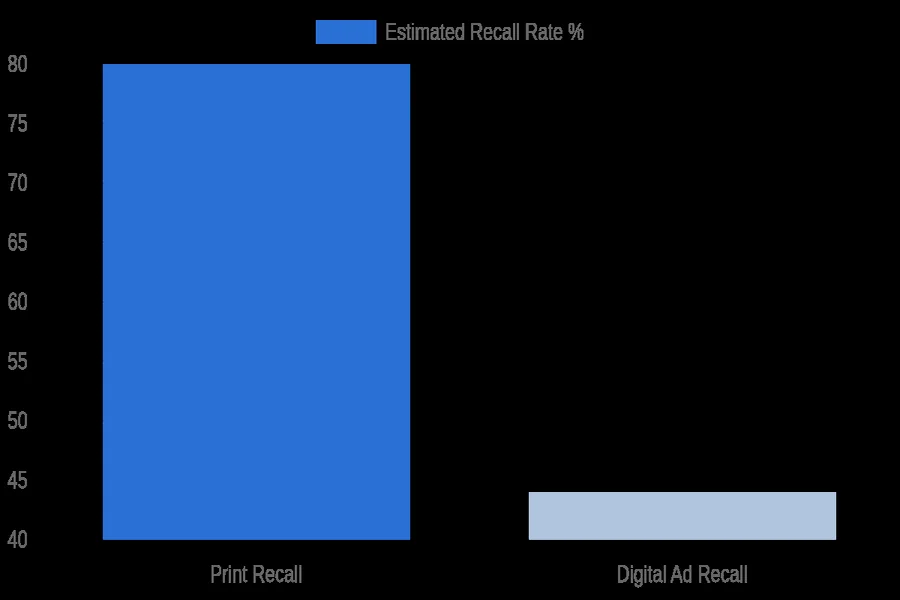
Print marketing has a 70 to 80 percent higher recall rate than digital advertising. That gap is enormous. You can run a well-targeted Instagram campaign and still lose to the folder that sat on a client’s desk for three days after your meeting. Physical materials occupy physical space, which means they stay in the client’s environment long after your digital ad has been replaced by the next one in the feed.
There’s also the trust dimension. According to print marketing statistics, 8 out of 10 people trust print ads the most when making purchasing decisions. That trust doesn’t appear from nowhere. It’s built, in part, by the tactile experience of handling something that required real production effort. You can tell the difference between a folder printed on cheap stock and one printed on a 14pt coated card. Your clients can too, and they’re drawing conclusions from that difference whether or not they say so out loud.
According to independent marketing research compiled by Persuasion Nation (2025), print advertisements receive an average response rate of 9 percent, compared to roughly 1 percent across email, paid search, and social media combined. That’s not a marginal edge. That’s a category-level difference.
A Concrete Scenario: The Proposal Walk-Through
Picture this. You’re a small commercial photography studio bidding on a contract with a regional hotel brand. You and one competitor show up to the same shortlist meeting. You bring a printed proposal inside a branded pocket folder, your logo foil-stamped on the front, your color palette carried through every page inside. Your competitor emails a PDF the morning of the meeting.
The hotel’s marketing director prints that PDF on an office printer. It comes out of the tray slightly crooked. Your folder sits flat on the table between two coffee cups. When the meeting ends, the director puts your folder in her bag to review with her team. The competitor’s PDF is still in her inbox, one of 200 messages.
That scenario plays out constantly, across industries, at every budget level. Branded print collateral doesn’t just document your offer. It carries your brand into rooms you’re not in anymore.
“Every piece of print collateral you send into the world is a physical representative of your brand identity. Its quality communicates your standards before anyone reads a single word.”
Summarized from Graphic Village’s analysis of how print quality shapes brand perception
Choosing the Right Materials for Your Business Stage
Not every business needs the same approach. Here’s a practical breakdown based on where you are and what you’re trying to communicate.
| Business Stage | Recommended Print Asset | Primary Signal Sent
|
| Pre-revenue / launching | Branded one-pager inside a basic folder | “We’re serious and prepared” |
| Early revenue / pitching | Custom printed pocket folder with proposal inserts | “We invest in quality presentation” |
| Established / scaling | Full branded collateral suite: folders, brochures, leave-behinds | “We’re a complete, dependable operation” |
| Agency / consultancy | Premium stock, finish options, logo placement front and back | “Our attention to detail carries into our work” |
The logic here is simple. Your materials should match the price point you’re charging. If your service costs four figures, your folder should not look like it cost four cents. Clients benchmark your pricing against your presentation instinctively, even if they’re doing it subconsciously.
For businesses ordering at volume, cost per unit drops sharply. Many small businesses avoid branded folders because they assume the cost is prohibitive. It usually isn’t. Ordering custom folders with logo in batches of 100 or more brings the per-unit cost to levels that make it a straightforward line item, not a luxury decision. Companies like custom folders with logo suppliers print full-color on 14pt stock with no setup fees and standard two-day turnaround, which removes the two objections most people have: cost and lead time.
Practical Steps to Upgrade Your Physical Brand Presence
You don’t need to overhaul everything at once. Pick the one touchpoint where you’re weakest and fix it first. Here’s a working checklist.
- Audit what you currently hand clients in meetings. If it’s a printout from an office printer, that’s your starting point.
- Pull your brand colors, fonts, and logo files into one folder on your computer so they’re ready when you order.
- Order a small batch of branded pocket folders, 25 to 50, to test quality and fit before scaling up.
- Use the folder to house all client-facing documents: proposals, contracts, case studies, and your business card tucked into the pocket.
- Review your digital and physical materials side by side. If your Instagram looks polished and your folder looks thrown together, you have a consistency gap that clients will feel even if they can’t name it.
Consistency across touchpoints matters more than perfection at any one of them. A well-designed logo, color scheme, typography, and visual elements create a unified identity that customers can easily associate with the brand, and this consistency across platforms, from websites and social media to print materials, helps build brand recognition. Your physical materials are part of that system, not a separate category.
The U.S. Small Business Administration’s brand management guidance consistently emphasizes that a recognizable, consistent brand identity is one of the most durable competitive advantages a small business can build, regardless of industry.
The Competitive Edge Most Businesses Leave on the Table
Here’s the honest reality. Most of your competitors are not thinking about their folders. They’re focused on ad spend, website SEO, and social content. Those are worthwhile areas. But none of them help you in the room when a client is deciding whether to trust you.
Print collateral occupies a gap in most small business marketing strategies, which means it’s one of the few remaining places where a relatively modest investment creates a disproportionate impression. You’re not competing with other people’s folders in that meeting. You’re competing with a printout from a home office and a PDF nobody opened. Clear the bar, and you clear it by a wide margin.
So the question worth sitting with is this: the next time a client reaches across the table, what does what they pick up say about you?