
It usually begins with a small annoyance. The light outside the garage switches on even though nobody is there. Ten minutes later, it happens again. By the third night, you are checking the window for animals, delivery drivers, or a neighbor taking an unusually late walk.
A motion-sensor light that activates too often is not necessarily faulty. In many cases, it is responding correctly to movement or heat that you did not consider during installation. The problem is usually the location, detection range, or sensitivity setting—and those are often easier to correct than replacing the entire fixture.
Start by Watching the Light Instead of Guessing
Before changing any settings, spend one evening observing when the light comes on. Note the time and what is happening nearby. Are cars passing? Is the wind moving a shrub? Does the dryer or heating system switch on at roughly the same moment? A short phone video aimed through a window can be helpful if the problem occurs while you are asleep.
Look beyond your own property as well. A sensor facing the street may detect pedestrians, cyclists, or vehicles that never enter your driveway. One mounted beside a shared path could be responding to a neighbor taking out the trash. The cause may be perfectly ordinary but outside the area you normally watch.
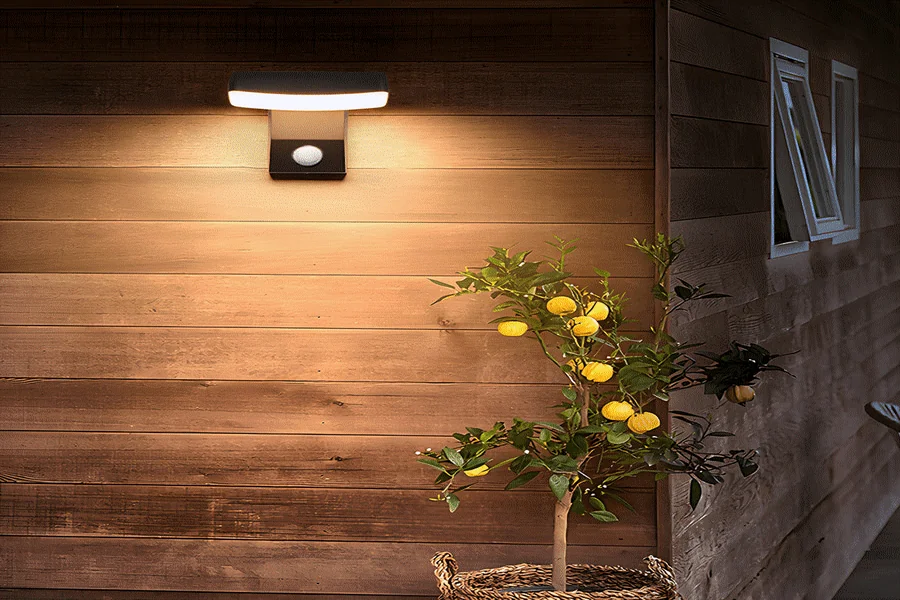
Plants close to a sensor can make it harder to identify what is actually causing repeated activation.
Heat Can Be Mistaken for a Person
Many outdoor sensor lights use passive infrared technology, commonly called PIR. Rather than seeing a person in the way a camera does, the sensor responds to changes in infrared energy across its detection area. A person walking through that area creates an obvious change, but people are not the only possible source.
A dryer vent, heating exhaust, or outdoor HVAC unit can release warm air that moves across the sensor. On a cold night, the temperature difference may be enough to activate the light. This explains why some fixtures appear to behave normally during summer but begin switching on unexpectedly in cooler weather.
Animals can be another source. A cat crossing a low wall, a raccoon near the bins, or a bird landing close to the fixture may enter the detection zone. Small insects flying directly in front of the sensor can appear much larger at such close range. If the light turns on around the same time each night, local wildlife may have quietly added your yard to its regular route.
The Widest Detection Range Is Not Always the Best
A generous detection range sounds useful, especially when a light is being added for security. In practice, a sensor that covers the road, sidewalk, neighboring driveway, and half the garden may create more frustration than protection. The goal is not to detect everything that moves. It is to detect movement in the area where light is genuinely needed.
For a garage, that may mean the final section of the driveway rather than the street. At a side entrance, the useful zone might be the gate and the few steps leading to the door. On a patio, the sensor should respond when someone approaches the seating area without constantly reacting to activity on the other side of the fence.
When comparing motion sensor wall lights, check whether the detection angle, sensitivity, illumination time, or lamp direction can be adjusted. A model with a slightly shorter but controllable range may be more practical than one that simply promises the greatest distance.
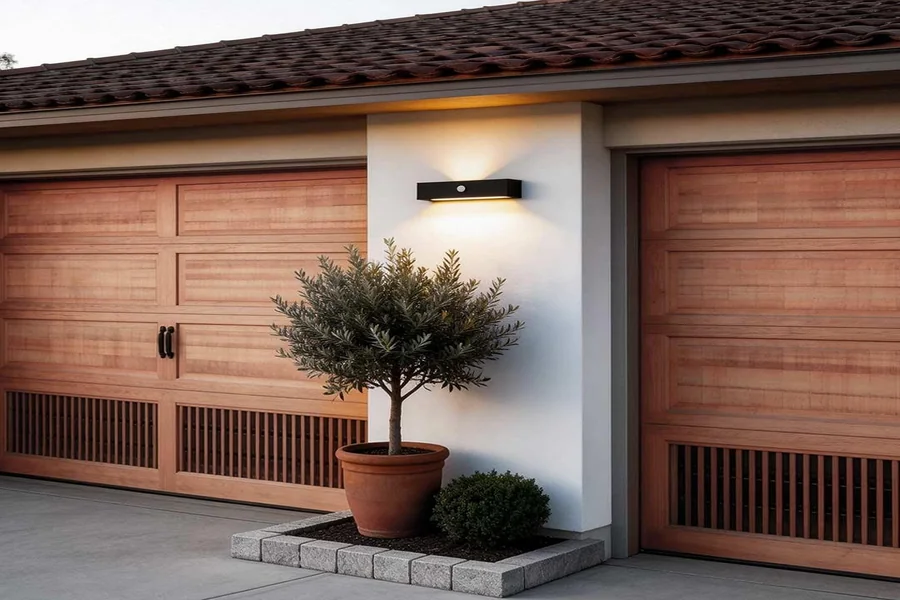
A garage light should cover the useful part of the driveway without monitoring the entire street.
Adjust Sensitivity Before Moving the Fixture
If the light has sensitivity controls, make small adjustments and test after each one. Turning the sensitivity all the way down may stop false activations, but it can also prevent the fixture from noticing someone approaching. Begin with a moderate reduction, wait until the light resets, and then walk through the intended detection area from several directions.
Walking across a sensor’s field of view may produce a different response from walking directly toward it. Test the route you actually use: from the driveway to the door, from the gate to the bins, or from the kitchen door to the patio. Ask another person to help so you can observe where the light activates instead of trying to judge it while walking.
The illumination timer matters too. A thirty-second light may be enough for unlocking a door but too short for carrying groceries from the car. A light that remains on for several minutes after every activation can make occasional false triggers feel much more disruptive. Choose the shortest duration that still gives you time to complete the task comfortably.
Check the Mounting Position
Mounting a sensor too high can cause it to overlook nearby movement, while placing it too low may make pets the main occupants of its detection zone. Follow the fixture’s installation guidance rather than assuming every wall light belongs at the same height. The correct position depends on the sensor design and the area it is intended to cover.
Also consider the direction of the wall itself. A fixture installed on the front of a garage naturally faces outward toward traffic. Moving it to the side wall or adjusting the sensor slightly downward may focus detection on the driveway. In a narrow side yard, angling the sensor away from a moving gate or a frequently used neighboring path can make a noticeable difference.
Do not relocate a hardwired fixture casually. Changes to exterior wiring, mounting boxes, and weather seals should be handled by a qualified professional. Water entering around an incorrectly mounted light creates a far more serious problem than an overenthusiastic sensor.
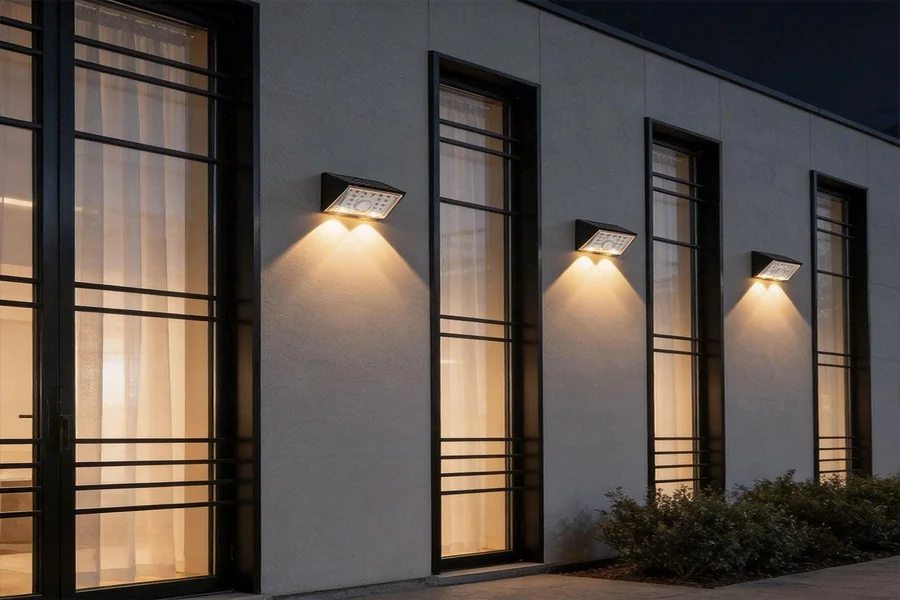
On a patio, a shorter and more focused detection zone can feel more comfortable than constant wide-area coverage.
Make Sure It Is the Motion Sensor
Some outdoor fixtures combine motion detection with a dusk-to-dawn photocell. The photocell turns the system on when surrounding light levels fall, while the motion sensor controls when the brighter illumination activates. Reflections from windows, nearby lamps, or car headlights can occasionally confuse the light-control cycle.
Review the operating modes before assuming something is broken. A manual override may keep the light continuously illuminated after the wall switch has been flipped in a particular sequence. Turning the power off for the recommended reset period can return some fixtures to their normal automatic mode.
A Good Sensor Light Should Become Unnoticeable
Once the settings are right, you should rarely think about the sensor. The light comes on when you arrive with your hands full, stays off when a car passes at the end of the street, and gives you enough time to reach the door without waving your arms in the dark.
If your light keeps waking the house at 2 a.m., resist the urge to blame the fixture immediately. Watch its pattern, narrow its field of view, check nearby heat sources, and adjust one setting at a time. The solution is often hiding in an ordinary part of the yard.