
Key Takeaways
- Small ad budgets perform best when focused on one clear business goal.
- Test a few meaningfully different ideas instead of many nearly identical ads.
- Track leads, bookings, purchases, and lead quality, not clicks alone.
- Create rules for pausing, improving, and scaling ads before launching.
- Use AI to speed up research and drafting, while keeping people responsible for judgment and accuracy.
For an Ottawa business, Facebook and Instagram ads can be a practical way to reach nearby homeowners, professionals, students, and shoppers without committing to a large media budget. The key is to treat every dollar as a chance to answer one useful question. Businesses that need help building that process can Hire Ottawa Social Media Strategist support for campaign planning, creative testing, and performance review. Whether you run a seasonal home service, a Kanata fitness studio, a ByWard Market retailer, or an online store serving the National Capital Region, a limited budget does not mean resorting to guesswork. It requires a focused offer, dependable tracking, and enough patience to learn what customers respond to.
Why Small Budgets Need a Different Plan
When a small budget is split across several campaigns, audiences, and ads, each option may receive too little delivery to provide a useful signal. Larger advertisers can afford longer experiments and broader comparisons. A local Ottawa service company may learn more by comparing two distinct inspection offers than by launching ten similar ads. Start with fewer, clearer concepts. Current guidance on paid social creative testing emphasizes differentiated messaging over cosmetic variations that divide spend and complicate analysis.
Set the Business Goal First
Every campaign should support one measurable outcome. Possible goals include qualified leads, online purchases, consultation bookings, appointment requests, email signups, or remarketing to people who have already visited your website.
Ask These Questions Before Spending
- What action should a prospective customer take?
- What is that action worth to the business?
- How quickly can your team respond to a lead?
- What offer gives people a credible reason to act now?
- What would the test teach you even if neither ad becomes a long-term winner?
Build a Simple Test Structure
Keep the campaign clean enough to explain the result. Choose one objective, such as leads or sales. Select one audience approach. Then prepare two or three ads with clearly different messages while holding the offer and landing page steady. For example, an Ottawa landscaping company could compare “Book your spring yard cleanup early” with “Get your yard ready for patio season.” Both promote the same service, but each tests a different customer motivation. Avoid judging performance after only a few hours, especially when conversion activity is low.
Choose Strong Creative Ideas
A genuine creative test changes the customer angle, not merely the background color. Useful variables include the main problem, the benefit, the opening video hook, the proof, the call to action, and the format.
- A roofing company can compare preventing costly leaks with getting a quick roof inspection.
- A fitness studio can compare a beginner-friendly message with a progress-focused message.
- An online retailer can compare a product demonstration with a customer story.
On a limited budget, testing the same ad with a different font often creates a weak lesson. Testing a different promise or objection creates a more valuable decision.
Track the Right Metrics
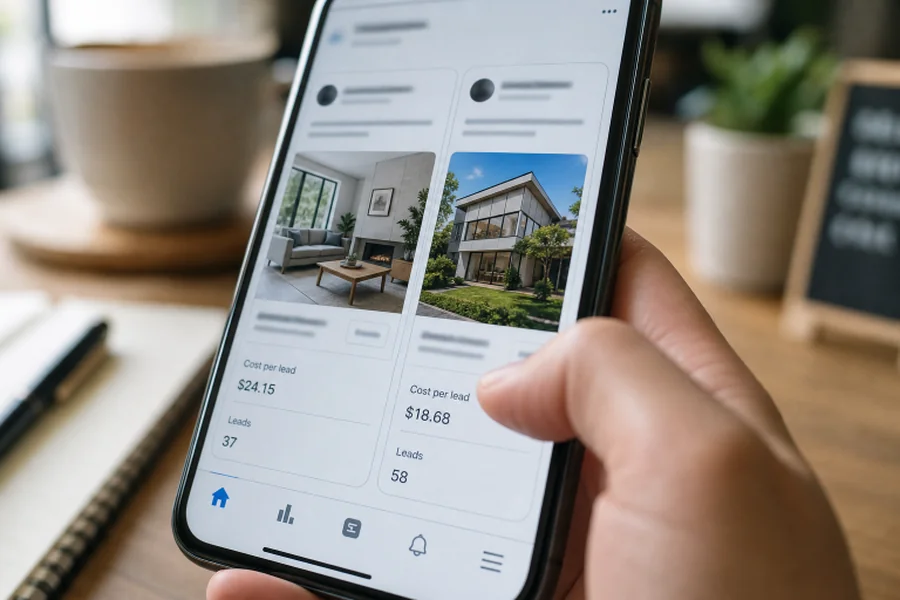
Clicks and likes can be early signals, but they are not the final business result. Review video hold or thumb-stop behavior, link click-through rate, landing page visits, and engagement with the offer. Then connect those signals to cost per qualified lead, cost per purchase, booking rate, lead-to-customer rate, and revenue after advertising costs. The cheapest click is not automatically the best outcome. An ad that produces fewer clicks but sends serious prospects to an Ottawa law office, contractor, or clinic may have greater value than a high-click campaign that attracts poor-fit inquiries.
Know When to Stop or Scale
Write decision rules before the campaign starts. Pause or revise an ad when it receives attention but no meaningful action, exceeds your target cost per result, sends visitors to a page that does not convert, or attracts the wrong kind of customer. Consider gradual budget increases when results remain steady for several days, fulfillment capacity is available, the offer remains profitable, and the message works across multiple formats. Sudden large changes can make the next performance review harder to interpret.
Avoid Common Budget Leaks
- Testing too many ads at once, which thins out available spend.
- Changing targeting, creative, offer, and landing page at the same time.
- Editing campaigns repeatedly before useful patterns emerge.
- Sending paid traffic to a slow, confusing, or poorly matched landing page.
- Ignoring whether leads become customers.
- Making budget choices with incomplete conversion tracking.
Use AI With Care
AI can help generate headline ideas, organize feedback, identify cost changes, and suggest future test questions. It can be useful when reviewing a larger pool of customer comments or drafting several starting concepts. Discussion of experimental ad budgets reflects the growing role of automation in how advertisers plan and evaluate tests. Human review remains essential. Check claims, protect customer privacy, remove generic language, verify that an offer can be delivered, and ensure the tone fits your audience. AI is an assistant, not a substitute for direct knowledge of Ottawa customers.
Create a Repeatable Testing Routine
- Review the previous test and record what worked, failed, or remains uncertain.
- Choose one new question, such as whether a testimonial beats a feature-focused message.
- Create two or three distinct concepts around the same goal and offer.
- Launch with a controlled amount you can afford to spend while learning.
- Review results on a set schedule rather than reacting to every daily fluctuation.
- Save winning messages, audience notes, and feedback for the next campaign.
Common Questions
How Many Ads Should a Small Business Test at Once?
Start with a small number of genuinely different concepts. The appropriate number depends on budget, conversion volume, and sales cycle, but fewer ads generally make it easier to evaluate limited spend.
Should You Test Audiences or Creative First?
If your local audience is already reasonably defined, test the message first. Strong targeting cannot compensate for an unclear offer or weak customer motivation.
What If an Ad Gets Clicks but No Leads?
Review the landing page, offer, form length, mobile experience, page speed, and conversion tracking. The problem may begin after the click.
Conclusion
Effective Facebook and Instagram ad testing is not about producing endless variations or changing multiple elements at once. For Ottawa businesses, it is about asking focused questions, measuring genuine business outcomes, and applying each lesson to the next campaign. Businesses can test specific elements such as ad copy, images, videos, audience segments, offers, calls to action, or landing pages while keeping other factors consistent enough to understand what influenced the results. Looking beyond clicks and impressions can also provide a clearer picture of whether an ad is contributing to inquiries, bookings, purchases, or other meaningful actions. Test fewer ideas, make the differences meaningful, allow enough time and data for useful comparisons, and let real customer response guide where the next dollar goes. Keeping organized records of test results can also make future campaigns easier to plan and reduce the risk of repeating ineffective approaches.