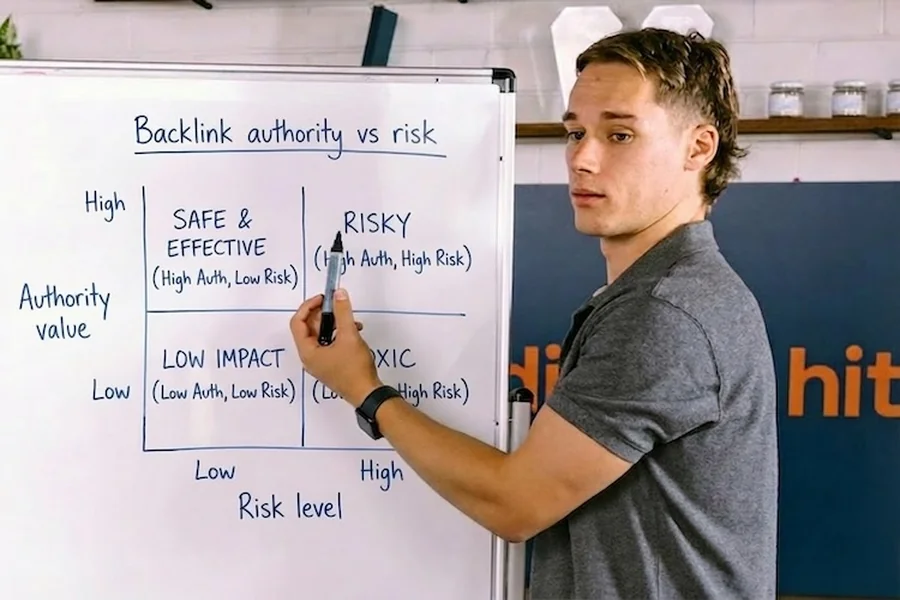
Most SEO reporting answers one question: did we go up or down? It is a fair question, but it is only half of the picture. A position on a results page is an outcome. The causes sit elsewhere, and for competitive queries the largest of them is usually the set of sites that link to you. Teams that watch positions without auditing links end up guessing. Teams that buy links without watching positions cannot tell which ones worked. This article covers how to run both checks together, and what to look for in each.
Start with the page, not the domain
Rankings belong to pages. Google does not rank your site for “project management software”; it ranks one URL, and sometimes it changes its mind about which one. That is why a domain-level visibility score hides the problems you most need to see: two pages competing for the same query, a blog post outranking the product page it was meant to support, a landing page that slid from position 6 to 14 after a redesign.
Checking at the keyword and URL level makes those problems visible. WowLink’s free URL rank tracker takes a domain and up to ten keywords and returns the exact position of each within the top 100 results, or reports that the domain is not ranked at all. Positions are pulled on demand, so the figure you see reflects the live results page at the moment of the check, not a crawl from last week.
Three settings that change the answer
The same keyword produces different results depending on who is searching, and three settings decide which version you are measuring.
Country comes first. A site in position 3 in the United States may be absent in the United Kingdom, where local competitors and local links carry more weight. Check the market you sell in, not the one you happen to sit in.
Device is second. Google ranks desktop and mobile separately, and the gap can be several positions when a page loads slowly or renders poorly on a phone. If most of your audience is on mobile, the desktop figure is the less useful one.
The third is a competitor. The tracker accepts one competing domain per check, which turns a bare number into a comparison. Position 8 reads differently when the rival you care about sits at 2 than when they sit at 15.
The AI Overview is a second ranking
For a growing share of queries, the first thing a searcher reads is Google’s AI-generated answer, with a handful of cited sources beside it. Being cited there and ranking in the organic list are related but separate results: a page can hold position 4 and be missing from the overview, or be cited from position 9. The rank tracker reports, per keyword, whether the AI Overview cites your domain. Record it alongside the position. When the two diverge, the cause is often on the page itself: cited competitors tend to answer the query more directly, near the top, in plain language.
When positions stall, look at the links
A page that is well written, technically clean and still stuck on page two usually has an authority problem. The pages above it are linked from more sites, or from better ones. The obvious response is to get more links, and this is where many budgets go wrong, because the number of links matters far less than where they come from.
A link from a site Google has not indexed passes nothing. A thousand links from twenty domains usually means sitewide footers, not editorial mentions. A domain whose link count tripled in a month has more likely been sold into a network than discovered by readers. None of this shows in a single authority score, which is why a high Domain Rating alone is a poor reason to pay for a placement.
What to check before you place a link
Vetting a donor site by hand means opening several tools and reconciling their numbers. WowLink’s spam backlink checker does that in one pass. It pulls about fifteen live signals for a domain, taking Domain Rating from Ahrefs and backlinks, referring domains, spam score and link velocity from DataForSEO, and it checks indexing against Google directly. An AI model then weighs them into a score from 0 to 100 with a verdict, and names the signals that counted against the site.
Four of those signals deserve the closest reading:
- Index status. A donor Google has not indexed is marked “avoid” whatever its other numbers say.
- Backlinks against referring domains. A wide gap between the two points to sitewide or templated links.
- Quality donors. How many of the site’s own top referring domains are dofollow, not spammy, placed in body content and not sitewide.
- Link velocity. Steady growth is normal; a sudden spike needs an explanation.
Each account gets ten free domain checks, and re-checking a domain you have already looked at does not use another. Customers who have ordered through the marketplace can submit up to 200 domains at once and export the results to CSV or Excel, which suits agencies screening a full outreach list. The same check is worth running on your own domain and on the sites already linking to it.
A simple monthly routine
- Run your ten most valuable keywords through the rank tracker for your main country and device. Note the position and the AI Overview status of each.
- Flag every keyword that dropped more than three positions, and every one sitting between 5 and 15, where a small gain in authority moves traffic the most.
- For each flagged page, list the links built to it since the last check and run the donor domains through the backlink checker.
- Before paying for any new placement, check the donor first. Skip anything marked “avoid” and read the stated reason on anything borderline.
- Re-run the rankings four to six weeks after new links go live. Links rarely move positions overnight.
Two checks, one answer
Neither check is much use alone. Rank data without link data tells you that something changed. Link data without rank data tells you what you bought. Together they tell you whether the money worked, which is the only question a client or a finance team will ask.