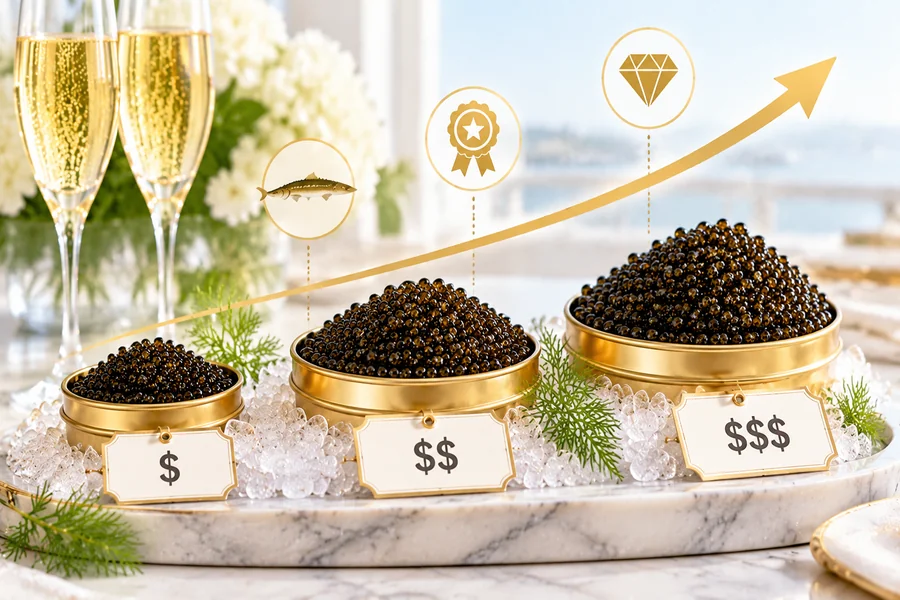
If you’ve been looking at the price of osetra caviar online and wondering why two tins labeled “osetra” can cost $109 and $250 respectively, you’re asking the right question. The answer isn’t marketing or markup. It’s a combination of where the sturgeon was raised, how long it took to mature, and what happened between the farm and your door.
This guide breaks down each variable so you can look at a price and understand what it reflects, not just trust a number on a label.
Why osetra prices vary so much within the same category
Osetra is a species, not a grade. Acipenser gueldenstaedtii produces eggs that range from small and olive-brown to large, pale gold, and nutty in flavor, depending on the individual fish, its age, diet, and the farm’s conditions. A 10-year-old female raised on a specific controlled feed in Italy will produce different eggs than a 5-year-old raised in a standard aquaculture setup in China.
Both are technically osetra. The price difference between them can exceed $100 per 50 grams.
There’s also the grade factor. Most farms sort eggs by size, color uniformity, and membrane firmness before packing. Smaller tins sold at lower prices often contain mixed-grade eggs, while top-tier offerings are hand-selected for consistency. That sorting process takes time and labor, and it shows up in the price.
What farm provenance actually does to the price
Where the caviar comes from matters more than most buyers realize. Three farms dominate the premium end of the market in a way that’s worth understanding.
Karat, based in Israel, uses recirculating aquaculture systems with filtered spring water. Their sturgeons are raised without antibiotics, and the water quality controls mean the fish aren’t stressed by environmental fluctuations. That stability produces eggs with a cleaner, more consistent flavor. Their caviar is priced higher partly because the operating cost of their system is higher.
Giaveri, in the Veneto region of Italy, has been farming sturgeon since the 1990s. The Sile River water they draw from has mineral characteristics that some buyers say come through in the taste. Giaveri’s production is relatively small by commercial standards, and they grade aggressively, meaning a large percentage of eggs don’t make it into their premium tins. That yield loss is baked into the price.
Rova, in Madagascar, operates at altitude in the Hauts Plateaux region, where cold spring water naturally keeps temperatures in the range sturgeons prefer without the energy costs of climate control. Their production is smaller still, and the logistics of shipping from Madagascar add a real cost that cheaper producers don’t face.
By contrast, large-scale Chinese aquaculture operations produce osetra at much lower cost per kilogram. Some of it is excellent. Much of it is competent but unremarkable. The price reflects volume, not necessarily quality, and the buyer takes on more uncertainty about what they’re getting.
Maturation time and why it costs more
Osetra females typically reach sexual maturity between 8 and 12 years, but most farms harvest earlier, around 5 to 7 years, to reduce operating costs. The problem with early harvest is that the eggs haven’t fully developed the fat deposits that give premium osetra its characteristic buttery, nutty taste.
Farms that wait longer charge more, and they’re entitled to. A female sturgeon that’s been fed and maintained for 10 years represents 10 years of feed costs, water treatment, labor, and space that could have been generating revenue earlier. That time cost is real, and it comes out in the tin price.
The eggs from older fish also tend to be larger and have a firmer membrane, which affects how they burst on the palate. If you’ve noticed that some caviars feel mushy while others have a satisfying pop, age and species genetics are usually the explanation.
Processing, cold chain, and what happens after the farm
How caviar is processed between the fish and the tin changes both the product and the cost. Malossol is the standard for premium caviar: lightly salted, typically 3 to 5 percent, which preserves the eggs without masking their flavor. The salt used matters too. Some producers use specific mineral salts to achieve flavor profiles; others use standard food-grade salt.
After processing, caviar needs to stay cold. Not refrigerator cold, but close to freezing, ideally around 28 to 32°F. Maintaining that range through packaging, transit, and storage is expensive. A producer shipping from Italy to the US is dealing with customs clearance, refrigerated freight, and the risk that any gap in the cold chain degrades the product. That cost doesn’t disappear; it moves into the retail price.
On the buyer’s end, this is why overnight shipping in insulated packaging isn’t a premium option, it’s a baseline requirement for a product that costs $150 a tin. Gel packs and Styrofoam coolers aren’t theater; they’re what keeps a 30-hour shipping window safe.
The $109 vs $250 osetra: what’s actually different
Put two tins side by side and the differences usually come down to four things.
Age of the fish at harvest. A $109 tin is more likely to come from a 5 to 6-year-old female. The $250 tin is more likely from a female harvested at 9 to 12 years, with the flavor development that comes from that timeline.
Farm source and production standards. The cheaper tin may be from a large-volume producer where efficiency is the priority. The more expensive tin often comes from a smaller farm where controlling variables is the priority, even when it reduces yield.
Grading. Premium tins are graded by size and color uniformity. A tin of consistently large, pale gold eggs requires more sorting than a tin with natural variation.
The cost of osetra caviar per gram tells you something useful here. At $109 for 50 grams, you’re paying $2.18 per gram. At $250 for the same weight, you’re paying $5.00 per gram. That $2.82 gap reflects real differences in input costs, not just branding.
For reference: most farmed osetra in the $2 to $2.50 per gram range comes from large-scale producers in China or eastern Europe. The $4 to $6 range typically covers small-batch European or Israeli farms with longer maturation cycles and stricter grading. Above $6 per gram, you’re usually looking at rare varieties, barrel-aged options, or very small production lots.
Neither price point is automatically better for every buyer. If you’re serving caviar as a component in a recipe, the $109 tin does the job. If you’re eating it off a spoon with a glass of champagne, the difference between a 5-year fish and a 10-year fish is noticeable enough to matter.
Where to buy and why the channel matters
How much does osetra caviar cost at retail versus specialty stores? The channel you buy through changes both the price and what you’re actually getting.
A restaurant markup on caviar can run 300 to 500 percent over wholesale. A Manhattan specialty food store carries similar overhead. You’re paying for the location, the staff, and the experience of the store, none of which affects what’s in the tin.
Buying direct from a specialist importer cuts several of those layers. The tin is the same; the markup structure isn’t. For most buyers, this means more product for the same budget, or the same product for less.
The other channel consideration is freshness. Specialty stores carry inventory, which means the caviar on the shelf may have been there for weeks. A direct importer selling to order is more likely to ship product that was recently processed and hasn’t been sitting in a display case. Caviar has a shelf life, and it’s not infinite. A tin that’s four months from its production date tastes different from one that’s two months out.
For caviar delivery across the US, the cold chain handling matters as much as the source. A producer with excellent caviar and mediocre shipping logistics will deliver a worse product than a producer with good caviar and excellent cold chain management. Ask how the tin will be shipped before you order, not after.
The real answer to what you’re paying for is this: at the lower end of the osetra price range, you’re getting a competent product from a cost-efficient operation. At the higher end, you’re paying for time, geography, and the specific decisions a farm made about how to raise its fish. Whether those decisions matter to you depends on how you’re eating it and what you want from the experience.