
Table of Contents
- Why the Story Matters More Than the Shape
- A Short Look at Challenge Coin Tradition
- Define the Coin’s Purpose
- Choose Symbols With Meaning
- Plan the Front, Back, and Edge
- Balance Detail With Readability
- Compare Materials, Finishes, and Add-Ons
- Common Design Mistakes to Avoid
- Build a Simple Review Process
- Present the Coin at the Right Moment
- A Final Design Checklist
- Conclusion
In Texas, a challenge coin can capture more than a logo. It can recognize a fire crew after a difficult season, celebrate a ranching family’s anniversary, mark a school graduation, or thank volunteers who supported a local event. Organizations planning a custom piece can begin by exploring lonestarchallengecoins.com, then focus on the message the coin should convey.
The best Texas challenge coins feel connected to a real place and a real moment. A design inspired by the Hill Country, the Gulf Coast, the Panhandle, West Texas, or a hometown main street should use those local details with purpose. Before choosing a shape, finish, or color palette, decide exactly what story recipients should remember when they hold the coin years later.
Why the Story Matters More Than the Shape
A coin becomes meaningful when people can explain why it exists. Its story should guide every decision, including the central image, colors, wording, date, and finish. For example, a Texas search-and-rescue team might use a compass, a river line, and a short motto to recognize coordinated work during an emergency. A company celebrating a long service milestone might use its founding year, a local landmark, and language that reflects its values.
Special shapes can be memorable, but they are not a substitute for a clear idea. A standard round coin with a strong emblem and readable message will usually outlast a busy design that tries to say everything at once.
A Short Look at Challenge Coin Tradition
Challenge coins are closely associated with military recognition and unit identity, although accounts of their earliest origins vary. The history of challenge coins spans civilizations and centuries, with several stories rather than a single universally confirmed origin. That uncertainty does not lessen the tradition’s importance. Coins remain personal reminders of service, belonging, achievement, and shared experience.
Today, the practice reaches far beyond military settings. Texas police and fire departments, veteran groups, schools, civic organizations, businesses, clubs, and reunion planners use coins to create a lasting connection. A recent look at the history of modern challenge coins also emphasizes how coins can commemorate units, accomplishments, and important relationships.
Define the Coin’s Purpose
Purpose should come before artwork. A retirement coin needs a different tone from a fundraiser token, an academy graduation coin, a reunion keepsake, or an employee recognition piece. Write one sentence that answers: “This coin exists to honor or remember what?” If the sentence is unclear, the visual concept will probably be unclear too.
Questions to Ask First
- Who will receive the coin, and what will it mean to them?
- What person, team, event, achievement, or milestone does it recognize?
- Should the tone be formal, warm, bold, humorous, or traditional?
- Will it be presented once, or used in an ongoing recognition program?
- Does it represent a specific Texas community, a statewide organization, or a local chapter?
Choose Symbols With Meaning
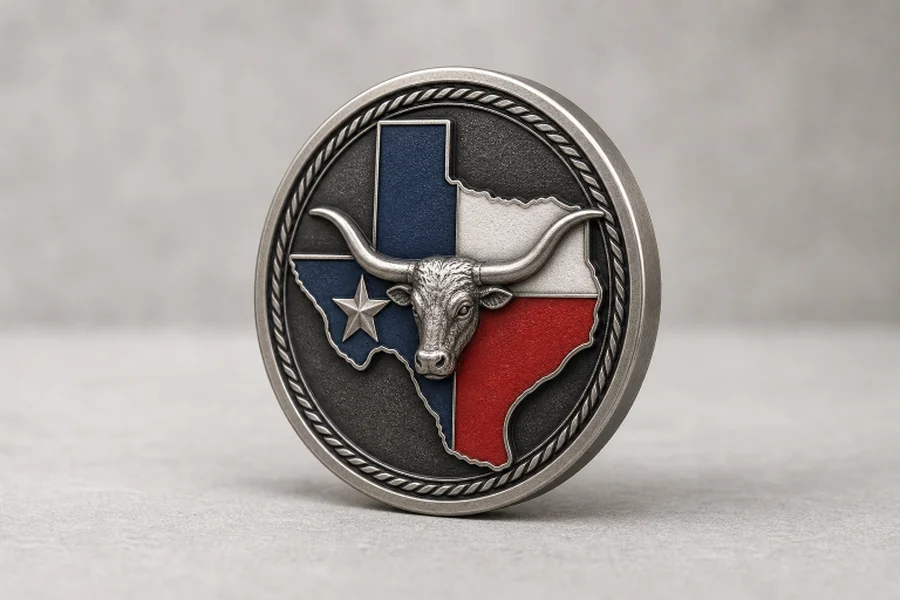
Start with one main symbol. It might be a longhorn silhouette, bluebonnet, courthouse dome, mission-inspired arch, oil derrick, ranch gate, star, badge, aircraft, or skyline. The right choice depends on the group’s actual history, not on which image seems most dramatic. Supporting details can include a date, coordinates, tools of the trade, a local waterway, or a short motto.
For each major element, write a one-sentence explanation before approving the design. This simple step reveals whether an image belongs on the coin or merely fills space. It also helps prevent mistakes involving logos, seals, flags, unit marks, or symbols that require permission.
Plan the Front, Back, and Edge
Dividing information across the coin keeps the story organized. The front usually works best for the primary identity. The reverse can explain the occasion or carry a supporting image. An edge can hold only brief details, such as a year, a motto, a unit number, or an individual number.
Basic Layout Plan
- Front:Use the main emblem, landmark, or symbol.
- Back:Add the event name, achievement, or message.
- Edge:Reserve it for short, essential text.
- Center:Preserve open space to keep the design easy to understand.
Balance Detail With Readability
Artwork that looks clear on a large monitor can become crowded at coin size. Keep phrases short, avoid tiny lettering, and review the proof at the intended diameter. Strong contrast between lettering and its background helps the message remain visible. Raised metal relief can create depth, enamel can separate important areas, and printed artwork may suit imagery that requires fine color variation.
Compare Materials, Finishes, and Add-Ons
Production choices should reinforce the story. Antique finishes can suit heritage-focused Texas designs, while polished gold or silver can fit formal awards. Black finishes may give public-safety or tactical designs a high-contrast appearance. Color should highlight meaningful areas rather than compete with every detail.
- Plating:Choose a finish that matches the mood and level of formality.
- Enamel:Use color to separate sections and direct attention.
- Relief:Add raised and recessed levels for depth.
- Special shapes:Consider them when the outline supports the story, such as a badge, shield, state outline, or equipment silhouette.
- Edge details:Consider numbering, engraving, or texture for limited editions.
- Functional features:Use additions such as bottle openers only when they genuinely fit the occasion.
Common Design Mistakes to Avoid
- Trying to represent too many ideas on one coin.
- Using text that cannot be read at the finished size.
- Including names, dates, or locations without a careful accuracy check.
- Using protected logos or official seals without authorization.
- Choosing colors with too little contrast.
- Skipping review by someone outside the design group.
- Treating presentation as an afterthought.
Build a Simple Review Process
A short, defined review process reduces late corrections. Identify one person with final approval authority, then set a clear deadline after which edits stop. This is especially useful when a coin includes a formal seal, multiple partner organizations, or a fixed presentation date.
- Write the purpose in one sentence.
- List all required names, dates, symbols, and wording.
- Select one primary concept.
- Review spelling, accuracy, balance, and readability.
- Ask a small group of intended recipients for feedback.
- Approve one final production proof.
Present the Coin at the Right Moment
The presentation gives the object its emotional context. At a Texas retirement ceremony, team meeting, graduation, reunion, or volunteer recognition event, explain the coin in a few sincere sentences. Name the achievement, point out the main symbol, and explain why the recipient was chosen. A brief private note can add meaning when a public presentation is not appropriate.
A Final Design Checklist
- Does the coin honor a clear person, group, event, or achievement?
- Can someone understand the main message at a glance?
- Are names, dates, logos, and symbols accurate and approved?
- Is all lettering readable at the final size?
- Do the finishes and colors support the design?
- Has an outside reviewer checked the final proof?
- Will the coin still tell its Texas story years from now?
Conclusion
A memorable challenge coin does not need the most complicated shape or the most expensive features. It needs a clear purpose, thoughtful symbols, readable details, and a presentation that suits the moment. In 2026, the strongest Texas designs will be the ones that turn a genuine local story into a small keepsake people want to carry, display, and share.