

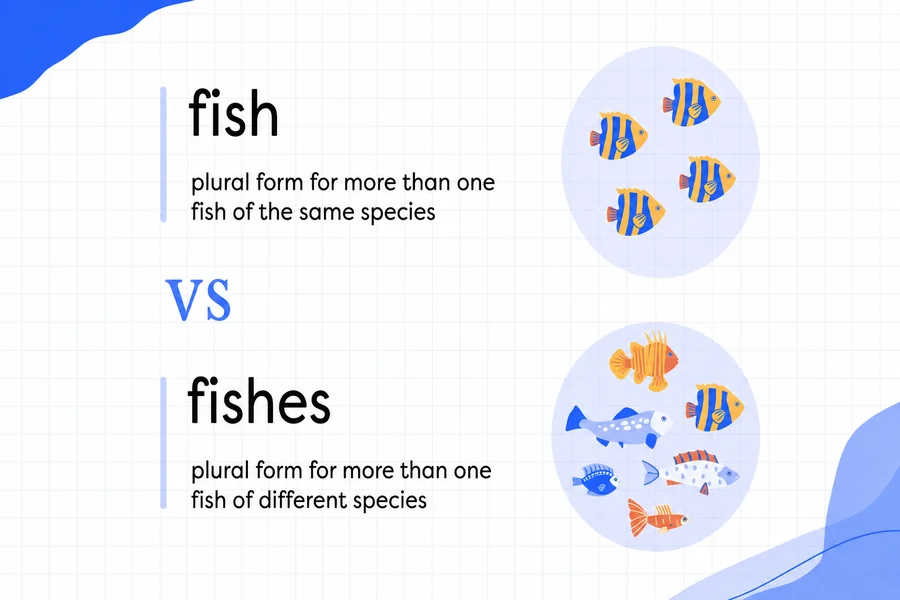
A lot of individuals are misled by the fact that both fish or fishes sound and look correct at first. Each of these words is used in a different context, though. Most of the people would use “fish” when they come across this word, but when it comes to “fishes,” that’s a different meaning.
When we know what the term fish or fishes means, we can prevent errors in writing and speaking. The wrong form can lead to an odd or inaccurate sentence. When you’re discussing your dinner or your marine biology, you need to communicate with clarity, and both words must be correct.
This guide tells the difference between fish or fishes and how each should be used correctly. Examples, common pitfalls, and tips will help you understand the meaning of these words in everyday life, academic writing, and science.
Define Fish
Generally, the word “fish” is used in its plural form in ordinary English. If you are discussing several fish of the same or different species (generally), then you will use “fish”—NOT “fishes.”
If you were fishing at the lake and caught 3 trout, you would say, “I caught 3 fish. There are a lot of times in life when this rule is applicable, in everyday conversation, cooking, fishing, and most general writing. When the number of people involved is important, the form “fish” is used rather than the species.
Define Fishes
The plural form “fishes” is used when talking about several different kinds of fish. It is often used in the contexts of biology, ecology, zoology, and scientific writing, where the distinction between species is important.
For instance, a marine biologist studying salmon, tuna, and cod would state, “These three fish are of three different genera.” The word “fishes” in everyday language sounds strange—but only when it’s used in the correct context. The term “fishes” may also be used as a verb, which means “to go fishing.
How To Properly Use The Words In A Sentence
Always pay attention to the context to use fish or fishes correctly. Use “fish” in normal situations when more than one of the same species are involved, and use fishes when more than one species are involved or use it as a verb—to ensure your sentences communicate your ideas clearly and accurately.
How To Use Fish In A Sentence
You can use fish as a plural noun in just about any day-to-day sentence. It can be used when talking about a whole group of aquatic creatures without mentioning any differences in species.
- She went to the market this morning and purchased 5 fish.
- During the rainy season, there are plenty of fish in the river.
- We spotted a lot of fish swimming near the reef: dozens.
When used correctly, the use of **fish** helps you maintain clear, natural writing. It is used in general in conversations, recipes, travel writing, and news reports.
Rea More: Onsite vs On-Site
How To Use Fishes In A Sentence
“Fishes” does not refer to a particular species but rather to multiple ones or to the word used as a verb. Usually found in scientific, academic, or literary contexts.
- There are more than 3,000 species of fish in the Amazon River.
- Every Sunday morning he fishes near the old bridge.
- The book deals with the freshwater fishes of SE Asia.
When writing about fish species, a precise and correct use of fishes conveys meaning and precision, particularly in scientific texts.
More Examples Of Fish & Fishes Used In Sentences
The difference between fish or fishes can be discerned from examples. “Fish” is used for everyday plural use, and “fishes” is used for multiple kinds of fish or as a verb to help readers grasp the meaning of biologic and/or action-based contexts.
Examples Of Using Fish In A Sentence
- Last night, she prepared 3 fish for dinner.
- The children added food to the fish in the garden pond.
- Too many fish have been removed from the ocean by overfishing.
- Over the weekend we caught some fish.
- Hundreds of tropical fish are kept in the aquarium.
- The cat was sitting by the fish bowl, gazing at the fish.
- Fish are caught each morning before dawn by local fishermen.
- Fresh fish from the harbour is served at the restaurant every day.
- Schools are used for large groups of small fish.
- The film was a documentary about scientists following fish across the Pacific.
Examples Of Using Fishes In A Sentence
- Every Saturday, he goes to the docks to catch some fish.
- Coral reefs have hundreds of types of fish belonging to various families.
- The study was on deep-sea **fishes** below 1000 m.
- Every summer she fishes with her grandfather at the lake.
- The researcher provided three different types of fishes with diet.
- The guide listed all of the fishes found in the Amazon basin that are native to that region.
- Mornings the old man quietly goes to the same rock, **fishes** and returns home.
- More than 200 species of fishes were recorded in the wetland survey by field biologists.
- The textbook contains a list of endangered fishes in North American rivers.
- Each time he shows off his work, he fishes for compliments.
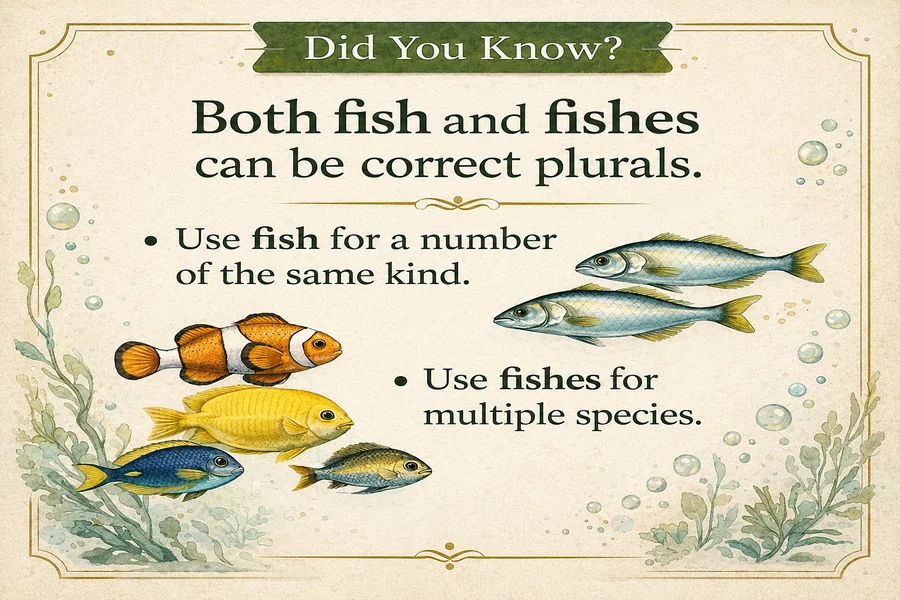
Fish or Fishes: Quick Comparison Table
Comparison Table
| Feature | Fish | Fishes |
| Primary Use | Plural of one or more individual aquatic animals | Plural referring to multiple distinct species |
| Context | Everyday speech, cooking, fishing, general writing | Biology, ecology, zoology, scientific writing |
| Example | “We saw five fish near the boat.” | “The lake has three native fishes: perch, bass, and trout.” |
| Used as Verb? | No | Yes — “She fishes every Sunday.” |
| Common in Science? | Rarely | Frequently |
| Common in Daily Use? | Yes | Less common |
| Species Distinction? | No | Yes |
| Sounds Natural? | Always | In specific technical contexts |
Quick rule: Use fish when you mean many individuals. Use fishes when you mean many species — or when it is a verb.
Common Mistakes To Avoid
Fish or fishes is often mispronounced with fishes when the context calls for fish, or fish when the context calls for fishes, as in scientific writing. Be sure to review the context to make sure that your sentence conveys the correct meaning.
Mistake #1: Using “Fishes” When You Mean “Fish”
One of the more common errors is the use of “fishes” in regular writing or talk. For instance, the plural “fishes” is not the common plural for everyday use and so “I bought some fishes from the grocery store” doesn’t sound natural.
Use fish in ordinary sentences, however, not in phrases. This will help your writing to remain clear, natural and correct to most readers. Use the plural noun fishes for scientific uses or when using as a verb.
100% of the time, read the setting before writing. Fish is used in casual speech/situational context and descriptions, and fishes indicates something biological or based on action. Properly selected words make things easier to understand and avoid misunderstandings.
Read More: 30 Other Ways to Say ‘Keep Up the Good Work’ (Updated 2026)
Mistake #2: Using “Fish” When You Mean “Fishes”
The other frequent error occurs in academic or scientific writing. For instance, the phrase “The study compared three species of fish” is less precise than “The study compared three genera of fish. The more correct word in the sentence would be fishes, since it is referring to different species.
Take into account your audience when deciding between “fish” or “fishes”. If you are discussing the difference between species, rather than individual fish, in a biology paper, textbook or field report use the word fishes.
Tips For Avoiding These Mistakes
Know the difference between fish and fishes in order to avoid any confusion of the two, take the context of the passage into account, and understand their meanings to ensure you use the appropriate form to make clear the individual count or species diversity.
Know the general plural form ‘fish’ for usual plural items that refer to any number of people.
Use fishes for more than one species or as a verb.
– Use a grammar guide/dictionary to write scientific or academic text related to aquatic organisms.
Context Matters
A word in an appropriate context is the right word. Fish is used in the plural form for everyday names, and is always used in the plural, in general writing. Fishes: different species of fish or fishing. You should always use the right word so that you won’t cause any confusion.
Fish
The standard English plural form of fish is fishes. It is used in general with any number of aquatic animals in spoken and written language in recipes, news reports, travel guides etc.
Also, in some instances, the word fish can be singular or plural. For example, in the sentence, “there is a lot of fish in this river”, the word fish is a collective noun.
Some examples of fish in different situations:
When talking about fish the same or similar species, use fish.
- It is used as both a count and mass noun in the standard text.
- Correctly using *fish* makes people understand your writing and makes it sound natural.
Fishes
When the difference between kinds of fishes is important, use fishes rather than fish. It is the preferred plural in biology, ecology, and field guides, and in academic research.
Furthermore, the word “fishes” is used as a third person, singular verb. Sentences such as “He fishes each morning” are grammatically correct and are the type of sentences that are commonly used in everyday writing.
Some examples of fishes used in various circumstances:
- When writing about two or more species in a scientific or research context use the word fishes.
- It also serves as a verb which means “to fish.
- Using ‘fishes’ correctly enhances accuracy and precision in formal and academic writing.
- Knowing about fishes helps to be clear about species diversity or about one’s own actions. Use it correctly, and it will help you to be precise in scientific, personal, or formal writing, rather than the general plural “fish”.
Exceptions To The Rules
The rules for fish or fishes are straightforward but there are some exceptions. For instance, idiomatic expressions and literary uses might include different standards than are used in basic grammar.
Likewise, regional variants and more antiquated forms of English sometimes use fishes, whereas modern English would find it more appropriate to use fish. Knowing these exceptions will make older texts easier to read and understand regional variations in the text.
Fish
English has several idioms which require the use of “fish” without regard to species or count. For example, there are plenty of fish in the sea although it is used to mean many people or varieties. Idioms don’t need to be rewritten with fishes and follow their own internal logic.
If fish is used as an uncountable noun or a collective noun, such as “fish is good for your health”, there is no need to make the noun plural. This usage is as a food, not as a number of animals.
Fishes
Biblical and Literary Use: In religious texts, the word fishes is used to mean loaves and fishes, and is not in keeping with current rules of grammar. The word fish used to be used in old literature as fishes were used in modern literature. Being aware of this will be useful in reading historical and religious texts.
This is because when fishes is used as a verb it follows the same rules as all other verbs, namely subject-verb agreement. The correct use of the third person is the verb use, and there is no need to discuss the plural use of the noun with this.
Read More: 30 Better Ways to Say Thank You for Cooperation (Updated 2026)
People Also Ask
| Question | Short Answer |
| Is the plural of fish fish or fishes? | Both are correct. Use fish for individuals; fishes for multiple species. |
| When do you use fishes instead of fish? | Use fishes in scientific contexts when referring to multiple different species. |
| Is it correct to say two fishes? | No. In everyday English, two fish is the correct form. |
| What does fishes mean in biology? | It refers to multiple distinct species of aquatic life studied scientifically. |
| Can fishes be used as a verb? | Yes. “He fishes every morning” is a correct verb use. |
| What is the difference between fish and fishes? | Fish = multiple individuals. Fishes = multiple species or a verb. |
| Is fishes a real word? | Yes. It is a valid plural and verb used in science and everyday speech. |
| Why do scientists say fishes instead of fish? | Scientists use fishes to distinguish between multiple species in research. |
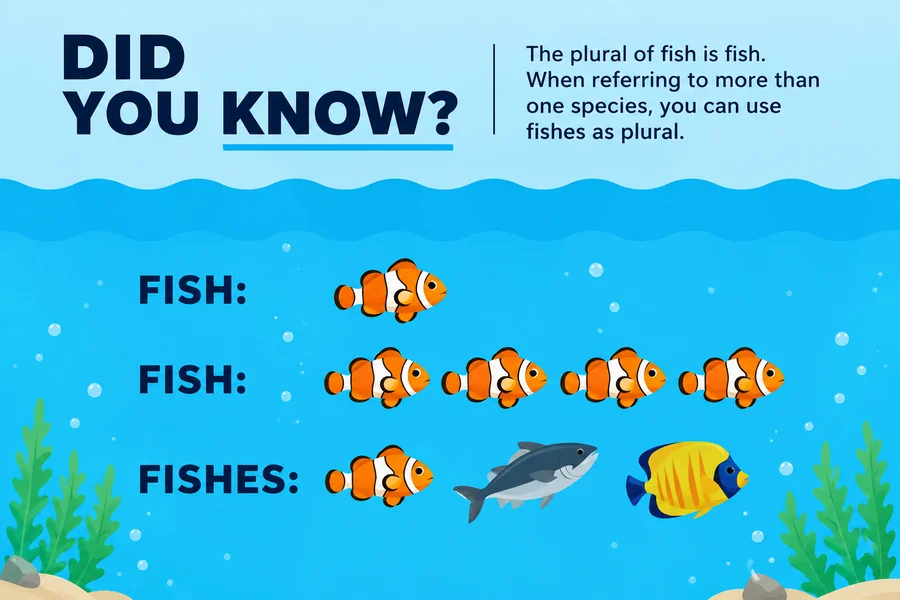
Practice Exercises
Learn to use the word fish or fishes with practice exercises. Fill in the blank, sentence writing, and multiple-choice exercises help reinforce individual count vs. species diversity, which is then applied to correct use in everyday, academic, and professional writing.
Complete the sentences with your own words.Write sentences in your own words.
Use the correct word: fish or fishes to complete the sentence.
1. She caught four __________ at the lake before noon.
The researcher made comparisons of the scales of 3 different __________.
Every Saturday morning he sails near the harbour.
4. The aquarium exhibit had tropical fishes from the Pacific.
The researcher published a paper on deep-sea _________ that occurs below 800m.
**Answer Key:**
1. fish
2. fishes
3. fishes (verb)
4. fish
5. fishes
Exercise 2: Sentence Writing
Write a sentence using each of the following words correctly:
| Word | Example Sentence |
| fish (plural noun) | We spotted five fish near the surface of the pond. |
| fishes (plural noun, scientific) | The river supports four native fishes: trout, bass, perch, and carp. |
| fish (collective) | There is a lot of fish in the northern waters this season. |
| fishes (verb) | She fishes every weekend with her father near the old dock. |
| fish (general) | The market sells fresh fish caught early each morning. |
Read More: In Route or En Route
Exercise 3: Multiple Choice
Select the appropriate word (fish or fishes) for each sentence.
In natural speech, when you use the plural form of a noun for more than one aquatic animal, the plural form of the word is 1. __________
– A) Fishes
– B) Fish
A biologist discussing salmon, tuna and cod as a whole category would use __________.
– A) Fish
– B) Fishes
3. After a long afternoon by the river, she came home with three __________.
– A) Fishes
– B) Fish
4. He gets up very early every morning to go near the pier.
– A) Fish
– B) Fishes
5. All the threatened __________ in the river system were listed in the conservation report.
– A) Fish
– B) Fishes
**Answer Key:**
1. Fish
2. Fishes
3. Fish
4. Fishes
5. Fishes
Final Thoughts
The difference between fish or fishes is critical to good communication. The common plural form is “fish,” as used in a sentence such as “I’m going to go fish” or other uses where more than one individual fish is being used; “fishes” is used in a sentence such as “He fishes for different species of fish” or when multiple species are being used for some other reason.
You can build up your knowledge and use the word correctly by completing the blanks, writing sentences, and doing multiple-choice questions. Remember — context matters. Use fish to count and in general conversation. For species-level discussions or as a verb, use “fishes.” Printing and using it correctly can make it more clear and accurate and can help with communication, whether in writing or speaking.
FAQs:
What is the difference between fish or fishes?
The word “fish” can mean several separate animals or be a verb, and “fishes” means several different species or is a verb.
Fish needs to be used when?
In oral communication, in cooking, on fishing trips, and in general writing, use “fish” to refer to several or many fish of the water without specifying their kind.
When to use “fish” in a sentence?
For two or more fish, write the word in the singular with ‘s’ for more than one; use the word in the singular for scientific or research purposes and when used as a third-person singular verb.For two or more fish, write the word in the singular with ‘s’ for more than one; use the word in the singular for scientific or research purposes and when used as a third-person singular verb.
Can fish be present in non-scientific writing?
Yes. Fish is also found in literature, religious texts, and daily language, such as “He fishes near the pier every morning.”
What is the difference between fish and fishes?
Always check context. Note: “fish” is used for people and everyday, and “fishes” is used for species and verb tenses in sentences.