

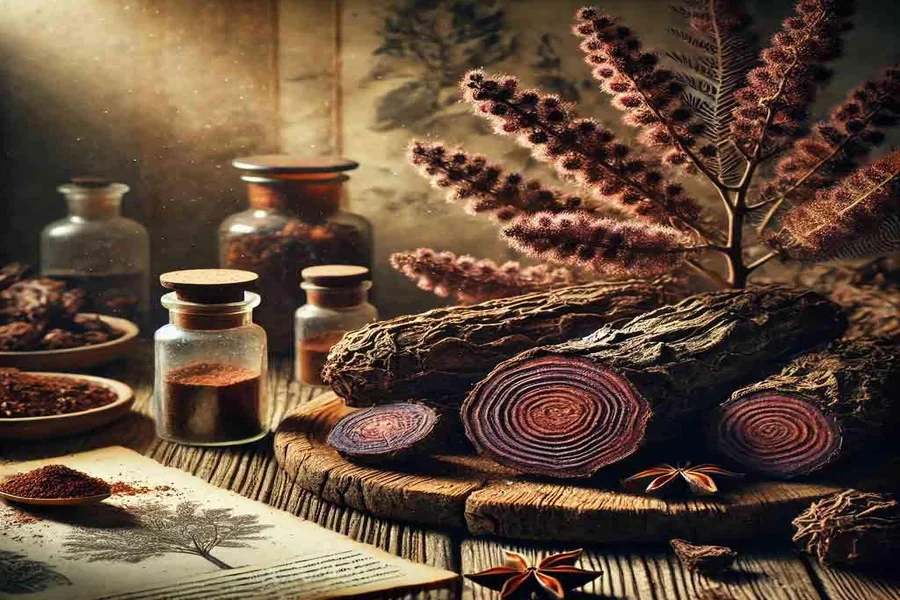
Root bark can appear in several physical forms. Some references describe large pieces, while others mention chips, shredded material, or finely ground powder. These terms can make the same botanical material seem more complicated than it is.
The main difference between these forms is usually their physical size and level of processing. Whole bark keeps much of its original structure. Chips are reduced into smaller sections. Powder is produced when the material is ground into much finer particles.
For Mimosa tenuiflora, terminology can be especially confusing because Mimosa hostilis is an established synonym. Kew currently accepts Mimosa tenuiflora as the species name and lists Mimosa hostilis among its synonyms.
Understanding the differences between these forms can help when reading botanical references, product descriptions, or educational material.
Starting With the Original Bark
Before considering chips or powder, it helps to understand what whole root bark represents.
Root bark is the protective outer material associated with a plant’s roots. It is structurally different from leaves, stems, flowers, and other plant parts.
When dried, the bark can retain its natural shape. Larger pieces may have uneven edges and different thicknesses. Their appearance can also vary depending on the age of the plant, growing conditions, and the section of root from which the bark originated.
This natural variation means whole bark does not necessarily have a perfectly consistent appearance.
The species itself is a woody shrub or tree native to parts of Mexico, Central America, and South America. Kew records its native range from southern Mexico through Venezuela and northeastern Brazil.
What Changes When Bark Becomes Chips?
Chipping is essentially a size reduction step.
Instead of keeping the bark in larger sections, it is broken or cut into smaller pieces. The resulting material is easier to handle than large pieces while still retaining visible sections of bark.
This is where the term MHRB Chips commonly appears. The abbreviation MHRB is generally associated with Mimosa hostilis root bark, while the accepted botanical name is Mimosa tenuiflora.
Chip sizes are not necessarily standardized. One source may use the term for relatively small pieces, while another may use it for larger fragments.
For that reason, the actual dimensions described by a supplier or reference are more informative than the word “chips” alone.
Powder Is Defined Mainly by Particle Size
Powder is different because the original pieces have been reduced much further.
Grinding creates numerous small particles. Instead of seeing recognizable sections of bark, the material takes on a loose, granular or flour-like appearance.
Not every powder has the same consistency. Some may be relatively coarse, while others can be much finer.
Particle size can influence how the material behaves during handling. Fine particles can move differently from larger fragments and may be more affected by humidity and air exposure.
The word “powder” therefore describes a physical form rather than a guarantee about the material’s composition or quality.
A Simple Way to Visualize the Difference
The three common forms can be viewed as stages of physical reduction:
Whole bark → larger pieces → chips → smaller particles → powder
This does not mean every batch follows the exact same sequence. Some material may be cut directly into smaller pieces, while other material may undergo additional grinding.
The important point is that the forms are primarily distinguished by physical structure.
Whole bark allows the original shape to remain visible. Chips provide smaller fragments. Powder removes most of the recognizable structure through grinding.
Why Whole Bark Can Look So Different From Powder
The difference in appearance is more than a matter of size.
A piece of bark can show several natural surfaces. It may contain rough outer areas, smoother sections, and variations in thickness.
Once the material is ground, those visual features become much harder to identify.
Powder can therefore appear more uniform even when it comes from bark that originally contained considerable variation.
This is one reason visual comparison between whole bark and powder should be done carefully. The processing itself changes how the material looks.
Moisture Behaves Differently Across Forms
Moisture is another factor worth considering.
Larger bark pieces have less exposed surface relative to their overall size. Fine particles have considerably more exposed surface.
Because of this, storage conditions can affect different forms in different ways.
Humidity can influence texture, especially when fine plant material is exposed to damp surroundings. Powder can also develop clumps when moisture enters the material.
For general botanical storage, keeping dried plant materials in stable, dry conditions helps preserve their physical characteristics.
Does Finer Mean Better?
Not necessarily.
A common mistake is to assume that a finer form automatically represents a better or more valuable material. Particle size alone does not establish botanical identity, purity, or quality.
A research project may require larger pieces because the physical structure needs to be examined. Another application may require a consistent particle size.
Therefore, the useful form depends on the purpose.
The same principle applies to many other dried plant materials. Leaves, roots, bark, and herbs can all be sold or studied in several physical forms without one form being universally superior.
The Importance of Accurate Botanical Names
Terminology becomes easier to understand when the scientific name is checked.
Mimosa tenuiflora belongs to the Fabaceae family and the genus Mimosa. Kew lists Mimosa hostilis Benth. as a heterotypic synonym of the accepted species name.
This explains why older publications and modern sources can use different names for the same plant.
Searching both names can be useful when researching historical literature. However, it is important to distinguish the accepted scientific name from commercial terminology.
Common abbreviations such as MHRB are convenient, but they do not replace proper botanical identification.
How Online Listings Can Create Confusion
Websites sometimes use different descriptions for similar materials.
For example, a page such as mimosahostilis.shop may use commercial terminology that is not identical to the language found in botanical databases.
This does not necessarily mean that one description is incorrect. Commercial descriptions often focus on physical form, while scientific sources focus on taxonomy and plant characteristics.
Readers should therefore look at the details behind a label.
If a description says “chips,” check whether it explains approximate particle size. If it says “powder,” check whether it distinguishes coarse material from finely ground material.
This approach gives a clearer picture than relying on a product name alone.
What Can Affect the Final Appearance?
Several factors can influence how dried root bark looks after processing.
Plant Material
The original roots can differ in thickness, age, and natural coloration. These differences can remain visible after drying.
Drying Conditions
Changes in moisture can affect the texture and appearance of plant material.
Cutting or Breaking
The size of the pieces depends on how the bark is physically reduced.
Grinding
Grinding determines how much of the original structure remains visible.
Screening
Separating particles by size can create a more consistent final texture.
Because several factors are involved, two samples described using the same general term may still look somewhat different.
Comparing the Three Main Forms
| Form | Structure | Appearance | Processing |
| Whole bark | Mostly intact | Large natural pieces | Minimal |
| Chips | Partly reduced | Irregular smaller pieces | Moderate |
| Powder | Highly reduced | Fine particles | Extensive |
This comparison focuses only on physical characteristics. It does not establish quality, chemical composition, safety, or suitability for any particular purpose.
Why Terminology Matters for Research
Clear terminology can prevent mistakes when comparing sources.
Suppose one article discusses whole root bark while another discusses powdered material. The two sources may appear to describe different substances when they are actually discussing different physical forms of related plant material.
The same issue occurs when older literature uses Mimosa hostilis and newer botanical databases use Mimosa tenuiflora.
Using both the scientific name and physical form during research can make information easier to organize.
For example, terms such as “whole root bark,” “root bark chips,” and “ground root bark” provide more detail than simply searching for “MHRB.”
Safety and Legal Considerations
Plant material should not be assumed to have the same legal status in every country or jurisdiction. Laws can depend on the plant, its constituents, intended use, and the way the material is prepared.
Commercial terminology does not determine legal status.
Anyone researching or handling botanical materials should check the rules that apply to their location and intended activity. Scientific databases can help with botanical identification, while government sources are more appropriate for current legal requirements.
Frequently Asked Questions
What is whole root bark?
It is root bark that remains in relatively large pieces rather than being extensively ground.
What does MHRB Chips mean?
The phrase generally refers to chipped root bark associated with Mimosa hostilis, an established synonym of Mimosa tenuiflora.
Are chips the same as powder?
No. Chips consist of larger pieces, while powder contains much smaller particles.
Does all root bark powder have the same texture?
No. Powder can range from relatively coarse to very fine.
Why does root bark have different shades?
Natural plant variation, drying conditions, and processing can all affect appearance.
Is Mimosa hostilis still the scientific name?
Kew currently accepts Mimosa tenuiflora and lists Mimosa hostilis as a synonym.
Does particle size prove quality?
No. Particle size mainly describes the physical form of the material.
Conclusion
Whole bark, chips, and powder are different physical presentations of root bark. The main distinction comes from how much the original material has been reduced.
Whole pieces preserve more of the bark’s natural structure. Chips create manageable fragments while retaining recognizable pieces. Powder takes the process further by producing much smaller particles.
Understanding these differences makes botanical research and online terminology easier to navigate. It also prevents assumptions that a particular form automatically represents better quality.
For Mimosa tenuiflora, the naming issue adds another layer of complexity because Mimosa hostilis remains a widely used synonym. Checking reliable botanical references can help connect the different terms and provide a clearer understanding of the plant.