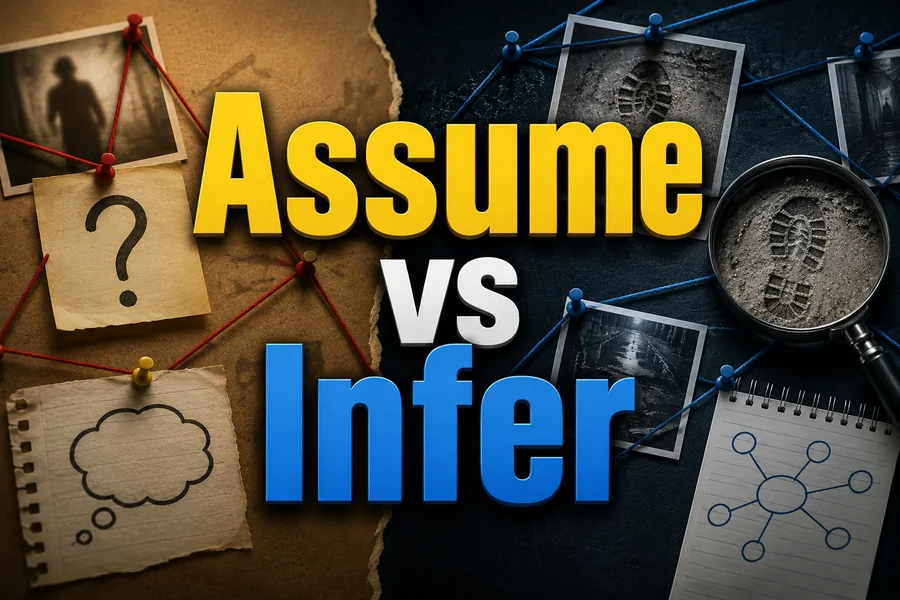
Some people mix up assume vs infer, since they both involve making assumptions. But the meanings of these two words are very different. To presume: To take something for granted without verifying. “Infer” means to draw a conclusion based on the information (evidence or reasoning) given.
Knowing the difference between assume vs infer will help you to write and talk more accurately. The wrong word will have a different meaning. Understanding both terms allows you to get your message across clearly, both in writing and in conversation — and in a professional environment.
This lesson will look at the difference between assume vs infer and exactly how to use each word. Definitions, real-life examples, common mistakes, and practice exercises will assist you in using assume vs infer with confidence.
Define assume
Assume: To take for granted something without proof or evidence. When you assume, you are assuming that something is true before confirming if it is. This occurs in everyday thought, in speech, and in decisions without people being aware of doing it.
You may think that a meeting was canceled because your co-worker wasn’t there, for instance, without being told. Assuming something is working with an unverified premise, as in professional writing, academic settings, and logic. “Assume” means to take the place of what one does not know with a guess, an expectation, or a belief. The assumptions are different from inference: If you assume something, you don’t have to think through any evidence first.
Define Infer
Infer: Make an assumption based on evidence, reasoning, or logical observation. “Infer” means to closely observe what you see and to make a logical guess. You are not taking a blind guess; you are using information that you have.
For instance, if you see your colleague with a packed lunch, you may assume that they will not be going out today. The answer is based on the reading of a clue. When a conclusion is drawn from what an observer has seen, heard, or read, the word “infer” is used. Inferring is a thinking process based on the facts given and is different from assuming. The difference between assume vs infer helps you to keep your reasoning and writing clear and honest.
How To Properly Use The Words In A Sentence
When using assume vs infer, it is important to always check the type of conclusion involved. Assume (when no evidence exists) Infer is determined by evidence and/or reasoning to draw a conclusion. The separation between these distinctions is the key to the accurate communication of ideas in sentences.
How To Use “Assume” In A Sentence
Use “assume” when someone accepts something as true without confirming it first. It shows a belief or expectation held without proof. This word fits situations where a person takes something for granted.
- She assumed the project deadline had not changed.
- He assumed everyone had already read the report.
- They assumed the client approved the budget without checking.
Using “assume” correctly signals a gap between belief and confirmed fact. It adds important nuance to your writing, especially when pointing out errors in thinking or communication.
How To Use “Infer” in a Sentence
Use “infer” when a conclusion is drawn from clues, facts, or evidence. It shows active reasoning rather than a simple guess. This word fits situations where someone works through available information to reach a logical conclusion.
- From his tone, she inferred that he was not happy with the results.
- The detective inferred the suspect had left in a hurry.
- Readers can infer the character’s motivation from her actions.
Using “infer” correctly shows that a conclusion is grounded in observation or logic. It signals thoughtful reasoning and is common in academic writing, legal arguments, literary analysis, and professional communication.
Assume vs Infer: Comparison Table With Examples
Quick Reference: Assume vs Infer—Key Differences at a Glance
| Feature | Assume | Infer |
| Core Meaning | Accept as true without proof | Conclude based on evidence or reasoning |
| Requires Evidence? | No | Yes |
| Type of Thinking | Passive / presumptive | Active / analytical |
| Who Does It? | Anyone — often unconsciously | A thinker working through clues |
| Common Contexts | Everyday thinking, planning, assumptions | Logic, analysis, law, literature |
| Part of Speech | Verb (also: assumption) | Verb (also: inference) |
| Example Sentence | He assumed the meeting was at noon. | She inferred the meeting had moved from the empty room. |
| Risk of Error | High — no evidence backing the belief | Lower—grounded in observable facts |
| Tone in Writing | Shows unchecked belief | Shows reasoned conclusion |
| LSI / Related Words | Presume, suppose, guess, take for granted | Deduce, conclude, reason, gather |
Real-World Example Comparison:
Assume: “I assumed she was angry because she did not reply.” (No direct evidence — just a guess.)
Infer: “From her short replies and long pauses, I inferred she was upset.” (Evidence — her behavior — drives the conclusion.)
This is the heart of the assume vs infer debate. One word fills a gap with belief. The other fills a gap with logic.
Read More: Savy or Savvy
More Examples Of Assume vs Infer Used In Sentences
You can clearly see the difference between assume vs infer through side-by-side examples. “Assume” shows an unverified belief or expectation. Infer shows a conclusion built from real evidence. Both words matter — using the right one sharpens your communication.
Examples Of Using “Assume” in a Sentence
- She assumed her coworker had submitted the report on time.
- He assumed the new policy applied to everyone in the department.
- The manager assumed the team understood the new procedure.
- They assumed the flight would be on schedule without checking the app.
- He assumed she was joking — she was not.
- The teacher assumed all students had completed the reading.
- I assumed the restaurant would still be open at 10 PM.
- She assumed silence meant agreement during the meeting.
- The engineer assumed the numbers in the spreadsheet were correct.
- He assumed the deal was final before the contract was even drafted.
Examples Of Using “Infer” in a Sentence
- From the data, analysts inferred that sales had dropped in the third quarter.
- She inferred from his hesitation that he disagreed with the plan.
- The jury inferred intent from the defendant’s prior behavior.
- Students can infer the author’s viewpoint from word choice alone.
- He inferred the package had arrived from the notification on his phone.
- The doctor inferred the patient had not been sleeping well based on symptoms.
- From the empty chair and cold coffee, she inferred he had left hours ago.
- The scientist inferred a connection between the two variables after analyzing the results.
- You can infer a lot from someone’s body language during a negotiation.
- She inferred the project was behind schedule from the team’s stressed expressions.
People Also Ask
Short answers optimized for Google’s People Also Ask boxes.
| Question | Short Answer |
| What is the difference between assume vs infer? | “Assume” means accepting something without proof. “Infer” means concluding from available evidence or reasoning. |
| Can you assume and infer at the same time? | Yes. You may assume something and later infer a different conclusion once evidence appears. |
| Is infer the same as conclude? | Nearly. Infer suggests drawing a conclusion from clues. A conclusion is the final result of reasoning. |
| Is “assume” a formal word? | Yes, “assume” is used in formal and informal contexts to mean accepting something as fact without proof. |
| When should you use infer instead of assume? | Use “infer” when evidence or observable facts lead to your conclusion, not just belief or habit. |
| What is an inference in writing? | An inference is a conclusion a reader draws from textual clues, not from what is directly stated. |
| Does “assume” have a negative meaning? | Sometimes. An assumption can imply overconfidence or careless thinking when no evidence supports the belief. |
| What is the noun form of infer? | The noun form of “infer” is “inference”—the conclusion drawn through reasoning from evidence. |
Common Mistakes To Avoid
“Assume” and “infer” are often confused; one person may assume and the other may infer or vice versa. Make sure you always understand if a conclusion is on evidence or belief. This will help you to ensure your writing is clear and your reasoning is also sound.
Mistake #1: Using “Assume” When You Mean “Infer”
One of the typical mistakes is writing down “assume” when you really mean “infer.” For instance, “I assumed from the data that the sales are decreasing” is wrong. The data provided you with evidence. That means you deduced it; you didn’t simply guess.
OES, however, infers when your conclusion is based on observable facts, clues, or data. This way, your sentence will convey thoughtfulness rather than a wild guess. It’s a simple thing that makes a big difference in the way your writing flows—for your academic and professional writing, at least.
Questions to ask yourself: “Do I have evidence for this? If yes, you infer it. When you make an estimation, make an assumption. That one question will save you from making that most common mistake in the assume vs infer debate.
Mistake #2: Using “Infer” When You Mean “Assume”
Aside from that, it is a second error to use “infer” where the context would rather imply “assume.” For example, although it can be inferred that the meeting was at 12pm, this is not actually correct. No evidence was involved, only a blind faith. This is an assumption and not an inference.
In sentences, use “assume” when someone takes it for granted that a belief or expectation is true. This is to show that the conclusion is not supported by evidence. The care taken in the way you’ve used words here will reveal to your reader the quality of your thinking.
Tips For Avoiding These Mistakes
To avoid confusing assume vs infer, build a simple habit: check the source of the conclusion before you write.
- Ask whether evidence is present. “Evidence” means “inference.” No evidence means assumption.
- Remember: assumption comes before investigation. Infer comes after it.
- When editing, replace every “assume” with “accept without proof” and every “infer” with “conclude from evidence”—if it still makes sense, the word choice is correct.
Context Matters
Choosing the right word between assume vs infer depends entirely on context. Assume fits situations where someone acts on an unchecked belief. Infer fits situations where reasoning or observation drives a conclusion. The right word shapes how readers understand your thinking.
Assume
Assumptions appear when someone takes something for granted without checking. This is common in planning, workplace communication, and everyday thinking. It often signals where misunderstandings begin.
Additionally, assume it can carry a neutral or slightly negative tone. It is not always careless — sometimes it is simply practical. But in logic and academic writing, assuming something without evidence is seen as a weakness in reasoning.
Examples of “assume” in various situations:
- Assume it reflects unchecked belief in personal and professional decisions.
- It can indicate an expectation held without confirming the facts first.
- Using “assume” correctly shows where a reasoning gap exists in an argument.
Infer
Inference appears when someone reaches a conclusion through active reasoning. It is the foundation of critical thinking, literary analysis, scientific reasoning, and legal argument. When you infer, you are doing the hard work of connecting dots.
Moreover, inference can operate on subtle or indirect evidence. A reader infers a theme from a story. A scientist infers a relationship from data. A detective infers a motive from behavior. The word fits anywhere logic and observation meet.
Examples of inferring in different scenarios:
- Infer shows a conclusion built from observation in academic or professional writing.
- It can follow from indirect evidence — body language, data, tone, or context.
- Proper use of inference marks rigorous, evidence-based thinking in any field.
Understanding the distinction ensures clarity when describing how conclusions are formed. The correct use of assume vs infer distinguishes careless guessing from careful reasoning—and that difference matters everywhere from classrooms to courtrooms.
Exceptions To The Rules
While the rules around assume vs infer are clear, some exceptions exist in specific professional and academic fields. Words can shift in meaning depending on discipline and formality. Knowing the exceptions prevents confusion in specialized writing.
Similarly, certain philosophical and scientific uses of both words push against their everyday meanings. Understanding these edge cases helps you assume and infer correctly even in complex or technical situations.
Assume Exceptions
- Scientific Assumption: In science and mathematics, “assume” is used as a formal term to introduce a premise in an argument or proof. “Assume X is true” does not mean careless guessing—it is a controlled starting condition for a logical process.
- Legal Assumption: In legal writing, courts may assume jurisdiction or assume facts not in evidence for the purpose of argument. This specialized use is different from careless everyday assuming, and it carries precise procedural meaning.
Infer Exceptions
“Infer” sometimes gets used loosely in casual speech as a near-synonym for “imply”—but this is technically incorrect. Only speakers or writers imply. Listeners or readers infer. Knowing this distinction adds another layer of precision.
- Statistical Inference: In statistics, inference moves from sample data to broader population conclusions. This is a formal, disciplined version of the word—not guesswork, but structured reasoning under mathematical rules.
- Legal Inference: Courts draw inferences from circumstantial evidence. A jury can infer guilt or innocence from facts presented, even without direct eyewitness testimony. This use of inference carries enormous practical weight.
Recognizing these exceptions ensures you use assume vs infer correctly even in technical, legal, or scientific contexts. The core logic stays the same: an assumption has no evidence, and an inference follows from it. The applications simply expand in specialized fields.
Practice Exercises
Practice exercises help you master assume vs infer. By completing fill-in-the-blank, sentence writing, and multiple-choice activities, you strengthen your understanding of both words and improve correct usage across personal, professional, and academic writing.
Exercise 1: Fill In The Blank
Fill in the blanks with the correct word: assume or infer.
- Without reading the email, she __________ that the meeting had been postponed.
- From the candidate’s nervous tone, the panel __________ that he was unprepared.
- He __________ that everyone in the group knew the agenda in advance.
- Based on the fingerprint evidence, investigators __________ the suspect was present.
- The students __________ the test had been canceled because no teacher arrived.
Answer Key:
- assumed
- inferred
- assumed
- inferred
- assumed
Exercise 2: Sentence Writing
Write a sentence using each word correctly:
| Word | Example Sentence |
| assume | She assumed the deadline was Friday without confirming with her manager. |
| infer | He inferred from the quiet office that something serious had happened. |
| assume | The team assumed the client had approved the revised proposal. |
| infer | The reader can infer the narrator’s loneliness from the repeated descriptions of empty rooms. |
| assume | He assumed the instructions were the same as last time. |
Exercise 3: Multiple Choice
Choose the correct word (assume or infer) for each sentence.
- __________ means reaching a conclusion from evidence without being told directly.
- A) Assume
- B) Infer ✓
- She had no information, yet she __________ that the report was accurate.
- A) Assumed ✓
- B) Inferred
- From the broken lock, police __________ that someone had forced entry.
- A) Assumed
- B) Inferred ✓
- When no facts are checked, a person tends to __________ rather than investigate.
- A) Assume ✓
- B) Infer
- Students should __________ the theme of a poem from its imagery and word choice.
- A) Assume
- B) Infer ✓
Answer Key: 1-B, 2-A, 3-B, 4-A, 5-B
Read More Articles: Himself vs Hisself
Conclusion
Clear and accurate communication requires an understanding of the difference between assume vs infer. Assume = to believe without evidence. “Infer” means to make an assumption based on the evidence and reasoning. There’s no such thing as a wrong word when it’s used in the wrong place—and can defeat the logic of an entire argument.
Correctly assume and infer every time using examples, exercises, and real-world contexts. Always keep in mind the main tenet: look for proof. If there is no evidence, then assume. “Evidence” means “inference.” Correctly using assume versus infer can enhance your writing, bolster your thinking, and ensure your communication is clear and on point, no matter your context.
FAQs
What is the difference between assume vs infer?
“Assume” means accepting something as true without proof. “Infer” means reaching a conclusion based on evidence or logical reasoning.
When should I use assume in a sentence?
Use “assume” when someone accepts a belief or expectation as true without first checking the facts or gathering any evidence.
When should I use infer in a sentence?
Use “infer” when a conclusion is drawn from observable facts, data, clues, or logical reasoning rather than from a simple guess.
Can assume vs infer mean the same thing?
No. Assume it involves no evidence. Inference requires evidence. These two words describe different mental processes and should not be used interchangeably.
How can I avoid confusing assume vs infer?
Ask yourself: “Do I have evidence for this conclusion?” If yes, use infer. If you are taking something for granted without checking, use assume. Practice with examples to build the habit.

Hi, I’m Emily Grace, a blogger with over 4 years of experience in sharing thoughts about blessings, prayers, and mindful living. I love writing words that inspire peace, faith, and positivity in everyday life.