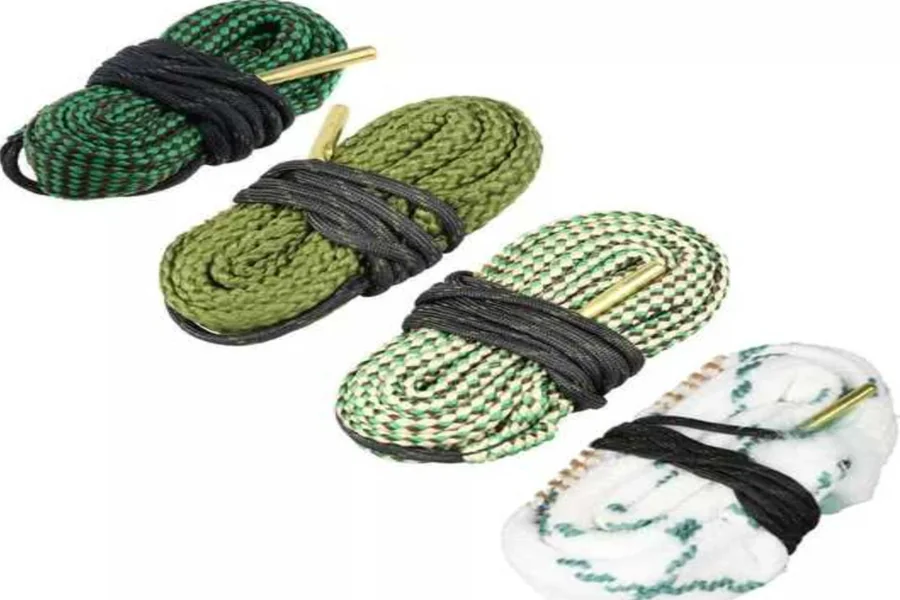
The owner of a single carbine rarely stops to think that the cleaning kit of the next shooter on the line might look completely different. Shotguns, pistols, revolvers and rifles are built differently, which means fouling builds up in them in different ways. The differences come down to bore diameter, barrel length, the threading on attachments and even bristle material. There is no one-size-fits-all tool, only kits put together for specific firearms and calibers.
Why Does Bore Diameter Shape the Whole Kit
The main difference starts with diameter. In a .22 rifle the attachment is thinner than a pencil, while in a 12 gauge shotgun it is nearly as wide as the neck of a bottle. The range of sizes makes this obvious: bore mops come in ten sizes from .17 to 12 GA, and each one fits only its own bore. The wrong size either rattles around or gets stuck, which is why a single set for every gun in the safe almost never works.
What Does a Rifle Need
A rifle barrel is long, and the rifling collects copper from bullet jackets after every range session. It calls for a full-length cleaning rod, a bronze bore brush, a jag with patches and cotton bore mops for solvent and final drying. Most attachments use an 8-32 thread, while the .17 uses 5-40. The crown is the most sensitive part of a rifle, so the rod goes in from the chamber end. For precision rifles, many shooters add a bore guide that centers the rod in the chamber.
Which Tools Suit Pistols and Revolvers
A short barrel doesn’t need a long rod: 8 inch flexible cables are made for pistols and 12 inch cables for revolvers. On a pistol, most fouling builds up on the slide rails and in the chamber, while on a revolver it collects in the cylinder chambers, on the cylinder face and around the forcing cone. Gun cleaning mops in .357/9mm, .40 and .45 cover most models chambered for these popular rounds. Nylon brushes are used on polymer frames. Handgun attachments are usually shorter than rifle ones, since the working stroke in a short barrel is small.
Why Do Shotguns Need Separate Tools
A 12 or 20 gauge smoothbore is wide, and patches have to be folded in several layers. The main fouling here is plastic wad residue and lead. A cleaning bore mop of this diameter fills the bore completely and spreads solvent evenly. Shotgun attachments use a 5/16-27 thread, so they go onto a rifle rod through an adapter, and a 36 inch cable handles full-length passes on longer barrels. Screw-in chokes are removed and cleaned separately, since carbon builds up under their threads and makes them hard to remove over time.
Which Designs Call for a Special Approach
Even within one type of firearm there are exceptions. Some designs block a rod from going in at the breech, or they trap fouling in hard-to-reach spots. Three kinds of firearms account for most of them:
- lever-action rifles and semi-auto shotguns, where a flexible cable replaces the rod;
- the AR-15 platform, which needs a separate brush for the chamber and locking lug area;
- revolvers, whose cylinder chambers get a separate pass one by one.
For these models, the kit gets one or two specialized items. The rest of the tools stay the same, and only the way of reaching the fouling changes. The owner’s manual usually states clearly which end the gun may be cleaned from.
A mixed safe is maintained not with one kit but with a combination of attachments for each barrel. Once the calibers and firearm types are written down, the list of tools takes only a few minutes to put together.