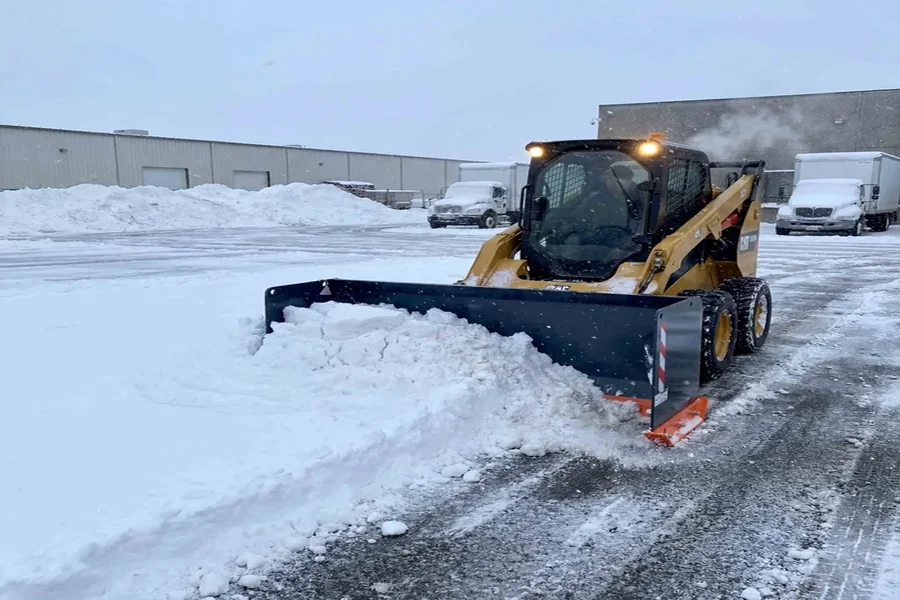
Commercial lots across the northern states get cleared by machines that treat snow as a volume to be relocated rather than a layer to be scraped. That is the distinction between a pusher and a blade, and on a five hundred stall lot it is the difference between three hours and six.
A 5 ft skid steer snow pusher works by carrying snow forward inside a box rather than casting it to one side. The box only does that if the cutting edge keeps full contact across its width.
Box Against Blade on Open Pavement
Why a Blade Loses Here
A blade angled to one side sheds snow continuously along its length, which suits long driveways where the snow can go onto a verge. On a parking lot there is no verge, and every pass that sheds sideways puts snow where the next pass has to collect it again.
What the Box Does Instead
A snow pusher confines the load between two side panels and carries it to the dump point in one movement. Nothing escapes sideways, so one pass across a lot deposits the entire windrow at the pile rather than spreading it along the route.
The Tradeoff Is Honest
A blade stalls gracefully by spilling, while a box simply loads up until the machine loses traction entirely. Matching box width to machine weight therefore matters more here than it does with a blade, and oversizing the box is the common and expensive error.
The Cutting Edge Is the Economics
Full-Width Wear
On a snow pusher running flat against pavement the edge wears across its whole length rather than at one corner. A bolted steel cutting edge can be reversed once and then replaced for a fraction of the cost of a new box, which is why it is the consumable here.
Material Follows the Surface
Steel cuts hardpack and ice, and it will also mark sealed asphalt and catch at expansion joints. Rubber and polyurethane protect the surface and wear faster, so contractors with mixed routes often keep one machine set up each way rather than compromising.
Wear Pattern Tells You Something
An edge worn heavily at one end means the machine is consistently carrying weight to that side, and that usually traces back to an uneven mount rather than to operator habit. Correcting the mount costs considerably less than buying another edge every season.
A worn or uneven edge is also what starts leaving a strip behind, and crews often respond by adding passes rather than checking it. Measuring edge thickness at both ends takes a minute and explains most complaints about a pusher that used to work.
Side Panels, Shoes and Trip Edges
Taller side panels hold more snow and make the box harder to see past, which matters on a machine where the operator is already looking over an attachment. Panel height and shoe setting therefore get decided together rather than separately.
Three settings decide whether it scrapes or drags:
- Panel shoes carrying the box just clear of the surface
- Shoes checked on flat ground rather than guessed
- Trip edge free to release on impact
A box plow fitted with a trip edge behaves differently again, because the lower edge releases on impact rather than stopping the machine. That is what protects the mount when the box finds a manhole rim under fresh snow, and without it the whole load path goes into the loader arms.
Working Near Curbs and Fixed Objects
Everything Is Buried
Curbs, drains, wheel stops and frost-heaved joints all disappear under snow, and a box moving at speed into a fixed obstruction transfers the entire momentum of the machine into the frame and the operator. A snow pusher has no give in it at all.
Walk the Site First
Marking fixed hazards with stakes that stand above expected snow depth costs almost nothing and lets a route be run at a sensible speed afterward. Doing it before the first storm rather than after is the whole point.
Reversing Is the Other Risk
A loader reversing to the pile repeatedly, in the dark, with a wide attachment out front, has every classic condition for a struck-pedestrian incident. Lighting and a working reverse alarm are not decoration on this equipment, and both get checked at the start of a route rather than after one.
Where Pusher Design Is Going
The direction is toward sectional edges that follow uneven pavement independently, which recovers the clean scrape a rigid box loses on a crowned lot. Steel-on-rubber hybrid edges and pullback plates that let one attachment both push and back-drag are spreading from municipal fleets into commercial work.
For a contractor the useful comparison is lot area cleared per hour rather than width. TMG Industrial lists box width, edge type and recommended carrier weight together, which decides whether a pusher will load a machine correctly or stall it.