

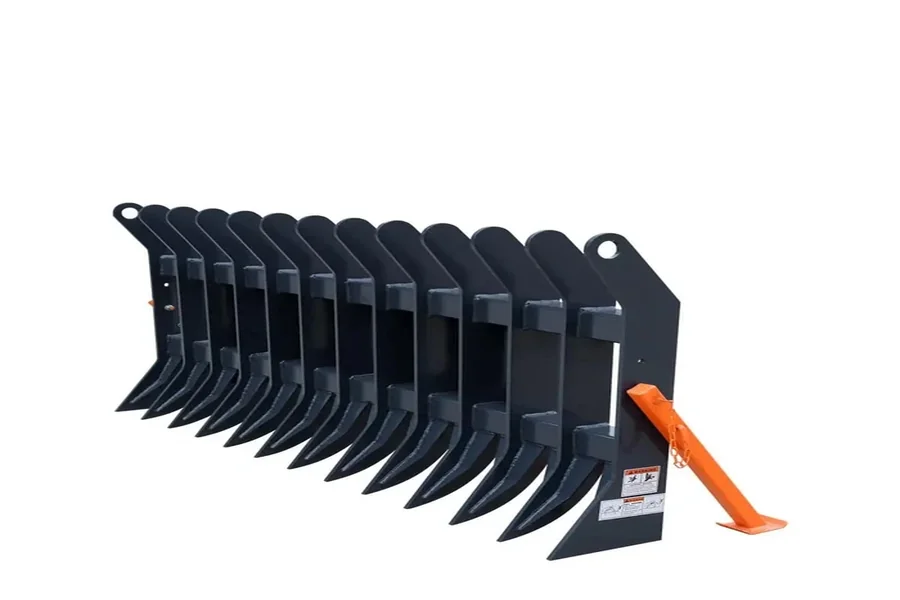
Clearing a paddock after a storm, or preparing ground that has been under scrub, produces a mixture that a bucket handles badly. Soil, roots, stone and broken timber all come up together, and a bucket carries the lot to the heap including the topsoil that should have stayed where it was.
A skid steer root debris rake solves that by letting the fines fall straight through. The tines carry the oversize material and leave the soil where it was, which is the difference between clearing a paddock and stripping it.
Tine Spacing Is the Whole Tool
What It Keeps and What It Drops
Tine spacing on a rock rake sets what the attachment keeps and what it drops. Wide spacing lets small stone and clods pass and collects only the large pieces, while narrow spacing holds more and begins to behave like a bucket.
Spacing Follows the Material
Rock picking on a paddock destined for cropping wants closer tines, because the stones that damage implements are small. Root raking after clearing wants wider tines, because the target is timber and the soil stays put.
Section Keeps the Spacing True
A tine that bends under a root shifts its gap permanently, and a rake with bent tines sorts unpredictably after that. Thicker sections at the root of each tine, and a reinforcing bar across the back, prevent it.
Replaceable Rather Than Welded
Tines are the consumable in this attachment. A rake whose tines cannot be replaced individually turns every lost tine into a workshop job with a cutting disc and a welder, which on stony ground happens more than once a season.
Depth, Flotation and the Carrier
The Operator Sets the Depth
Rock rake working depth comes from how the operator carries the attachment rather than from a control. Run too deep it digs and fills with soil, run too shallow it rides over the material it should be collecting, and the useful setting is just into the surface.
Flotation Changes Everything
A tracked machine spreads its weight and lets the rake skim, while a wheeled machine on soft ground sinks and pulls the rake deeper than intended. The same attachment behaves differently on the two carriers on a wet paddock.
Skids Hold the Setting
Depth skids at each end hold the setting while the operator concentrates on the pile ahead. Without them the rake wanders between digging and skimming across a single pass, which is exactly how a paddock ends up with its topsoil sitting in the windrow.
Two Ways to Work It
Windrowing and collecting suit different jobs entirely.
The choice depends on the area being cleared more than on the material in it, and on whether a second machine is available to follow the rake down the paddock picking up what it has gathered into rows.
The trade comes down to this:
- Windrowing suits large areas with a loader following
- It keeps the rake moving continuously
- Collecting suits small areas or a bin on site
- Collecting is slower per cubic metre and avoids a second pass
A landscape rake used for levelling works the opposite way again, spreading and grading rather than gathering, and the tine geometry reflects that. Owners wanting both jobs from one attachment are usually disappointed in one of them.
The material left behind is the point of the exercise. A paddock raked properly keeps its topsoil and loses its stone, and over a season that difference shows up in pasture rather than in the heap. A soil conditioner run afterwards finishes the surface.
Working Around Buried Obstructions
A Tine Catching Something Immovable
A buried stump, a rock shelf or an old fence post stops the attachment dead and transfers the machine’s momentum into the loader arms and through them into the operator. At working speed that is a sudden stop rather than a gradual one, and it is how arms get bent.
Walk New Ground First
Marking known obstructions, and raking at a speed that allows a reaction, are both unremarkable precautions and both routinely skipped on ground the operator believes they already know. Familiarity is exactly what makes this hazard a recurring one rather than a rare one.
Thrown Material Is the Second Risk
A rock rake tine releasing a trapped stone launches it in an unpredictable direction and at real speed. Bystanders and vehicles belong well clear rather than at the edge of the work, which is harder to enforce than it sounds on a family property.
Where Land Clearing Attachments Are Going
Hydraulic grapple tops that clamp the load onto the tines have moved from forestry equipment into general-purpose rakes, which largely removes the spillage that makes collecting slow. Replaceable bolt-on tines have become standard rather than a premium feature.
For an operator the useful comparison is tine spacing and tine section rather than overall width. TMG Industrial lists working width, tine spacing and mounting standard together, which allows an attachment to be matched to the material and the carrier already on the property.


