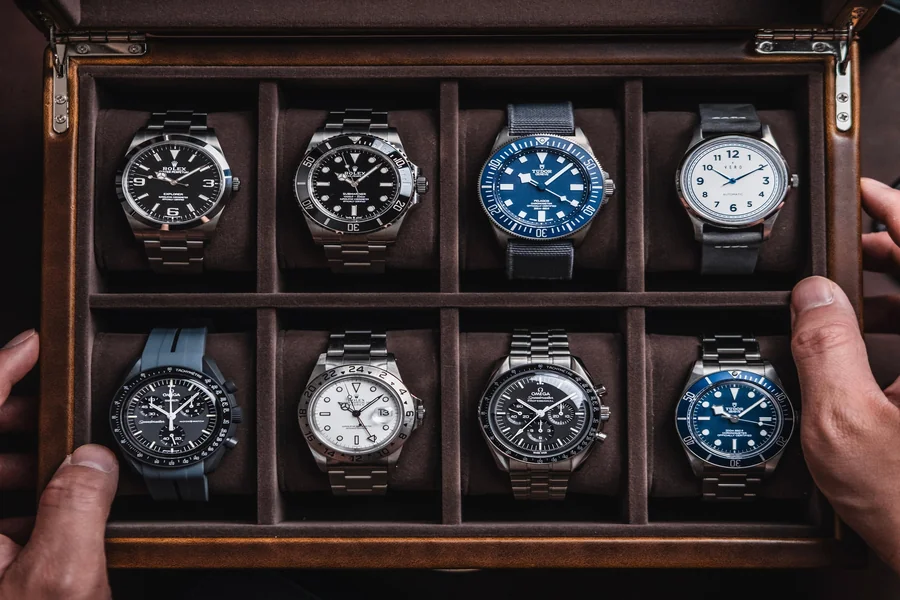
Most watch collections begin by accident. One watch is bought for a milestone, a second because it was available, a third because a friend had one, and by the fourth the owner is calling it a collection without ever having decided what it was for. There is nothing wrong with that path, but it tends to produce a drawer of similar watches, a few regrets, and a nagging sense that the money could have gone further.
Experienced collectors think differently. They treat the first five watches as roles to fill rather than objects to acquire, and they fill those roles in an order that lets each purchase teach something about the next. The result is a collection where every watch has a reason to exist, gets worn, and holds its value better than a set of impulse buys ever could. This is how that thinking works.
Roles, Not Brands
The foundational shift is to stop asking which brand to buy and start asking what job the watch will do. A serious collection of five covers five distinct situations, and the brands and references that fill them can vary enormously by taste and budget. The roles are more stable than the names.
- The daily. A robust, versatile watch that goes on the wrist most mornings without a second thought. Usually steel, usually water-resistant, usually with a bracelet.
- The dress watch. Thin, understated, on a leather strap, worn with a suit or for formal occasions where a sports watch would be wrong.
- The complication. A watch bought for the mechanism: a chronograph, a perpetual calendar, a travel-time function, a moon phase. The one that rewards looking at the dial.
- The statement. The watch that expresses the owner’s taste unapologetically, whether that is an integrated-bracelet sports icon, an avant-garde case in exotic materials, or a piece from an independent maker.
- The personal piece. A watch chosen for meaning rather than logic: a vintage reference from a birth year, a model a parent wore, a design the owner simply loves. The collection’s anchor.
A collector who fills these five roles will own five watches that never compete with one another for wrist time, which is the practical test of whether a collection is well built.
The Order Matters
The sequence in which the roles are filled affects both enjoyment and cost, because each watch teaches the collector something about their own preferences that shapes the next choice.
Start with the daily
The daily is bought first because it gets worn most and because it reveals the most. Case size, bracelet comfort, dial legibility, and how the watch looks under a cuff all become clear after months of wear, and those lessons apply to everything that follows. A collector who discovers that forty-one millimeters is too large, or that a bracelet is more comfortable than expected, has learned something that will save money on the next four purchases.
Classic choices here are the steel sports references from the major houses: a Rolex Submariner, GMT-Master II, or Datejust, an Omega Seamaster, or, for those who can obtain one, a steel integrated-bracelet piece from Audemars Piguet or Patek Philippe. The common thread is durability, water resistance, and a design that works in nearly every setting.
Add the dress watch second
The dress watch is the counterpoint to the daily and the piece most collectors underestimate. It is thin where the daily is substantial, quiet where the daily is recognizable, and worn on the occasions when the daily looks out of place. A Patek Philippe Calatrava is the reference point for the category, though Jaeger-LeCoultre, Vacheron Constantin, and A. Lange & Söhne all produce dress watches that serious collectors hold in equal regard. Precious metal is traditional here, and a manually wound movement is a common preference for the slimness it allows.
Choose the complication third
By the third watch, the collector knows their case size, their preferred metals, and whether they favor bracelet or strap. That knowledge makes the complication a far better purchase than it would have been first. The category is broad: a chronograph like the Rolex Daytona, a perpetual calendar or annual calendar from Patek Philippe, a world timer, or a travel-time watch with a second time zone. The rule is to buy a complication that will actually be used. A perpetual calendar on a watch worn twice a year spends most of its life stopped and needing to be reset.
Make the statement fourth
The statement watch is where collectors express themselves, and it is placed fourth deliberately. By this point the collection has a daily, a dress piece, and a complication, so the statement can be as bold as the owner likes without leaving a gap. For some that is a Royal Oak or a Nautilus. For others it is a Richard Mille in carbon or titanium, a piece from F.P. Journe, De Bethune, or MB&F, or a gem-set reference. There is no wrong answer here, only the question of whether the owner will still love it in ten years.
Let the personal piece find you
The fifth role is filled last because it cannot be planned. It is the vintage Rolex from a grandfather’s era, the Cartier that recalls a particular trip, the reference that was on the wrist of a hero. Collectors who force this purchase tend to regret it; collectors who wait for it tend to treasure it.
Where the Watches Come From
For most of the references that fill these roles, the buying channel is now the secondary market. Authorized dealers allocate the most desirable sports models to established clients, and the discontinued references that anchor many collections were never available at retail to begin with. That makes the choice of dealer one of the most important decisions in the collecting process.
A good dealer does three things. It authenticates in-house, with staff who handle the major brands daily. It lists every watch with the reference, the set contents, the condition, and in-house photography, so that buyers can evaluate before committing. And it provides a way to see the watch in person, whether in a boutique or through a trusted intermediary. Wrist Aficionado, for example, stocks authenticated new and pre-owned luxury watches from Patek Philippe, Audemars Piguet, Richard Mille, Rolex, and independent makers such as F.P. Journe, with boutiques in New York, Beverly Hills, and Miami Beach where pieces can be viewed before purchase, alongside insured shipping for collectors elsewhere. Any dealer under consideration should be held to that standard: authentication, transparency, and access.
The Mistakes That Waste Money
Collections go wrong in predictable ways, and most of them are avoidable with the role-based approach.
- Buying the same watch three times. Three steel sports watches from three brands are one role filled three times over. The second and third add little wrist time and sell at a loss.
- Chasing what is hot. References at the peak of hype trade at the peak of their prices. Collectors who buy the role rather than the trend end up owning better watches for less.
- Ignoring wearability. A watch that is too large, too heavy, or too precious to wear becomes a safe-deposit item. The collection exists to be worn.
- Skipping the dress watch. The most common gap in otherwise strong collections, discovered on the night of the event where the sports watch looks wrong.
- Buying without the set. Papers and box affect resale significantly. A collector who intends to trade up should buy full sets from the start.
- Treating every purchase as an investment. Some watches appreciate; many do not. Buying for the role and the pleasure of ownership, with appreciation as a possible bonus, is the approach that survives market corrections.
Beyond Five
Five is not a ceiling; it is the point at which a collection has a shape. From there, collectors tend to go deeper rather than wider: a second complication, a vintage counterpart to a modern daily, a focus on one maker or one era. The role framework still applies, but the roles become more specific and personal. What does not change is the discipline of asking, before every purchase, what job the watch will do that nothing already in the box can.
Key Takeaways
- Think in roles, not brands: daily, dress, complication, statement, and personal piece.
- Fill the roles in order; the daily teaches sizing and comfort, the dress watch adds range, the complication rewards knowledge, the statement expresses taste, and the personal piece arrives on its own schedule.
- Buy complications that will actually be used and dress watches that will actually be worn.
- The secondary market is the realistic channel for most desirable references; choose a dealer on authentication, listing transparency, and the ability to see the watch.
- Avoid filling one role repeatedly, chasing hype, buying unwearable pieces, or treating every purchase as an investment.
- Past five, go deeper rather than wider, and keep asking what job each new watch does.
Frequently Asked Questions
What should my first luxury watch be?
A versatile daily: steel, water-resistant, on a bracelet, from a house whose references hold value. It will be worn most and will teach the most about personal preferences before larger purchases are made.
Do I really need a dress watch?
Most collectors who skip it eventually buy one. A thin watch on a strap fills the formal occasions where a sports watch looks out of place, and it broadens the collection more than a second sports watch would.
Is it better to buy new or pre-owned?
For many of the most desirable references, pre-owned or unworn secondary-market examples are the only realistic option, since retail allocation is limited. Buying from a dealer that authenticates and documents each piece makes the distinction less important than the condition and set.
How do I know if a watch will hold its value?
No one knows with certainty. Steel sports references from the major houses and discontinued models with strong followings have historically held value well, but markets move. Buying a watch for its role and its appeal, with value retention as a secondary consideration, is the approach that ages best.
Should I buy the statement watch first if it is the one I really want?
It can be done, but a collector who has already owned a daily for a year will choose the statement piece with far better knowledge of size, weight, and metal preference. Waiting usually produces a better decision.
What does “full set” mean and does it matter?
The watch with its original box, stamped and dated papers, and accompanying booklets and tags. It matters for resale and for provenance, particularly on high-value references, and collectors who plan to trade up should prioritize it.
Conclusion
A luxury watch collection is not measured by how many pieces it holds or how much they cost, but by whether each one has a reason to be there. The role-based approach gives every purchase that reason before the money is spent: a daily that gets worn, a dress watch that fills the gaps, a complication that rewards attention, a statement that reflects the owner, and a personal piece that could not be planned. Built in that order, from dealers who authenticate what they sell, five watches become a collection rather than a drawer.