

A friend of mine builds custom motorcycles. Started in a garage with a welder and a PayPal button on a one-page website. Five years later he has twelve employees, a warehouse, and customers in nine countries. The motorcycle business scaled. His payment setup did not.
That is the trap most growth-stage companies fall into. You pick a payment platform that solves today’s problem brilliantly. Then you grow. And the thing that worked at $500K in annual revenue becomes a ceiling at $15 million.
Juspay and Square both want your business. But they are built for very different versions of your company.
Square Was Never Designed for the Problem You Are About to Have
I want to be careful here because dumping on Square would be lazy and inaccurate. Square is an exceptional product for the market it was built to serve.
Small business. Retail. In-person payments. The white card reader that plugs into your phone. Invoicing. Basic online checkout. A whole ecosystem that lets a bakery or a yoga studio accept money without thinking about payment infrastructure at all.
That is valuable. Genuinely.
But Square’s architecture was designed around simplicity, not flexibility. One processor. One acquiring relationship. One set of rails. For a coffee shop doing $400K a year? Perfect.
For a company processing across multiple geographies with varying authorization rates by region? That simplicity becomes a constraint fast. You cannot route a declining transaction to an alternative processor because there is no alternative processor. Square is the processor. When it declines, the sale is gone. That single-rail limitation is the exact gap Juspay was built to close.
Where Juspay Enters a Completely Different Conversation
Juspay does not compete with Square at the small business tier. It would be a terrible choice for a bakery. Too much infrastructure for someone who just needs to swipe cards and move on.
But Juspay was built for the exact moment Square stops being enough.
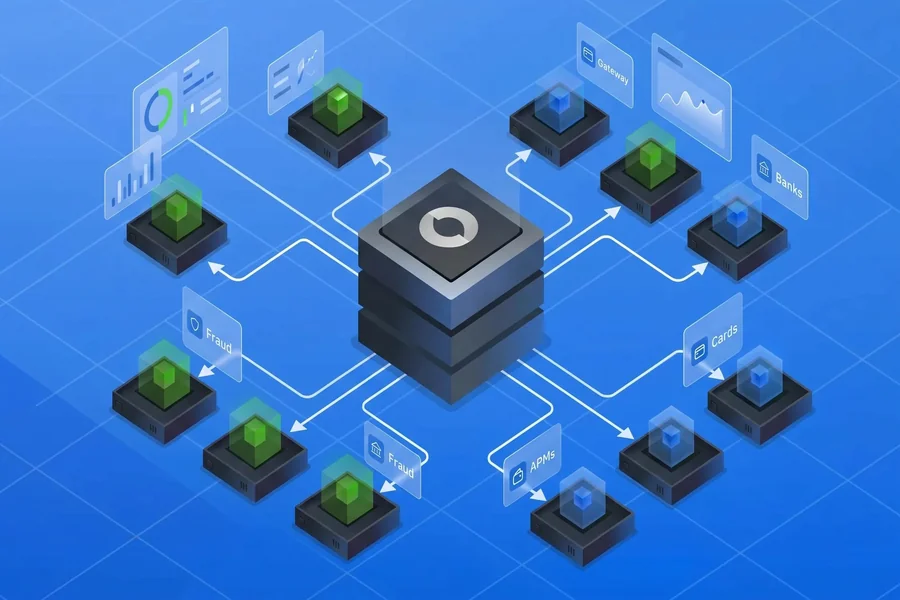
Over 300 PSP integrations. Real-time intelligent routing that evaluates each transaction against historical performance data. Card type, geography, amount, processor track record at that specific moment. When a transaction fails on one rail, Juspay reroutes it to another automatically. Merchants using this approach recover 5% to 12% of sales that would have otherwise died silently in a decline code nobody bothered to investigate.
Routing across multiple processors requires being above the processors, not being one of them.
The Scaling Wall That Growth Companies Hit
Companies do not outgrow Square because Square breaks. They outgrow it because their payment needs become more complex than Square’s model can accommodate.
| Growth Stage Question | Square’s Answer | Juspay’s Answer |
| We need to accept payments quickly | Built for this. Live in hours | Overkill at this stage |
| Our decline rates vary by country | No cross-processor routing | Dynamic routing across 300+ PSPs |
| A processor went down during peak traffic | No failover. You wait | Automatic reroute to best-performing processor |
| Engineering wants routing visibility | Closed system | Hyperswitch open-source, full code inspection |
| We process in 10+ countries | Limited to 6 core markets | 100+ countries with localized processor selection |
| Volume crossed $50M and growing | Architecture shows strain | Built for 300M+ daily transactions |
I should be fair about this table. Square has deliberately chosen its market. Comparing it unfavorably on enterprise questions is like criticizing a pickup truck for not being a semi. Different vehicle for a different job.
The question is what happens when you outgrow the pickup truck.
The Open-Source Angle That Changes the Conversation
One thing Square cannot match. Juspay offers Hyperswitch under Apache 2.0. Built in Rust. Over 200 connectors. Your engineering team can inspect routing logic directly. Understand why a specific transaction went where it went without filing a ticket and waiting.
For growth-stage companies building payment infrastructure with the next three years in mind, that transparency matters. You are not choosing a vendor. You are choosing how much visibility you will have into the system your revenue depends on.
Conclusion
One pattern worth watching that most analysts have not connected yet. Juspay processes over 300 million transactions daily with annualized TPV above $1 trillion. That volume creates a compounding advantage. More data sharpens routing intelligence. Better routing lifts authorization rates. Higher rates attract more enterprise merchants who feed more data back into the system. Square built something remarkable for small business payments. But the feedback loop a multi-processor orchestration layer generates is structurally impossible for a single-stack processor to replicate. The companies planning their payment architecture around where they are going rather than where they are right now tend to land on orchestration. And once the conversion numbers prove the decision right, going backward becomes very hard to justify.