
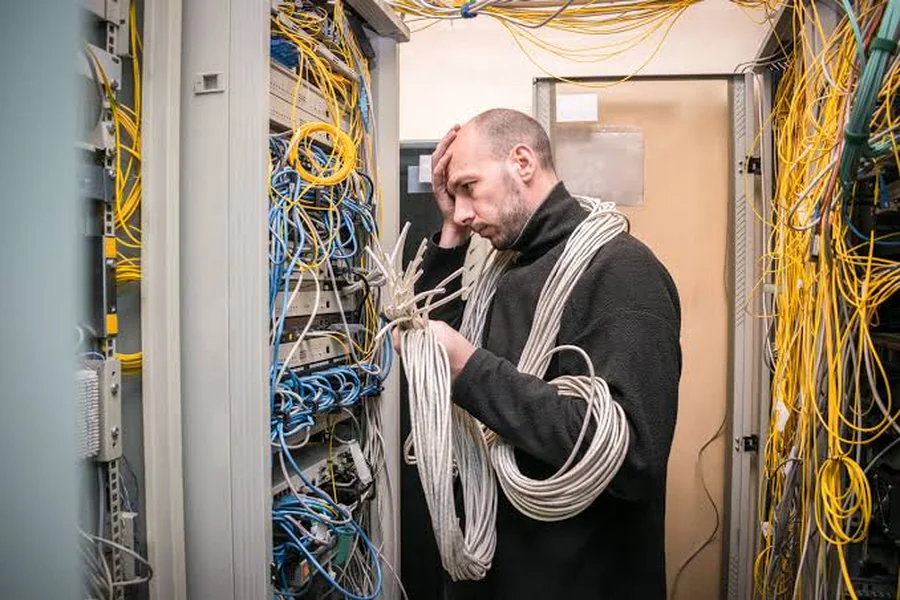
Nine times out of ten, the rack I get called about looks fine from the aisle. Panels on, doors closed, nothing obviously wrong. Then you pop the rear door and it is a wall of patch cords, power whips, and fiber bundled so tight it looks braided. That cabinet runs hot, and the team has already replaced two fans in six months.
Nobody budgets for this. Cabling feels like the free part of the build. But air is the thing you’re actually paying for, and a bad cable bundle is a dam that holds it back. I’ve opened enough cabinets to say this plainly: you can buy the best cooling plant on the market and still cook equipment because of how someone zip tied a harness in 2019.
Here’s the plan for this piece. You’ll learn what tangled cabling actually costs you, why the fastening method matters more than most people think, and how to build a rack standard your team will follow without a supervisor standing behind them.
What actually happens to a cabinet full of zip ties
Take a standard 42U rack with two top-of-rack switches, dense patch panels, and a power strip on each side. Cold air comes in the front door and is supposed to leave through the back. When cables are bundled rigid and pushed against the rear door, hot exhaust gets trapped between the equipment and the door. It recirculates right back into the intake.
Your sensors read normal at the top of the rack. The gear at the bottom quietly bakes. That’s why so many hot spots live four to six U off the floor, where nobody points a thermal camera during a routine walk.
The energy angle is bigger than the airflow angle, and it’s the one that gets budget signed off. The Department of Energy has long identified data center cooling as one of the largest single loads in commercial buildings, which is exactly why airflow discipline pays for itself. Every degree you claw back at the intake shows up on the utility bill, not just the thermostat.
Why the fastener matters more than the bundle
Zip ties are cheap, permanent, and wrong for anything you plan to touch again. I’ve watched a network engineer cut through a nylon tie and nick a live fiber strand. That’s a multi-hour outage created by a two cent part.
Hook-and-loop straps solve three problems at once. They’re reusable, so a technician can release a trunk, move a patch, and refasten it in under a minute. They don’t crush fiber or exceed bend radius limits the way over-tightened plastic does. And they’re forgiving of the cable you add six months later, which is the part every capacity plan gets wrong.
The rule I use: hook-and-loop for anything that moves, supports a flexible count, or carries fiber. Zip ties only for structural runs you’ll never open again, and even then, leave slack. That single habit change killed most of the rework calls on one colocation floor I worked on.
There’s a standards reason too. The National Institute of Standards and Technology publishes guidance that federal systems and their contractors rely on for cabling, labeling, and physical protection. When you can point at a recognized standard instead of your personal preference, the argument with the facilities team ends a lot faster.
How to build a rack standard your team will actually follow
A standard that lives in a PDF dies in a week. Build it into the physical work and it sticks. Here’s the sequence I’d run, in order:
- Set the pathway first.Give power down the left rail, data up the right. Pick it, label it, never mix it.
- Separate copper from fiber.Fiber goes in its own bundle, its own trough, its own color. Never lash them together for tidiness.
- Size the bundle before you fasten.Leave room for roughly a third more cable than what’s in front of you. You will add more. You always add more.
- Fasten every six to eight inches on horizontal runs.Any looser and cables droop into the airflow. Any tighter and you’re just braiding.
- Label both ends and the midpoint.Midpoint labels are the difference between a fifteen minute change and a two hour hunt.
- Photograph the finished rack.That picture becomes your baseline and your proof when someone asks why the next build looks different.
Do this once, on one rack, and time your next move, add, or change. You’ll feel the difference before the airflow data comes back.
The part nobody wants to hear about patches
Moves, adds, and changes are where good cabling goes to die. Someone needs one port at 2 a.m. They cut the strap, pull the new run, and never re-dress the bundle. Six months of that and you’re back to the wall of noodles.
Two things fix it. First, set an unplanned change window policy: any cable you touch during an incident gets properly dressed before you leave the row, even if it costs ten extra minutes. Second, stock the right lengths. Half of bad cabling is just a tech using a twelve foot patch cord because that’s what was in the bin.
I’d rather buy five lengths of the right strap than one more spool of the wrong cord. Fasteners are the cheapest line item in the whole build and the easiest one to underbuy.
There’s also a compliance angle that surprises people. Physical protection of cabling is a real control in federal acquisition requirements, and the General Services Administration sets the contracting framework vendors have to work inside. If your team sells into government or regulated customers, clean cabling isn’t cosmetic. It shows up in audits.
Where this fits in a build you’re already planning
If you’re ordering racks right now, add a column to your bill of materials for fasteners, labels, and vertical cable managers. Not vague categories, actual part counts. Factor it the way you’d factor screws for a cabinet: boring, necessary, and annoying to source late.
Good data center cable management really comes down to one idea: make the cable easy to move, and it stays organized. Reusable fastening is the whole trick, because permanence is what turns a neat rack into a mess nobody wants to touch.
Whether you’re building out a new row or cleaning up one that’s been running since the last refresh, start with the rack that runs hottest. Fix the airflow, label the runs, and switch the ties. Your cooling load will thank you, and so will whoever gets paged at 3 a.m. So which cabinet in your facility is the one you’ve been avoiding?