
Key Takeaways
- DNA can suggest biological connections, but records and family interviews help confirm them.
- Ethnicity estimates are statistical estimates, not proof of a specific ancestor or cultural identity.
- Shared DNA matches work best as research leads that must be tested with independent evidence.
- Birth, marriage, death, census, military, immigration, and newspaper records add details that DNA cannot supply.
- Unexpected discoveries can affect living people, so privacy and empathy matter throughout the process.
Family history research can begin with a simple question: Who was the relative everyone talked about, but nobody could fully identify? Whether you are tracing an immigrant ancestor, checking a surname story, or looking for a missing parent in a family tree, a focused question gives your research direction. A 23andMe ancestry DNA test kit may provide useful genetic clues, but it is most valuable when paired with documents, memories, and careful analysis.
The goal is not to build the largest possible tree as quickly as possible. It is to create a family history that distinguishes proven facts from possibilities, respects living relatives, and preserves the context behind each name and date.
Start With One Family Question
Broad searches often produce broad confusion. Instead of trying to discover everything at once, choose one person, family branch, or story. For example, you might ask, “Where was my great-grandmother born?” or “Who were the parents of the man listed as a boarder in the 1920 census?” Write down what you already know, including names, nicknames, dates, places, photographs, and oral traditions. Label each item as confirmed, possible, or unknown.
Gather Stories Before Searching Databases
Older relatives may remember clues that searchable records do not capture, such as a former street name, a church, an occupation, a military unit, or a family nickname. Ask open questions: Where did the family live before moving? Did anyone use another spelling of the surname? Were children adopted, fostered, or raised by relatives? Which letters, certificates, family Bibles, and labeled photographs still exist? Record answers carefully, but treat memories as leads rather than final proof.
Build a Record-Based Family Tree
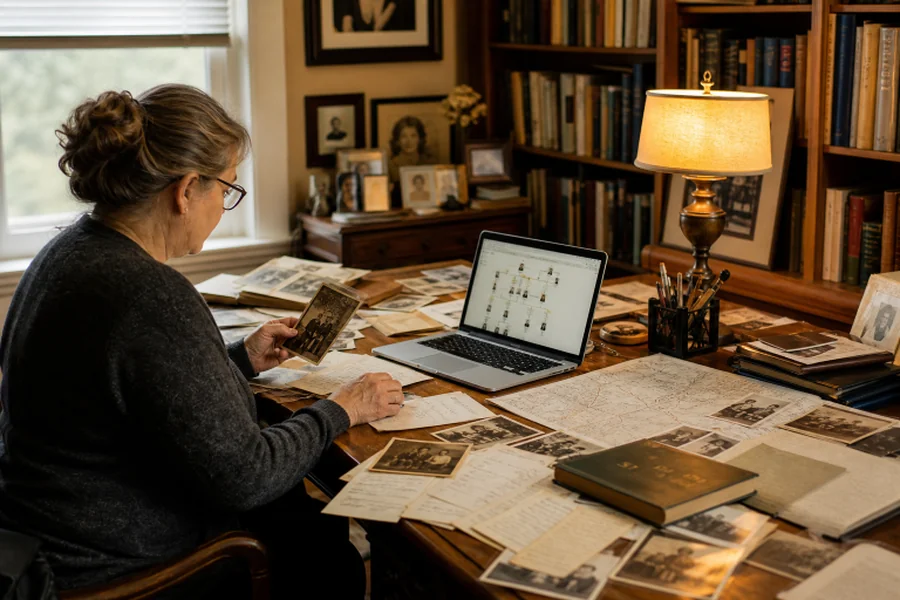
A reliable tree connects every important claim to evidence. Begin with close generations and work backward, recording full names, alternate spellings, dates, locations, and the document that supports each detail. Useful starting points include birth or baptism records, marriage licenses, death certificates, cemetery records, household schedules, passenger lists, naturalization files, military papers, and local notices. The records available to genealogists and family historians through the National Archives can also help researchers identify federal materials relevant to a family’s past.
Do not assume two people with the same name are the same person. Compare age, spouse, children, occupation, neighborhood, and nearby relatives. A second independent record can turn a promising theory into a stronger conclusion.
Understand What DNA Can and Cannot Show.
DNA testing can reveal people who share genetic material and can help identify possible biological relationships. It cannot independently provide a complete family tree. Ethnicity results are estimates based on comparisons with reference populations, so that different companies may report regional patterns differently. Distant ancestors may leave little detectable DNA, and relatives inherit different segments from shared ancestors. For these reasons, a missing match does not automatically disprove every proposed connection.
Use DNA Matches as Research Leads
Start by grouping matches that appear connected to the same family line or location. Look for repeated surnames, towns, and clusters of relatives, then compare their public trees with original records. Keep a research note for every theory and mark it as confirmed, possible, or unproven. Before adding a new ancestor, seek support from more than one source, such as several related DNA matches plus a census record, probate file, or marriage document.
Test Family Stories, Then Add Context
Family traditions can preserve an important truth even when details shift over time. An ancestor said to have entered through one port may have arrived elsewhere. A military story may belong to an uncle rather than a grandfather. A changed surname may reflect marriage, immigration, adoption, or a decision made later in life. Approach contradictions with curiosity rather than judgment.
Once you identify a person, move beyond names and dates. Maps, city directories, land records, newspapers, school files, and workplace records can show why a family moved, what work was available, and which relatives lived nearby. DNA testing and traditional genealogy helped identify a soldier in a 2026 case involving Revolutionary War remains whose life could then be investigated through historical research. The same principle applies to everyday family history: DNA may open a door, while records explain what lies beyond it.
Protect Privacy and Handle Surprises Respectfully
Genetic research can reveal an unknown parent, half-sibling, adoption, or other unexpected connection. Pause before reaching conclusions or contacting someone. Review whether several matches support the same finding, discuss the situation with a trusted person, and use a brief, respectful message that creates no pressure to reply. Never post another living person’s result, birth date, contact details, or private family story without permission.
Review the testing site’s privacy settings before sharing results or uploading raw data elsewhere. Public family trees should limit identifying details for living people. Thoughtful boundaries protect both your research and the people whose lives may be affected by it.
Create a Simple Research System
A spreadsheet, notebook, or genealogy program can keep the project manageable. For each person, track:
- Full name, nicknames, and alternate spellings
- Birth, marriage, death, and location details
- Record type, repository, and source notes
- Relevant DNA matches or family clusters
- Confidence level and the next research step
Common Questions
Can DNA replace traditional genealogy?
No. DNA can suggest relationships, while documents provide names, dates, places, and details about a person’s life.
Why do relatives receive different results?
Relatives inherit different combinations of DNA, and companies may use different reference groups and methods to estimate ancestry.
What if records and DNA disagree?
Recheck names, spelling variations, dates, locations, and assumptions. Look for additional records and multiple relevant matches before changing a documented conclusion.
Conclusion
The strongest family histories bring together science, documents, and human memory. DNA can raise an important question, records can test it, and historical context can make the answer meaningful. Work patiently, document your evidence, and treat every discovery with accuracy and respect.