
Your water heater fails on a Tuesday morning. Cold shower, no warning, zero negotiating room. At that moment, you’re not comparing appliances calmly. You’re writing a check for whatever gets hot water back fastest. That’s exactly the wrong time to make a decision worth thousands of dollars over a ten-to-twenty-year horizon.
So here’s the better approach: decide now, while you have time. The gap between a traditional tank system and a tankless unit is bigger than most homeowners realize, and picking the wrong one for your house means paying that mismatch penalty every month, for years.
Why the Energy Bill Angle Is Worth Your Attention
Water heating isn’t a minor line item. According to the U.S. Department of Energy, water heating is responsible for roughly 13% of both annual residential energy use and consumer utility costs. That means for a typical American household spending around $2,000 a year on energy, the water heater alone accounts for roughly $260 annually before you factor in system inefficiency or age-related decline.
A tank that’s running past its prime? That number climbs. Sediment builds up on the heating element, the insulation degrades, and the unit works harder to hold the same temperature it managed effortlessly five years ago. You feel it in the bill long before you see steam or puddles on the floor.
This is where the tankless argument gets compelling, and where most homeowners start paying attention.
How Each System Actually Works
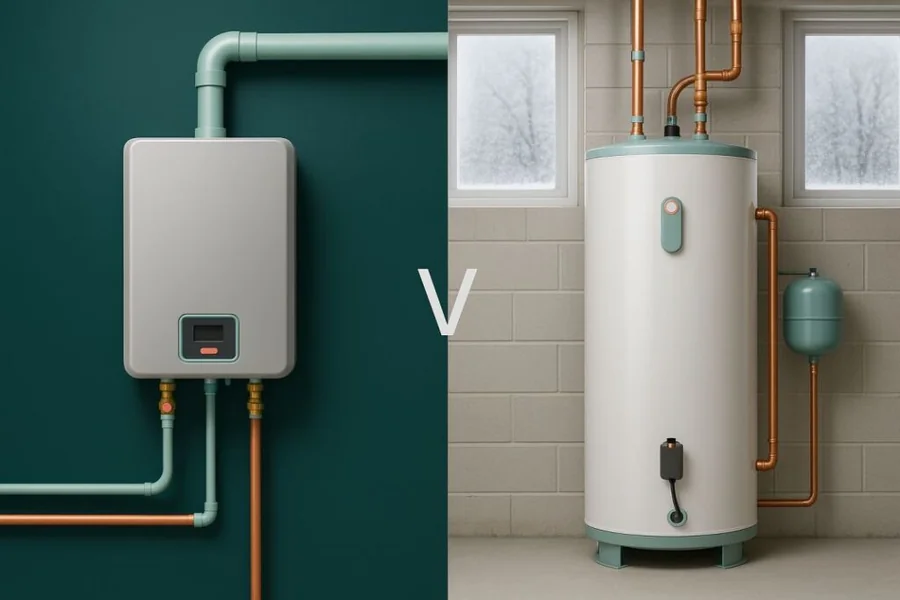
A traditional storage-tank water heater does one thing all day, every day: it keeps a large reservoir of water hot and ready. Gas or electric elements cycle on and off constantly to maintain the set temperature, regardless of whether anyone in the house needs hot water at that moment. That continuous reheating is called standby loss, and it’s pure waste.
A tankless unit works the opposite way. Cold water flows through the unit only when you open a tap, and a high-powered burner or electric element heats it on the way through. No storage, no standby loss, no tank to corrode from the inside out.
The tradeoff is flow rate. A single tankless unit has a maximum output measured in gallons per minute. Run the dishwasher, a shower, and a washing machine simultaneously, and a smaller unit will struggle. That’s a real limitation, not a minor footnote, and it matters more in larger households than the efficiency numbers alone suggest.
Lifespan: The Number That Changes the Math
Most homeowners buy on upfront price and regret it. Here’s what the long view actually looks like:
| Feature | Traditional Tank | Tankless
|
| Average Lifespan | 8 to 12 years | 15 to 20+ years |
| Standby Energy Loss | Yes, constant | None |
| Space Required | Large footprint | Wall-mounted, compact |
| Hot Water Supply | Limited by tank size | Continuous on demand |
| Upfront Cost | Lower | Higher |
| Maintenance Complexity | Moderate | Annual descaling required |
Tankless water heaters typically last 15 to 20 years, while traditional tank water heaters last 8 to 12 years, nearly double the lifespan. Buy a tank heater at age 35 and you’re replacing it twice before retirement. Buy tankless and you may see one replacement, total, in that same window. That’s a different financial picture than the sticker price implies.
The 3C Decision Matrix: A Framework for Choosing
Rather than chasing a single “best” answer, I find it more useful to run three variables against your actual living situation. Call it the 3C Decision Matrix: Cost threshold, Climate conditions, and Capacity demands.
Cost threshold is about how much upfront investment you can absorb versus how much monthly savings matter to you. If you’re flipping a rental property in six months, the lower sticker price of a tank heater makes more sense. If you’re staying put for 15 years, tankless almost always wins on total cost of ownership.
Climate conditions refers to your local water quality. Hard water is the silent assassin of tankless units. Mineral scale builds up inside the heat exchanger and, left untreated, can cut a system’s lifespan nearly in half. If your municipality reports high mineral content, budget for annual descaling or a whole-home water softener as part of the true cost.
Capacity demands is your peak hot water moment. A two-person household where no one runs appliances simultaneously is a perfect tankless candidate. A family of five with overlapping morning routines, a high-efficiency dishwasher, and a 60-gallon spa tub needs either a high-output tankless unit, multiple units, or a well-sized tank that can handle surge demand without complaint.
Run your situation through all three before you talk to anyone selling you something.
What Homes in Hard-Water Regions Teach the Rest of Us
Island environments are a useful case study. Imagine a homeowner on Maui who switched from a 10-year-old tank heater to a tankless unit without first testing their water. Within three years, the heat exchanger was scaling badly, performance had dropped noticeably, and the unit needed a service call that cost more than a year’s worth of energy savings. The fix was a water softener, which should have been part of the original installation plan.
A good maui plumber will test water hardness before recommending a system, because the right water heater for a soft-water neighborhood in Kahului might be the wrong call for a home in Kula drawing from a different water source. Local knowledge matters more here than any national comparison chart suggests.
This is true in any region with variable water mineral content, from central Arizona to coastal Hawaii. The efficiency gains the DOE documents for tankless units assume reasonably clean water supply conditions. For homes that use 41 gallons or less of hot water daily, according to the U.S. Department of Energy’s Energy Saver resource, demand water heaters can be 24% to 34% more energy efficient than conventional storage tank water heaters. But that range assumes the heat exchanger isn’t fighting a quarter-inch of calcium carbonate scale.
The Maintenance Commitment, Honestly
Tank heaters are relatively forgiving. Flush the sediment once a year, check the anode rod every few years, and the unit will quietly do its job until it doesn’t. The failure mode is usually dramatic but predictable: a slow leak, a rusty tinge to the water, a unit that stops heating efficiently in its final years.
Tankless units demand more consistent attention. Annual descaling is non-negotiable in most regions. The good news is that each component, the heat exchanger, the flow sensor, the igniter, can often be replaced individually rather than swapping the whole unit. That repairability is a big part of why the lifespan numbers are so much better.
“The biggest mistake homeowners make with tankless water heaters is treating them like set-it-and-forget-it appliances. Annual maintenance isn’t optional, it’s what earns you the 20-year lifespan in the first place.” This reflects a widespread consensus among licensed plumbing professionals and is reinforced by manufacturer documentation across the major tankless brands.
Making the Final Call: A Quick Checklist
Before you commit to either system, work through these four checkpoints:
- Test your water hardness. Hard water above 7 grains per gallon typically requires a softener alongside any tankless unit.
- Map your peak demand. Count how many hot water fixtures could run at the same time on your busiest morning. That number determines the flow rate your tankless unit needs, or whether a large tank is simply easier.
- Price the full install, not just the unit. Tankless installs often require upgraded gas lines or electrical panels. Get a complete quote before comparing prices.
- Factor in your timeline. Staying less than five years? The higher upfront cost of tankless may not recover before you move. Staying longer? The efficiency gains and extended lifespan almost always tip the math in its favor.
There’s no universal winner here. There’s only the right answer for your house, your water, and your actual usage pattern.
The homeowners who get this decision right are the ones who slow down before the crisis, run the numbers honestly, and ask the right questions before they’re standing in a cold shower trying to remember a plumber’s phone number.