
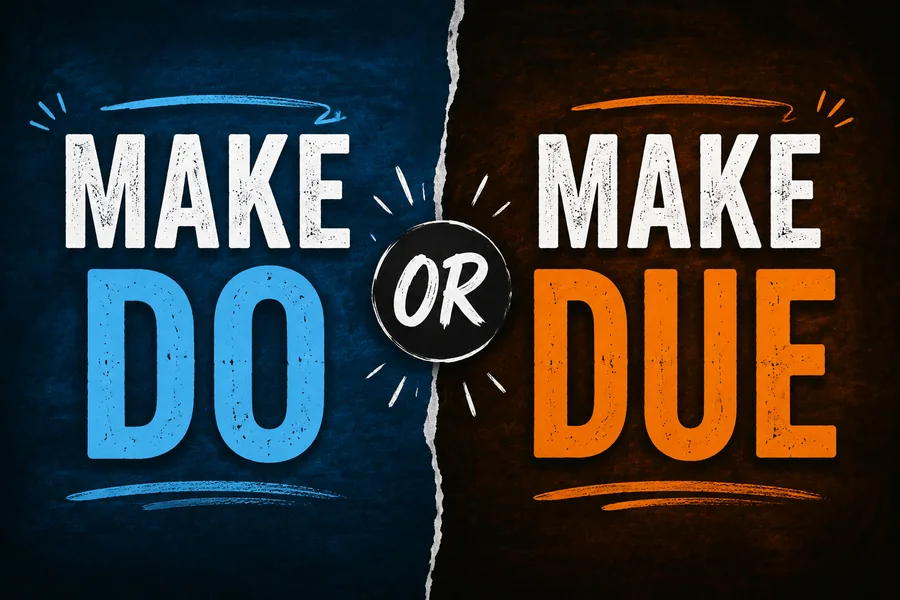
Many people get tripped up by make do or make due because both versions look right at first glance. But only one is correct. “Make do” is the right phrase. “Make due” is a spelling error that has spread through casual writing and everyday speech.
Knowing the difference between make do and make due helps you write clearly and avoid a mistake that editors notice right away. One word changes the meaning — and in formal writing, that matters. This guide breaks down the correct usage, shows real examples, and helps you remember which version to use every time.
Define Make Do
The English phrase “make do” has a basic definition of “to muddle through.” It is only applicable in resource-constrained scenarios. As a verb phrase, its core centers on the pragmatic logic of relying on existing conditions to tide over difficulties.
In the common phrase we will explain in this work, the core auxiliary verb “do” refers to performing a function and fulfilling a specific intended use. The complete phrase “make do with” applies to scenarios where something remains operational despite being imperfect. This phrase is used across a wide range of contexts, including households, workplaces, and general daily life, and it is most frequently employed when there is a shortage of time, funds, or supplies.
Define Make Due
The phrase “make due” is not a standard English phrase. It is a very frequently incorrectly spelled version of the correct expression “make do.” The word “due” is often used in expressions like “give credit where credit is due” and “due diligence,” and people assume that “make due” sounds correct, but in fact it does not follow standard grammatical usage.
There is no uniform meaning for the version of this idiom, “make do.” It will be correctly read by normal readers but will be detected as an error by editors and grammar-checking programs. The proper usage of this phrase has always been “make do.”
How To Properly Use make do or make due In A Sentence
Always use “make do” to describe meeting with limited resources; otherwise, you will use a set of phrases that are easily confused. The wrong term “make do” does not have a standard meaning and must not be used in formal or informal writing.
How To Use “Make Do” in a Sentence
The core semantic meaning of the phrase “make do” is to manage to cope when resources fall short of ideal standards. It can be applied to three types of scenarios: daily conversation, business writing, and narrative creation. Its standard collocation is “make do with,” which is followWhen carrying out tasks, we lacked suitable specialized tools, so we could only barely make do with the existing supplies in the shed.
- The budget was cut, but the team has found a solution.
- The unnamed woman prepared a proper main meal by making do with the only ingredients she had on hand.
The correct use of the phrase “make do” can demonstrate a user’s resourcefulness in solving problems under pressure. It is important to note that this phrase can only collocate with the word “do” and must never be miswritten as the easily confused word “due.”
Read Also: Afterward or Afterwards
How To Use Make Due In A Sentence
The English phrase “make due” is an incorrect usage that is unsuitable for formal writing, professional emails, or publicly published content. It is a misuse of the correct phrase “make do,” and the two phrases cannot be interchanged.
This article reminds all writers that if the incorrect collocation “make due” is used in their work, it must be replaced with the correct phrase “make do.” Correct spelling conveys intended meaning accurately, and there is no valid sentence structure in which the former can be properly substituted for the latter.
More Examples Of Make Do & Make Due Used In Sentences
We juxtapose the easily confused phrases make do or make due to highlight their differences. The former is appropriate for use in all contexts, while the latter does not conform to the norms of standard written English, and authentic usage examples of the former will be provided later in this paper.
Examples Of Using Make Do In A Sentence
- As the storm destroyed the power supply, that homelife spent a full three days without power.
- Still, the head chef was able to cook up some good, competent food with just five ingredients.
- We are out of packing tape—so we used rubber bands now.
- Stretching budgets and slim workforces can only be the means by which small and micro enterprises can barely get by.
- While awaiting new textbooks, students use old textbooks temporarily.
- The printer at the office went down, so I converted and saved the files to PDF as a last resort.
- I didn’t have enough money to buy equipment, so I had to learn how to make the old equipment work.
- The rescue team had to use basic supplies until further supplies arrived.
- When the most critical period of the project was when all the team members had no choice but to trim back on their sleep and rest in order to push the project’s research projects ahead, they had to work at full capacity.
- The team wasn’t fully staffed and had only two people employed full time, so the manager had to run the show by the skin of his teeth.
Examples Of Using “Make Do” in a Sentence
“Make due” does not have correct example sentences because it is not a valid phrase. The list below shows how “make due” appears in writing errors—paired with the corrected version:
| Incorrect (Make Due) | Correct (Make Do) |
| We had to make due with old supplies. | We had to make do with old supplies. |
| She made due with what she had. | She made do with what she had. |
| The team made due without a full budget. | The team made do without a full budget. |
| I had to make due when the system crashed. | I had to make do when the system crashed. |
| They made due with a smaller venue. | They made do with a smaller venue. |
Common Mistakes To Avoid
The misused phrase is “we had to due to less funding,” and it is the most frequent mistake made by English writers, replacing “do” in the correct collocation “make do” with the familiar, widely used word “due.” Use of “do” instead of “due” makes the form correct.
Mistake #1: Using “Make Due” When You Mean “Make Do”
When explaining grammatical error correction, the author of this paper first presents the correct example sentence, “We had to make do with less funding,” then explains that the word “due” in the incorrect collocation should be replaced with “do.”
Context is the clearest guide for judging English word usage. When describing a person handling affairs while relying on limited resources, the correct phrase to use is “make do.” The commonly miswritten phrase make due has no independent semantic meaning, and it is only mistakenly recognized as correct due to the public’s usage habits.
Many English writers frequently misuse the phrase “make do.” Its core semantic meaning is to barely manage with existing resources, and it cannot express any of the three semantic categories: completing a task, fulfilling an obligation, or meeting a standard.
Mistake #2: Using “Make Do” When You Mean Something Else
In English writing, two common misuses of the phrase “make do” must be noted. Corrections should be implemented to align with the specific contexts of each misuse, and correct phrases that match the intended semantic meaning must be selected. This approach maintains a sharp writing style and conforms to the writing principle of using precise, accurate language.
To accurately and properly use the English phrase “make do,” I have developed a convenient memory scheme. This scheme binds the phrase to the end rhyme of daily question sentences. and is applicable to scenarios such as management and response, which are exactly the types of scenarios where the word “do” must be used.
Tips For Avoiding These Mistakes
The quickest way to get this right every time is to remember one rule: “make do” rhymes with “What will you do?” You are doing something—managing, coping, or adapting. The word is always “do.”
- Remember: “make do” = manage with what you have. “Make due” = not a real phrase.
- When editing your writing, search for “make due” and replace it with “make do.”
- Read the sentence aloud. “Make do with less” sounds natural. “Make due with less” sounds slightly off—trust that instinct.
Read Also: How to Spell Untill
Context Matters
This paper defines “make do” as a pragmatic response to constraints that applies to all contexts where resources are limited across four categories: time, money, tools, and support. Its core is an action logic that advances progress toward set goals without abandoning them, relying on the resources that are already available at hand.
Make Do
The English phrase “make do” can be used across both formal and informal registers. In a business memo, one may write “the department will make do with existing software,” while in casual daily conversation, one may say “we’ll just make do”; its semantic meaning remains fully complete and unchanged across all usage scenarios.
In emergencies: “Rescue workers had to make do with basic supplies until reinforcements arrived.”
Examples of “make do” in various situations:
- At home: “We made do with the leftovers instead of cooking something new.”
- At work: “The IT team had to make do without updated hardware.”
- In emergencies: “Rescue workers had to make do with basic supplies until reinforcements arrived.”
Make Due
So long as we understand the difference between this set of fixed collocations, we can totally eliminate the self-doubts regarding which usage to use. The phrase “make due” is incorrect in all contexts, and the correct phrase “make do” is only to be used when expressing the meaning of barely coping with a difficult situation.
In English, there is a pair of easily confused phrases: make do and make due. When describing scenarios where people struggle to get by with limited resources, “make do” is the correct choice in the vast majority of cases, with only an extremely small number of rare special boundary exceptions.
Exceptions To The Rules
We propose the “idiom extension” phenomenon: the idiom “make do,” which was originally used in resource-constrained scenarios, can now also be employed to express acceptance of things that fall short of expectations. For example, it is used to describe settling for an unsatisfactory hotel, and this usage conforms to standard grammatical norms.
Make Do
- Idiomatic Stretch: In early applications, the hyphenated form “make-do” was primarily used as a modifier. Typical use cases of this term still appear in contemporary formal writing, and both spelling variants are fully compliant with standard writing norms.
- Historical Usage: In the context of modern English, the phrase “make do” has no valid exceptions that would make it a compliant usage. It is not included as a standard usage in any authoritative dictionary. Only a small number of informal sources classify it as a regional variant, and all grammar authorities refuse to recognize this usage as valid.
Make Due
A large number of English speakers unconsciously use the non-standard phrase “make due” in spoken English. The two phrases are phonetically similar and hard to distinguish in oral communication, and only the standard phrase “make do” complies with standard English usage norms, a requirement that only applies in written contexts.
- Informal Speech: Please bear in mind the three standard collocations of the word “due”: due diligence, due credit, and in due time, and never confuse them with the unrelated phrase “make do.”
- “Due” in Other Phrases: Grammar exercises targeting the easily confused phrases “make do” and “make due” help learners firmly master the differences in their usage and learn to identify errors and write correct forms of the phrases in authentic sentences.
Practice Exercises
The following exercises will be useful for you to remember the distinction between make do or make due. Doing them will help you practice identifying an error in a real sentence and composing the correct sentence from scratch.
Exercise 1: Fill In The Blank
Fill in the blanks with the correct phrase: make do or make due.
- The volunteers had to __________ with limited medical supplies during the relief effort.
- When the coffee machine broke, everyone had to __________ with instant coffee.
- We did not have a ladder, so we had to __________ with a step stool.
- The startup had to __________ without a dedicated marketing team in its first year.
- She could not afford new furniture, so she learned to __________ with what she already owned.
Answer Key:
- make do
- make do
- make do
- make do
- make do
Exercise 2: Sentence Writing
Write a sentence using each of the following correctly:
| Word/Phrase | Example Sentence |
| make do | After the budget cuts, the department had to make do with fewer staff members. |
| make do | The hikers made do with a basic shelter when the weather turned bad. |
| make do | He was short on time but made do with a quick outline instead of a full draft. |
| make do | The school made do with older computers until the new ones arrived. |
| make do | They did not have a delivery van, so they made do with two personal cars. |
Exercise 3: Multiple Choice
Choose the correct option for each sentence.
- __________ means to manage with the resources you currently have.
- A) Make due
- B) Make do ✓
- “We had to __________ with the tools available” is correct when written as:
- A) make due
- B) make do ✓
- Which version is a spelling error?
- A) Make do
- B) Make due ✓
- “She __________ when the power went out by using candles” should read:
- A) made due
- B) made do ✓
- In formal writing, which phrase is always acceptable?
- A) Make due
- B) Make do ✓
Answer Key: 1-B, 2-B, 3-B, 4-B, 5-B
Conclusion
Make do or make due means to go ahead with activities as they have available resources. It can be used in different contexts such as the home, workplace, crisis situations, or everyday contexts and essentially means that improvement can occur despite having limited resources.
Test yourself in scenarios with limited conditions with hands-on self-practice using real cases; do not hesitate and use the phrase with confidence: Make do with me.
FAQs
Is it ” make do or make due”?
The correct phrase is make do. “Make due” is a common spelling error. “Make do” means to manage with limited resources. “Make due” has no recognized meaning in standard English.
What does “make do” mean?
Make do means to manage or get by with what is available. You use it when something is not ideal but still workable. Example: “We had to make do with what was in the pantry.”
Why do people write instead of make do or make due?
People write “make due” because the word “due” appears in many common phrases like “due diligence” or “in due time.” That familiarity makes “make do” feel correct—but it is not. The right spelling is always make do.
Can “make do” be used in formal writing?
Yes. “Make do” is appropriate in both formal and informal writing. It is a standard English phrase and appears in professional documents, news writing, and everyday communication.
How can I remember the correct spelling?
Link makes doing to the idea of doing something. You are managing, coping, and doing what it takes. The phrase is about action — and the word “do” keeps that meaning clear. If the idea involves getting things done with less, write “make do.”
Read More Articles: Difference Between Brought and Bought