

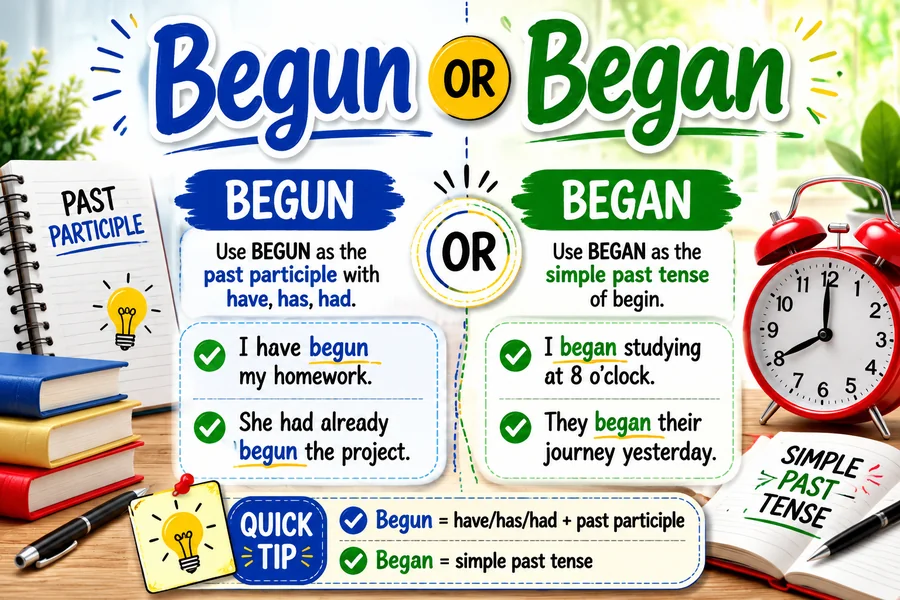
The words begun or began are often mixed up. Both are past tenses of the verb begin, but they are very different in use, with “begun” being the past participle (and requiring an auxiliary verb) and “began” being the simple past tense.
The correct use of the verbs “begin” and “begun” helps maintain the correctness of the writing of the English language. These two forms are especially disconcerting in formal writing or professional e-mail—most people do not realize how significant this grammatical attribute is.
Let’s look at the difference between the two different uses of the two similar English verbs, this day, began and begun. This guide includes four sets of learning resources to support your understanding of the appropriate use of both words.
Table of Contents
- Define Began
- Define Begun
- How To Properly Use The Words In A Sentence
- How To Use Began In A Sentence
- How To Use Begun In A Sentence
- More Examples Of Began & Begun Used In Sentences
- Examples Of Using Began In A Sentence
- Examples Of Using Begun In A Sentence
- Common Mistakes To Avoid
- Mistake #1: Using “Began” When You Mean “Begun”
- Mistake #2: Using “Begun” When You Mean “Began”
- Tips For Avoiding These Mistakes
- Context Matters
- Began
- Begun
- Exceptions To The Rules
- Began
- Begun
- Practice Exercises
- Exercise 1: Fill In The Blank
- Exercise 2: Sentence Writing
- Exercise 3: Multiple Choice
- Conclusion
- FAQs
Define Began
First of all, it must be clarified that “began” is the simple past tense of the verb “begin,” and it has two core usage rules: first, it can describe completed actions that started at a specific time in the past; second, it can be used independently without an auxiliary verb, making it a common, easy-to-use, entry-level, first-choice word for describing such past events.
We can use a simple, everyday example to explain this: when describing the meeting that started at 9 a.m., the verb “began” is the correct term to use. This word inherently carries a past tense meaning, so no additional auxiliary verb is required. As long as one correctly masters its applicable context, this type of vocabulary can be used easily and properly.
Define Begun
“Begun” is the past participle of the verb “begin.” It cannot be used independently. To conform to standard grammatical rules, it must be paired with common auxiliary verbs such as “has,” “have,” and “had.”
We first examine two typical correct example sentences that properly use the verb form “begun.” When “begun” is used without an auxiliary verb, it not only sounds unnatural and awkward but also constitutes a grammatical error. This rule can fully demarcate the distinct usage boundaries for the two inflected forms of the verb “begin.”
How To Properly Use The Words In A Sentence
To accurately distinguish between the two easily confused verbs, began and begun, one only needs to check whether the target sentence contains an auxiliary verb. Use “begun” if an auxiliary verb is present, and use “began” if no auxiliary verb exists. This rule can eliminate the vast majority of usage confusion that arises in everyday contexts.
Use of how to use in a sentence.
When describing actions that occurred in the past, use the verb “began”; there is no need to add any auxiliary verb before it, as it is by itself a complete simple past tense verb.
- Our group encountered rain immediately after we left our residence.
- I will begin this lecture with a short story.
- This company launched its operations in 2018.
The verb “began” can accurately mark definite actions that occurred in the past. It is concise and straightforward and suitable for use in both formal and informal writing contexts.
Read Also: Fare Better or Fair Better: Stop Making This Common English Mistake
How To Use “Begun” In A Sentence
Begun, the past participle of an irregular verb, must be preceded by an auxiliary verb. This form can only collocate with has, have, and had; any sentence that lacks these required matching auxiliaries will be grammatically incoherent.
- The meeting has started.
- Construction of the new road has started.
- For all professional English writers, correct use of the word “begun” can effectively improve writing quality. This word must always be paired with an auxiliary verb, with absolutely no exceptions.
To clarify the usage differences between “began” and “begun”, the quickest method is to observe their actual usage scenarios. In the following content, we will present the respective usage of each of the two words, as well as the changes that occur when the two words are interchanged.
More Examples Of begun or began Used In Sentences
The most convenient way to tell the difference between the simple past tense form, began, and the past participle, begun, is to look at how they are used in sentences. The next few sentences will show how these two words are used and how their meaning changes when they are swapped.
Examples Of Using “Began” in a Sentence
- The initial core entrepreneurial idea originated in an ordinary small garage.
- The storm began to arrive in the early hours of the morning.
- I run daily in accordance with my doctor’s instructions.
- The opening of this concert was postponed due to a sound system malfunction.
- She used her lunch break to pick up her pen and start writing a novel.
- The cause of that debate has long been impossible for anyone to clearly recall.
- Construction of the new bridge commenced in the spring of last year.
- The instant the door opened, the dog immediately began to bark.
- Once the first step is taken, all matters fall into their proper place.
- Surprisingly, he had long since recovered quietly, and no one around him had noticed.
Examples Of Using Begun In A Sentence
- The investigation into the cause of the fire involved in this incident has been officially launched.
- The man began to lose confidence in his own plan.
- This expressway project has begun construction ahead of schedule.
- Children had already started doing their homework before dinner.
- Our entire organization has officially entered a brand-new chapter of development.
- The countdown to the final event has been officially launched.
- Both parties launched bilateral talks last month.
- She personally witnessed substantial progress being made in the work.
- Even English writers with solid foundational skills may occasionally mix up “began” and “begun.” These errors arising from interchanging the two terms can be easily corrected, as long as one masters the proper logic for identifying correct usage.
- Many learners write grammatically incorrect sentences such as “She has begun the task.” This sentence contains a grammatical error: when “has” functions as an auxiliary verb, it must be followed by a past participle, so the correct verb form is “begun” rather than “began.”
Read Also: Troubleshooted or Troubleshot: Which One Is Correct?
Common Mistakes To Avoid
Distinguishing between “began” and “begun” is simple: if a sentence includes the auxiliary verbs “has,” “have,” or “had,” use “begun.” The example sentence “The project has begun” is grammatically correct, natural, and aligned with standard usage.
Mistake #1: Using “Began” When You Mean “Begun”
To correctly distinguish between ‘began’ and ‘begun,’ one should first check the auxiliary verb in the relevant sentence. This is a good habit that guarantees these two verb forms are used correctly every time.
Next, we will discuss the second common type of grammatical error in English writing. The erroneous example sentence is “The meeting began at noon.” The word “begun” lacks an auxiliary verb; the correct form that can function independently to use here is the simple past tense “began.”
This section of the popular science piece on basic English grammar first presents the correct example sentence: “The meeting began at noon.” It stipulates that the verb form “begun” must not be used when there is no auxiliary verb in the sentence, to correct this type of verb misuse.
Mistake #2: Using “Begun” When You Mean “Began”
To distinguish between these two words, first grasp the context and read the sentence to conduct a self-check: use “began” for an independent past action and use “begun” if an auxiliary verb is present.
To distinguish between begun or began, one can develop several practice habits.
To judge the correct usage of the past forms of the verb “begin,” first check whether the sentence contains the auxiliary verbs “has,” “have,” or “had.” If any of these auxiliaries are present, use the form “begun”; if no such auxiliary is present, use the form “began.”
Tips For Avoiding These Mistakes
When proofreading, read the text aloud, and rely on auditory perception to compensate for the oversights that occur during silent reading.
- The irregular verb “begin” conjugates as “begin”→”began”→”begun,” and memorizing this set of conjugation forms can avoid usage confusion.
- In English, the past tense form began and the past participle form begun, two easily confused forms of the same verb, share identical semantic meanings. One can accurately select the correct form simply by checking whether an auxiliary verb is present in the sentence, thus eliminating confusion when choosing between the two.
- The verb “began” is used to describe a single completed action that occurred in the past. It can function as an independent predicate, does not require collocation with auxiliary verbs, and is capable of independently sustaining and fully conveying its intended meaning.
Context Matters
The verb “began” is suitable for both casual daily conversations and formal writing and is applicable to use cases including press releases, business reports, and private messages between friends, enabling it to clearly and concisely convey the simple past tense.
Began
Below are examples of each scenario.
The past participle of the verb “begin” is “begun.” It is only used in English with the perfect tense and must be properly coordinated with the auxiliary verbs has, have, or had to express a past action in relation to a time point in the present or in the past.
Examples of “began” in various situations:
- Simple past narration: “The project began in January.”
- Storytelling: “It began with a phone call nobody expected.”
- Reporting: “Protests began early in the morning.”
Begun
The perfect tense with the verb “begun” is mainly used to indicate actions that can result in later actions. It is about linking events across time, and “begun” is the core verb for the very purpose of adding cross-temporal connections.
The verb form “begun” is also used correctly in English writing, and it can help the writer be expressive rather than most casual writers while showing a high level of command of the tense usage and leaving a positive impression.
Examples of “begun” in different scenarios:
- Present perfect: “She has begun her new role.”
- Past perfect: “They had begun before the announcement.”
- Formal writing: “The process has begun in earnest.”
First, we clarify that the basic rules governing the verb forms “began” and “begun” are strictly defined, with flexible usage only applicable in a small number of contexts. Mastering these rules can eliminate the wasteful effort of repeatedly double-checking their usage in edge cases.
Exceptions To The Rules
In the creation of fictional narratives, creators may flexibly adjust the conventional usage of tenses to generate expressive effects. The use of “began” in the example sentence “It began as a whisper and ended as a roar” holds true even if the work’s timeline is loosely constructed.
Began
- Direct quotations must retain the speaker’s original wording. Even if the tense of the quotation is inconsistent with the tense of the surrounding context, the original phrasing of the quotation may not be altered. The term “began” in the example must never be changed arbitrarily.
- Many people mistakenly believe that the past participle begun can only collocate with the auxiliary verb have. In fact, this word can also be paired with the verb be to express passive voice. In the example sentence, “was” serves as an auxiliary verb, and this usage is grammatically compliant.
Begun
- Fixed expressions in English have some usages of the word “begun” that have a formal, slightly antiquated style but are still grammatically correct. The verb “begun,” instead of the more familiar past participle, is used as an adjective in the classic saying “Well begun is half done.”
- Having the foresight to detect all types of exceptions can avoid overcorrection of situations that may seem anomalous and normal in reality.
The two forms of the English irregular verb “begin” must be distinguished: “began” (simple past tense) can be used alone, as in the example: The class began at 9 o’clock, and “begun” (past participle) requires an auxiliary verb, as in the example: The class has already begun.
Begun or Began: Quick Comparison Table
| Feature | Began | Begun |
| Type | Simple past tense | Past participle |
| Needs a helping verb? | No | Yes (has / have / had / was) |
| Example | The class began at 9 AM. | The class has begun. |
| Tense used in | Simple past | Perfect tenses, passive voice |
| Stands alone? | Yes | No |
| Common error | Using with a helper verb | Using without a helper verb |
Practice Exercises
Please select the correct word from “began” and “begun” to fill in the blank.
Exercise 1: Fill In The Blank
Fill in the blanks with the correct word: begun or began.
- The race __________ at exactly seven in the morning.
- She has __________ her new job at the clinic.
- They had __________ building the bridge before the funding arrived.
- The argument __________ over a simple misunderstanding.
- Construction has __________ on the city’s new transit line.
Answer Key:
- began
- begun
- begun
- began
- begun
Exercise 2: Sentence Writing
| Word | Example Sentence |
| began | The meeting began right after everyone arrived. |
| begun | She has begun preparing for the final exam. |
| began | He began his career as a junior editor at a small magazine. |
| begun | The repairs had begun before the inspector showed up. |
| began | The film began with a long, quiet shot of an empty road. |
Exercise 3: Multiple Choice
Choose the correct word (began or begun) for each sentence.
- The dog __________ barking the moment the car pulled in.
- A) Begun
- B) Began
- She has __________ to understand the importance of good sleep.
- A) Begun
- B) Began
- The talks __________ last Tuesday at the government offices.
- A) Begun
- B) Began
- Work had __________ on the report long before the deadline.
- A) Began
- B) Begun
- It all __________ with a single question nobody could answer.
- A) Begun
- B) Began
Answer Key:
- Began
- Begun
- Began
- Begun
- Began
Conclusion
Mastering the usage difference between “begun or began” is a small advanced step in English grammar learning that generates notable positive benefits over time. “Began” is the simple past tense that can be used independently, while “begun,” as a past participle, must be paired with auxiliary verbs such as “have,” “has,” and “had.”
Misuse of grammatical forms does not necessarily undermine the core meaning of an expression, but it will diminish the sense of careful polish in writing. In professional contexts, academic work, and any piece of written content that requires its audience to treat it seriously, the correct use of grammatical forms is critically important.
You need not worry at all about mixing up these two easily confused irregular verbs. I have sorted out a set of judgment rules with an extremely high accuracy rate. When paired with two short practice exercises, these rules allow you to thoroughly distinguish between the correct usages of began and begun.
FAQs
What is the difference between begun or began?
The simple past tense form of the English verb “begin,” which is “began,” can be used independently as the predicate in a sentence. Its past participle, begun, must be paired with has, have, or had to be used properly.
When should I use began in a sentence?
Use began when describing a completed past action with no helping verb. Example: “The show began at eight.”
When should I use begun in a sentence?
The past participle “begun” must be paired with a preceding auxiliary verb, as in the example sentence “The show has begun.” Omitting the required auxiliary constitutes a grammatical error.
Can begun be used without a helping verb?
No. “Begun” always requires a helping verb. Writing “The meeting begun at noon” is incorrect. The correct form is “The meeting began at noon.”
How can I remember begun or began quickly?
Check for a helping verb first. Has, have, or had before the verb? Use “begun.” No helping verb? Use began. That single rule covers almost every case.
Read More Articles: Suprise or Surprise: Correct Spelling, Meaning, Examples, and Full Usage Guide