

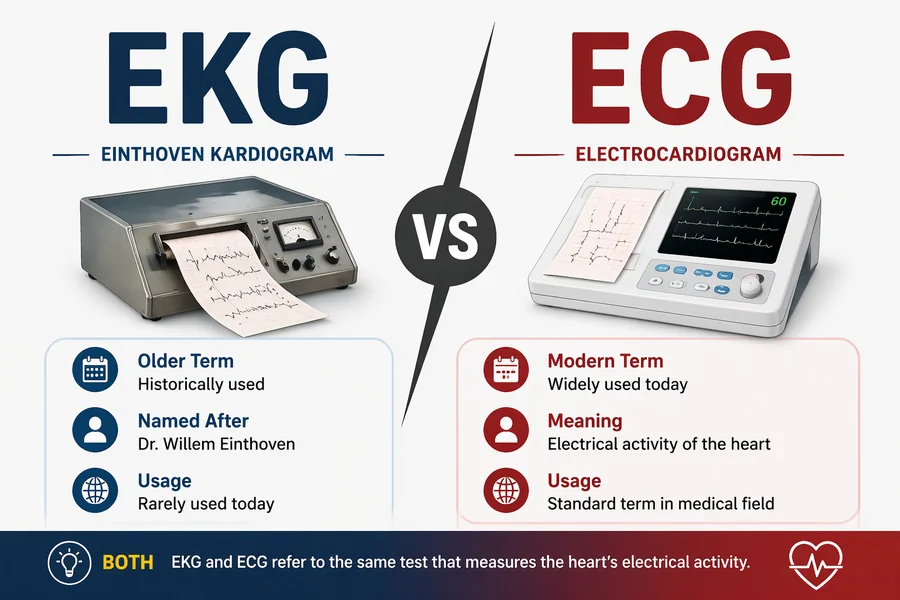
The EKG vs ECG problem confuses many as both terms are used in medical practice. Nevertheless, they are talking about the same test. Electrocardiogram is abbreviated as ECG and EKG as the German spelling of the term.
Being aware of ECG vs EKG is one method of not getting lost when reading a medical record or talking to a medical professional. There is nothing wrong about using either of the words, however, it is easier to understand when and why each of them is used and simplify the communication process. We are going to address the difference between EKG or ECG in this guide, and show how to use each of these terms and the most common questions that are asked by patients and by students.
Define ECG
ECG is an abbreviation of electrocardiogram. It is a diagnostic procedure which captures the electrical heart activity. It is used by doctors to identify heart issues, measure heart rhythm and overall heart health.
ECG is a common term in English speaking countries. ECG is widely used as the standard abbreviation in hospitals, clinics, and medical textbooks in the United States, United Kingdom, and Canada.
An ECG is a device that operates by attaching small patches of electrodes on the skin. These patches detect electrical impulses generated by the heart and show it in the form of a wave on a paper or a screen.
Define EKG
EKG is an abbreviation of Elektrokardiogramm, the German equivalent of electrocardiogram. The reason behind the introduction of the abbreviation is that the early research in the field of cardiac electrical activity was predominantly conducted by German and Dutch scientists in the first half of the 20th century.
EKG is still common today in the United States particularly within clinical practice and among cardiologists. It refers to the same thing as ECG. The two terms do not have any medical difference.
The ECG and EKG refer to the same non-invasive test which measures your heart.
EKG vs ECG: Quick Comparison Table
| Feature | ECG | EKG |
| Full form | Electrocardiogram | Elektrokardiogramm (German) |
| Language origin | English | German |
| Common in | UK, Canada, global medical texts | United States, clinical use |
| Medical meaning | Records heart electrical activity | Records heart electrical activity |
| Test type | Non-invasive | Non-invasive |
| Same test? | Yes | Yes |
Example: A doctor may say “we need to run an EKG” in a US hospital, while a doctor in London may say “let us do an ECG.” Both mean the same cardiac test.
How To Properly Use The Words In A Sentence
EKG and ECG should be used correctly at all times by ensuring you check the location of writing or speaking. ECG is used more in formal medical writing and overseas. EKG has become a common vernacular in clinical practice in the United States.
How To Use ECG In A Sentence
ECG can be used in formal reports, academic papers and in medical documentation. Most international guidelines and journals use the preferred spelling.
- The doctor ordered an ECG to check the patient’s heart rhythm.
- The ECG results showed no signs of arrhythmia.
- Patients should have an ECG screening regularly (once they are over 40).
Correct usage of ECG is an indication of professional knowledge of international medical standards. It is particularly suitable in written reports and research situations.
How To Use EKG In A Sentence
EKG is widely applied in the clinical discourse and in the hospital environment of the United States. It is equally true and well known among health care professionals around the world.
- The leads were connected by the nurse to conduct an EKG.
- His EKG revealed an abnormal heartbeat which required follow-up.
- The EKG was examined by the cardiologist who made a diagnosis.
There is nothing wrong with using EKG in a clinical discourse and it will never be misunderstood with any trained medical expert.
Read Also: Tear vs Tare: What’s the Difference, Meaning & Easy Examples
More Examples Of EKG & ECG Used In Sentences
You can clearly see the interchangeable nature of EKG vs ECG through examples. Both terms describe the same test. The difference is style, origin, and regional preference — not medical meaning.
Examples Of Using ECG In A Sentence
- ECG showed some abnormal electrical activity in the lower chambers.
- A baseline ECG was done prior to the start of the stress test.
- The hospital also updated its ECG machines to enhance accuracy.
- Nurses have been trained on the use of ECG electrodes within less than five minutes.
- The cardiologist made a comparison of the new ECG and the previous year ECG.
- The initial test in a workup of chest pain is often an ECG.
- The ECG showed a normal sinus rhythm with no acute changes.
- She had an ECG performed when she had her cardiac checkup annually.
- The ECG tracing was copied and attached to the file of a patient.
- Results from the ECG helped confirm the diagnosis of atrial fibrillation.
Examples Of Using EKG In A Sentence
- ER physician ordered 12-lead EKG right away.
- His EKG was returned with the evidence of a heart attack in the past.
- The technician was performing the EKG when the patient was lying back.
- EKG is a painless procedure that lasts less than ten minutes.
- The EKG printout exhibited a typical image of the left bundle block.
- She was nervous but the EKG was done before her.
- The EKG showed that the patient was in normal sinus rhythm.
- An initial EKG was performed prior to the beginning of the new drug.
- EKG was performed on the ambulance team on the way to the hospital.
- The doctor explained the result in each part after the EKG.
Common Mistakes To Avoid
Many people confuse EKG vs ECG by thinking they are different tests. Always remember they refer to the same procedure. The only real mistake is believing one is more accurate or advanced than the other.
Mistake #1: Thinking ECG and EKG Are Different Tests
A common mistake is assuming that an ECG is more detailed than an EKG or vice versa. This is not true. Both abbreviations describe the same 12-lead cardiac test. There is no clinical difference between them.
If a doctor orders an EKG and the report comes back labeled ECG, this should not cause alarm. The test performed, the electrode placement, the wave patterns recorded — all of it is identical.
Always remember: EKG and ECG are the same test with two different abbreviations rooted in two different languages.
Mistake #2: Using ECG or EKG To Mean Different Equipment
Another mistake is assuming that EKG refers to the machine and ECG refers to the test or the reading. This distinction does not exist in medical practice. Both terms can refer to the test, the machine, or the resulting printout depending on context.
Saying “the EKG machine” or “the ECG machine” are both correct. Saying “read the EKG” or “read the ECG” are both fine too.
Tips For Avoiding These Mistakes
These are some of the points to remember to avoid confusion with EKG vs ECG.
- It is important to remember that EKG is of German origin and that ECG is the abbreviation of the same word used in English.
- Apply ECG in official writings, research reports, and global medical records.
- Apply EKG in daily clinical dialogue, particularly in the US.
- Do not assume that one term is a higher or alternative form of the test.
Context Matters
Choosing between EKG and ECG often comes down to context. The medical meaning stays the same. What changes is setting, formality, and regional standard.
ECG
ECG is the preferred term in academic medicine, global clinical guidelines, and most English-language journals. ECG is generally used in official publications of organizations such as the World Health Organization and the American Heart Association.
It is also the standard spelling in the majority of hospital charting software and medical school programs.
Examples of “ECG” in various situations:
- ECG is common in medical textbooks and scholarly journals.
- It is employed in official diagnostic reports in the majority of countries.
- Most international cardiac guidelines use ECG as the default term.
EKG
EKG is more prevalent in the US clinical setting and patient daily communication. The United States emergency departments, cardiology offices, and general practitioners tend to revert to EKG when communicating verbally.
Patient-facing materials also commonly use it due to the fact that the vast majority of Americans are accustomed to the spelling of EKG due to years of exposure.
Applications of “EKG” to other situations:
- EKG is a norm in emergency departments and outpatient clinics in the US.
- It is frequently found in patient forms, billing codes and procedure listings.
- There are a significant number of US-trained cardiologists who use EKG during clinical discussions.
Knowing the setting of EKG vs ECG will enable you to use the appropriate term in the appropriate audience. Both of them are medically accurate.
Exceptions To The Rules
While the rules around EKG vs ECG are clear, some exceptions and nuances do exist. Certain specialties, institutions, and documents use one term exclusively.
ECG
- Exercise ECG: This type of test is also known as a stress ECG, and is conducted as the patient runs on a treadmill. Ecg is practically a universal term in documentation of stress testing.
- Holter ECG: A holter monitor is used to record 24-48 hours of continuous ECG data. In the majority of medical texts it is called ambulatory ECG monitoring.
EKG
Resting EKG: In most US hospitals the 12-lead test at rest is referred to as a resting EKG on order forms and nursing documentation.
12-Lead EKG: The phrase is frequently used in emergency medicine in the US, and is typically pronounced and written as 12-lead EKG, even in hospitals that otherwise call ECG other places in their documentation.
Understanding these exceptions can assist you in the real clinical settings without getting lost.
Practice Exercises
Practice exercises help you master EKG vs ECG. By completing fill-in-the-blank, sentence writing, and multiple-choice activities you can get comfortable using both terms correctly in medical and everyday contexts.
Read Also: Suprise or Surprise: Correct Spelling, Meaning, Examples, and Full Usage Guide
Exercise 1: Fill In The Blank
Fill in the blanks with the correct term: ECG or EKG.
- The cardiologist reviewed the __________ tracing for signs of arrhythmia.
- Most US ERs have nurses do a _________ on every patient with chest pain.
- In its findings, the research paper has employed the abbreviation of the following: _________.
- The patient wanted to know what a _________ was, and the doctor told her that it measures heartbeats.
- A 12-lead __________ was ordered before the surgery could proceed.
Answer Key:
- ECG or EKG (both correct)
- EKG (US clinical setting)
- ECG (formal writing)
- ECG or EKG (both correct)
- EKG (common US clinical phrasing)
Exercise 2: Sentence Writing
| Word | Example Sentence |
| ECG | The ECG showed a normal sinus rhythm with no concerning changes. |
| EKG | The nurse placed the leads and ran the EKG in under five minutes. |
| ECG | The published study referenced ECG findings in over 500 patients. |
| EKG | He had a baseline EKG taken before starting his new heart medication. |
| ECG | The ambulance team transmitted the ECG reading to the hospital. |
Exercise 3: Multiple Choice
Choose the correct answer for each question.
- Which term is more common in formal medical writing?
- A) EKG
- B) ECG
- EKG is an abbreviation from which language?
- A) French
- B) German
- Which statement about EKG vs ECG is true?
- A) They are different tests
- B) They are the same test
- In US emergency departments, which term is most commonly used in verbal communication?
- A) ECG
- B) EKG
- A Holter monitor is a type of what?
- A) Ambulatory ECG
- B) Surgical EKG
Answer Key:
- ECG
- German
- They are the same test
- EKG
- Ambulatory ECG
Conclusion
The distinction between EKG vs ECG is important to the communication of any medical setting. ECG is an English abbreviation of electrocardiogram. EKG is a German spelling of the word. They both mean the same test which measures the electrical activity of your heart.
They do not have a choice of what is right or wrong. The context determines the one to use. So, ekg vs ecg whats the difference? ECG is most effective in formal writing, international medical records and research. EKG is a natural part of daily clinical discourse, particularly in the United States.
With the exercises above and a review of the examples, you can confidently use both terms. Note: the machine is the same, the test is the same and the results are the same. Language origin and regional habits are the only variations.
FAQs:
What is the difference between EKG vs ECG?
EKG and ECG refer to the same cardiac test. ECG stands for electrocardiogram in English, while EKG comes from the German word Elektrokardiogramm. There is no clinical difference between them.
When should I use ECG in a sentence?
Use ECG in formal medical writing, academic papers, and international clinical documentation. It is the standard term in most global medical guidelines and journal publications.
When should I use EKG in a sentence?
Use EKG in everyday clinical conversation, especially in US hospital settings. It is widely understood by all medical professionals and appears frequently on US patient forms and procedure orders.
Can ECG and EKG appear in the same document?
Yes. In many clinical settings both terms appear depending on who wrote the section. It is not considered an error. Consistency within a single section is preferred for readability.
How can I avoid confusing EKG vs ECG?
Always remember they mean the same thing. ECG is the English abbreviation and EKG is the German-derived one. Choose based on your audience, setting, and whether the context is formal writing or everyday clinical use.
Read More Articles: Difference Between Brought and Bought: Simple Guide With Examples