

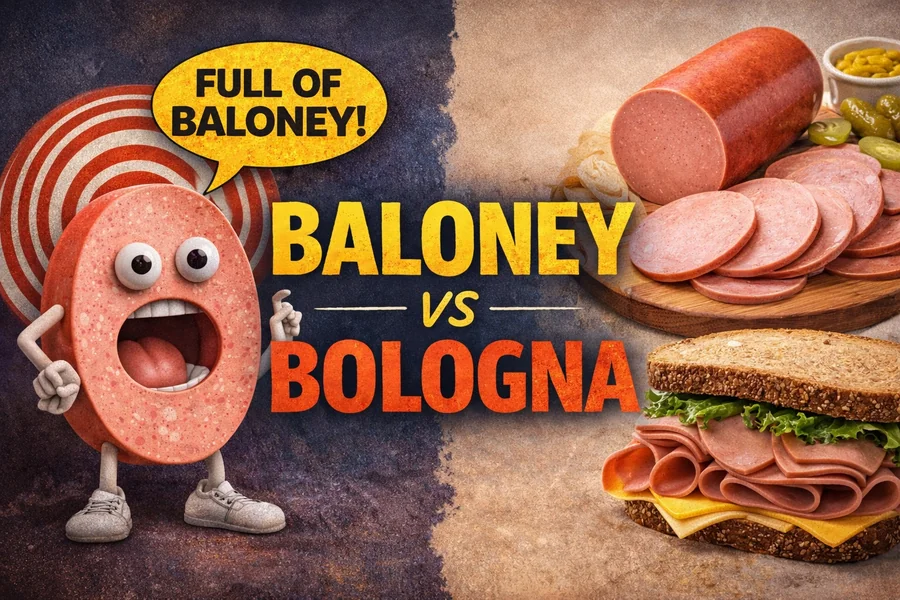
Many people confuse baloney vs bologna because they look and sound related. They are the words that may be spoken in ordinary language and used in the text that is written in normal English. They possess varied definitions.
Bologna is a type of sausage that comes from Italian cuisine. Baloney, on the other hand, is an informal slang word that means nonsense or something that is not true.
Understanding baloney vs bologna helps avoid confusion in writing and speech. But conversely being different makes you know what you are saying and not to use a wrong word in a sentence.
This guide explains the difference between baloney vs bologna, shows examples & highlights common mistakes. By the concluding part, you will have been in a position to know when to use what word.
Define Baloney
Baloney is a slang term used to describe nonsense or something that is not believable. He/she generally employs it when a person believes that something is wrong or farfetched.
For example, if someone makes a claim that sounds unrealistic, another person might respond by saying, “That’s baloney.” In this respect, the word implies disbelief or disapproval.
Baloney is common in informal speech. It normally appears in the dialogue, in humour and in the prose.
Some common meanings of baloney include:
- Something meaningless or untrue.
- An unbelievable statement.
- One way to refute a claim humorously.
Example:
- “That story about winning the lottery twice sounds like baloney.”
In short, baloney is a slang word that signals doubt or disbelief.
Define Bologna
Bologna is a type of sausage made from finely ground meat. It normally consists of pork, beef or a combination of meats and spices.
The name comes from the Italian city of Bologna. Sausage style gained popularity in most nations and is also commonly applied in sandwiches.
Unlike baloney, bologna is a food term. It is a real product as opposed to opinion or expression.
People often slice bologna and serve it in sandwiches, snacks, or lunch meals.
Examples of bologna in everyday life include:
- Bologna sandwiches
- Fried bologna with eggs
- Packed bologna in school lunches
Example sentence:
- “She made a sandwich with cheese and bologna.”
Although the pronunciation of bologna in English often sounds like “baloney,” the spelling and meaning are different.
Baloney vs Bologna: Quick Comparison
| Word | Meaning | Context | Example Sentence |
| Baloney | Slang for nonsense or something untrue | Informal speech | “That excuse is baloney.” |
| Bologna | A type of sausage made from meat | Food and cooking | “He ordered a bologna sandwich.” |
This quick comparison helps clarify baloney vs bologna. One word refers to nonsense, while the other refers to food.
How To Properly Use The Words In A Sentence
Using baloney vs bologna correctly depends on context. The definitions are highly contrasting and therefore, it is significant to use an appropriate word.
Remember this simple rule:
- Use baloney when talking about nonsense or disbelief.
- Use bologna when talking about food.
You can check the meaning first and then write, to make sure that your sentence is clear.
Read Also: Inbalance Or Imbalance: How To Spell It Correctly And Avoid Mistakes
How To Use Baloney In A Sentence
Baloney appears mostly in informal conversations. It can be frequently applied when a person does not agree with a statement.
Examples of correct usage:
- “That rumor is pure baloney.”
- “Don’t believe that story. It’s baloney.”
- “He said he ran ten miles in ten minutes, but that sounds like baloney.”
Baloney works well in casual dialogue or storytelling. It gives speech personality and humour.
But when writing formally it is normally better to use such words as false, incorrect or nonsense
How To Use Bologna In A Sentence
Bologna refers to food. It is commonly found when explaining food or goods.
Examples of correct usage:
- “She packed a bologna sandwich for lunch.”
- “He fried slices of bologna in a pan.”
- “The deli sells fresh bologna and cheese.”
When writing about food, always use the spelling bologna.
Even though the pronunciation sounds like “baloney,” the spelling should remain the same in written English.
More Examples Of Baloney & Bologna Used In Sentences
Looking at examples makes it easier to understand baloney vs bologna.
Below are several sentences showing the correct use of each word.
Examples Of Using Baloney In A Sentence
- “That explanation is baloney.”
- “He said he met a celebrity yesterday, but it sounds like baloney.”
- “Stop telling baloney and be honest.”
- “Her excuse about missing the meeting was baloney.”
- “That claim about instant success is baloney.”
- “The rumor spreading online is complete baloney.”
- “He laughed and said the whole story was baloney.”
- “The advertisement sounded like baloney to me.”
- “Calling that plan perfect is baloney.”
- “I don’t believe that theory. It’s baloney.”
These examples show how baloney expresses disbelief.
Examples Of Using Bologna In A Sentence
- “He made a sandwich with bologna and mustard.”
- “She bought fresh bologna from the market.”
- “The lunch menu included a bologna sandwich.”
- “They fried bologna slices for breakfast.”
- “The picnic basket had bread and bologna.”
- “Kids often enjoy simple bologna sandwiches.”
- “He added bologna to the sandwich with cheese.”
- “The deli offers smoked bologna.”
- “My grandfather likes grilled bologna.”
- “She prepared a snack with crackers and bologna.”
These sentences show the correct use of bologna in food-related contexts.
Common Mistakes To Avoid
Many people mix up baloney vs bologna because the words sound similar.
The meanings of the same are however very different. A misuse of either one may alter the meaning of a sentence.
We will examine two errors.
Mistake #1: Using “Baloney” When You Mean “Bologna”
A common mistake happens when someone writes baloney when referring to food.
Incorrect example:
- “I ate a baloney sandwich.”
Correct version:
- “I ate a bologna sandwich.”
Remember that bologna is the correct spelling when referring to the sausage.
Mistake #2: Using “Bologna” When You Mean “Baloney”
Another mistake occurs when someone writes bologna when they actually mean nonsense.
Incorrect example:
- “That story is bologna.”
Correct version:
- “That story is baloney.”
In this case, the slang word baloney should be used.
Read Also: Specialty Or Speciality: What’s The Difference in Meaning, Spelling & Usage?
Tips For Avoiding These Mistakes
To avoid confusion with baloney vs bologna, try these simple tips:
- Remember that baloney = nonsense
- Remember that bologna = food
- Check the context before writing
- Think about whether the sentence is about an opinion or a meal
These simple checks make writing clearer.
Context Matters
Choosing between baloney vs bologna depends entirely on context.
Understanding the situation helps you select the correct word.
Baloney
Baloney usually appears in casual speech. It expresses doubt, disagreement, or humor.
For example:
- Someone claims something unrealistic.
- Another person responds by saying it is baloney.
Situations where baloney is used:
- Debates or arguments
- Casual conversations
- Storytelling
In these contexts, the word helps show skepticism.
Bologna
Bologna appears in cooking or food discussions.
For example:
- Grocery shopping
- Restaurant menus
- Meal descriptions
In these cases, the word refers to the sausage itself.
Examples include:
- Bologna sandwiches
- Fried bologna
- Bologna slices
Recognizing the context makes it easy to choose the correct word.
Exceptions To The Rules
The rules for baloney vs bologna are clear, but some situations can still cause confusion.
One reason is pronunciation. In American English, bologna is often pronounced “baloney.” Due to this, several individuals think that spelling should be in accordance with sound.
However, the correct spelling remains bologna when referring to the food.
Baloney
Baloney appears mainly as slang. It is not commonly used in formal writing.
However, it may appear in:
- Dialogue in books
- Informal articles
- Comedy or humor
In these cases, baloney adds personality to the sentence.
Bologna
Bologna may appear in different food contexts.
Examples include:
- Traditional bologna: sliced sausage for sandwiches
- Regional bologna styles: smoked or seasoned variations
Despite pronunciation differences, the spelling remains the same.
Practice Exercises
Practice helps reinforce the difference between baloney vs bologna.
Try the exercises below.
Exercise 1: Fill In The Blank
Fill the blank with baloney or bologna.
- That explanation sounds like complete ________.
- She packed a ________ sandwich for lunch.
- I don’t believe that story. It’s ________.
- He bought fresh ________ from the deli.
- That rumor is pure ________.
Answer Key
- baloney
- bologna
- baloney
- bologna
- baloney
Exercise 2: Sentence Writing
Write sentences using the correct word.
| Word | Example Sentence |
| baloney | That excuse sounds like baloney. |
| bologna | She made a sandwich with bologna. |
| baloney | The claim about instant fame is baloney. |
| bologna | He added bologna and cheese to the sandwich. |
| baloney | Saying that plan will work instantly is baloney. |
Exercise 3: Multiple Choice
Choose the correct word.
- ________ is a slang word meaning nonsense.
- A) Bologna
- B) Baloney
- A sandwich often includes ________.
- A) Baloney
- B) Bologna
- Saying something unbelievable may sound like ________.
- A) Baloney
- B) Bologna
- The deli sells sliced ________.
- A) Baloney
- B) Bologna
- Calling that excuse believable is ________.
- A) Baloney
- B) Bologna
Answer Key
- Baloney
- Bologna
- Baloney
- Bologna
- Baloney
Conclusion
Understanding baloney vs bologna helps you write and speak more clearly.
Baloney is an informal word that means nonsense or something unbelievable. Bologna is a type of sausage often used in sandwiches.
Although the words are similar in sounds, they have entirely different meanings. The application of the right word is dependent on the context.
If the sentence is about disbelief, choose baloney. If it is about food, choose bologna.
With practice and examples, it becomes easy to remember the difference between baloney vs bologna.
FAQs:
What is the difference between baloney and bologna?
Baloney means nonsense or something unbelievable, while bologna refers to a type of sausage used in sandwiches.
Why does bologna sound like baloney?
In English pronunciation, the word bologna is often spoken as “baloney,” which causes confusion between the two spellings.
When should I use baloney in a sentence?
Use baloney when you want to describe a statement as false, exaggerated, or unbelievable.
When should I use bologna in a sentence?
Use bologna when talking about food, especially sandwiches or deli meat.
Is baloney formal or informal?
Baloney is an informal slang word. It is normally spoken rather than written.
Read More Articles: Hopeing Or Hoping: Which Spelling Is Correct?