To write well and correctly, it’s essential to understand loose or lose difference. The words are similar but not the same. They are easily confused, particularly when typing quickly. This article explains it all simply so you can be sure to get it right.
What Is The Loose Or Lose Difference?
The loose or lose difference comes down to meaning and grammar:
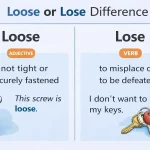
- Loose is an adjective. It describes something that is not tight or not fixed.
- Lose is a verb. It describes an action, like misplacing something or failing to win.
This small spelling change leads to a big difference in meaning.
Loose Vs Lose: Quick Answer
Loose means not tight or free.
Lose means to misplace something or fail to win.
Example:
- My shirt is loose.
- I don’t want to lose my phone.
Loose Or Lose Difference Explained Clearly
The loose or lose difference becomes easy when you focus on usage:
- Use loose when describing a condition
- Use lose when showing an action
Quick test:
- Replace with “not tight” → use loose
- Replace with “fail” or “misplace” → use lose
Key Differences Between Loose And Lose
Here is a quick breakdown of the loose or lose difference:
- Loose
- Adjective
- Describes something
- Means not tight
- Lose
- Verb
- Shows action
- Means to misplace or fail
This is the core rule you need to remember.
Read Also: Organised Or Organized: The Real Difference Most Writers Miss (With Clear Examples)
Loose Vs Lose: Quick Comparison You Can Scan In 10 Seconds
| Feature | Loose | Lose |
| Part of Speech | Adjective | Verb |
| Meaning | Not tight or free | To misplace or fail |
| Usage | Describes something | Shows an action |
| Example | These shoes are loose | I might lose my keys |
| Memory Trick | Double “o” = more space | Single “o” = action |
This table helps you quickly understand the loose or lose difference at a glance.
What Does Loose Mean?
Loose is used to describe something that is not tight, fixed, or secure.
Common uses:
- Clothing that does not fit tightly
- Objects that are not firmly attached
- Situations that feel relaxed or free
Examples:
- This jacket feels loose
- The screw is loose
- Keep the rope loose
In each case, loose describes a state, not an action.
What Does Lose Mean?
Lose is used when something happens. It is always an action.
Common uses:
- Misplacing something
- Failing to win
- No longer having something
Examples:
- I don’t want to lose my wallet
- They may lose the game
- Try not to lose your focus
Here, lose shows an action or result.
Common Mistakes With Loose And Lose
Many writers confuse these words because of their similar spelling.
Incorrect vs Correct:
- ❌ I don’t want to loose my phone
- ✅ I don’t want to lose my phone
- ❌ These pants are too lose
- ✅ These pants are too loose
Why this happens:
- Fast typing
- Similar pronunciation
- Lack of clarity on grammar rules
Fixing this mistake improves your writing instantly.
Easy Ways To Remember The Loose Or Lose Difference
You can lock in the loose or lose difference with simple tricks.
1. Double “O” Rule
- Loose has two “o” → more space → not tight
- Lose has one “o” → action
2. Sound Trick
- Loose sounds like “looss”
- Lose sounds like “looz”
3. Replace Method
- Replace with “tight” → use loose
- Replace with “fail” → use lose
These methods work in real writing situations.
Read Also: Busyness Vs Business: Meaning, Differences & Simple Examples
Real-Life Examples Of Loose And Lose
Understanding the loose or lose difference is easier with real examples.
Loose in daily use:
- The handle is loose
- Wear loose clothes in hot weather
- The chain is too loose
Lose in daily use:
- Don’t lose your keys
- I always lose my charger
- They might lose the match
These examples show how each word fits naturally.
Loose Vs Lose In Sentences
Here are side-by-side examples to highlight the loose or lose difference:
- The knot is loose → describes condition
- Don’t lose the rope → shows action
- My shoes feel loose
- I might lose my balance
Seeing both in context helps you remember faster.
Why The Loose Or Lose Difference Matters
Using the wrong word can confuse readers.
Example:
- “Don’t loose your bag” → incorrect
- “Don’t lose your bag” → correct
Where it matters:
- School assignments
- Blog writing
- Emails and messages
Even small grammar errors can affect clarity and trust.
Loose Or Lose Difference In Digital Writing
Mistakes often happen online.
Common reasons:
- Auto-correct errors
- Fast typing
- Lack of proofreading
Simple tip:
Pause and check your sentence before posting. This helps avoid mixing up the loose or lose difference.
Practice Sentences (Test Yourself)
Fill in the blanks:
- My shirt is too ______
- I don’t want to ______ this chance
- The bolt feels ______
- Try not to ______ your temper
Answers:
- loose
- lose
- loose
- lose
Practice helps you remember the correct usage.
Loose Or Lose Difference In Exams And Writing Tests
This topic often appears in:
- Grammar tests
- English exams
- Writing tasks
Tip:
Focus on meaning, not spelling alone. This makes choosing the right word easier.
Final Thoughts
Once you know the ropes, the loose or lose question is easy. One word describes an object. The other describes an action.
Key takeaway:
- Loose = not tight
- Lose = lose or fail
After some practice, you will avoid making this common error and improve as a writer.
FAQs:
What is the difference between “loose or lose difference”?
Loose means not tight. Lose means to misplace something or fail.
How do you use lose in a sentence?
Example: I don’t want to lose my keys.
How do you use loose in a sentence?
Example: These shoes feel loose.
Why do people confuse loose and lose?
They look similar and sound close, which leads to spelling mistakes.
Read More Articles: Baloney Vs Bologna: What’s The Real Difference?

Hi, I’m Emily Grace, a blogger with over 4 years of experience in sharing thoughts about blessings, prayers, and mindful living. I love writing words that inspire peace, faith, and positivity in everyday life.