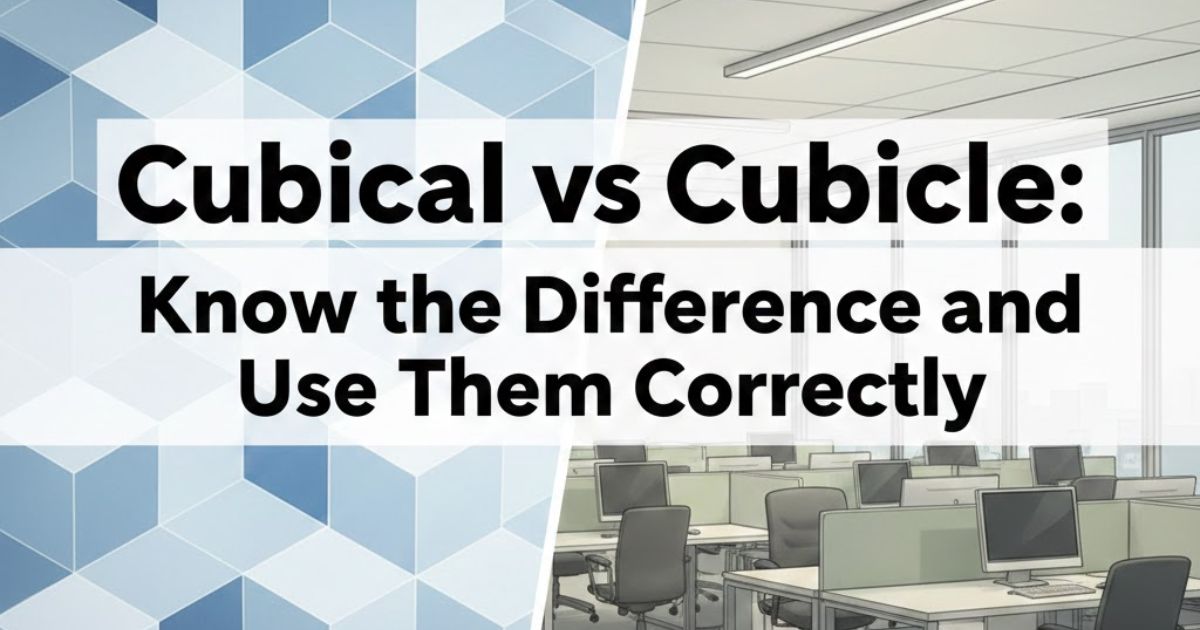
Many people confuse cubical and cubicle, but understanding the difference is important for clear communication. A cubical refers to a geometric shape with equal sides and faces, often used in math, architecture, and design.
On the other hand, a cubicle is a small workspace or office partition designed for productivity and privacy. Using the wrong term can lead to misunderstandings, especially in writing, emails, or professional discussions.
In this article, we will explain the meanings, differences, and correct usage of both words. By the end, you will feel confident using cubical and cubicle in the right context, whether you are discussing shapes or office spaces.
Understanding the Terms: Cubical and Cubicle
Cubical
A cubical is a three-dimensional geometric object that has six equal faces, twelve edges, and eight vertices. It is essentially a cube-shaped structure used in mathematics, architecture, and design. The term comes from the word cube, and it describes anything with equal sides and angles.
For example:
- “The museum displayed a cubical sculpture with perfect symmetry on all sides.”
- “In geometry class, we studied cubical matrices to understand three-dimensional space.”
Notice that cubical is mostly used in scientific, architectural, or mathematical contexts. Using it to describe office workspaces is incorrect. Understanding this distinction helps improve professional writing, communication clarity, and accuracy in context.
Cubicle
A cubicle is a small, partitioned workspace often found in offices, libraries, or studios. It provides privacy, organization, and focus while still being part of a larger environment. The word comes from the Latin cubiculum, meaning a small room.
For example:
- “Each employee has a cubicle with a desk and computer.”
- “The library offers soundproof cubicles for focused study.”
Unlike cubical, which describes a cube-shaped object, cubicle refers to a functional office space. Using the correct term improves professional writing, communication clarity, and helps avoid misunderstandings in emails, reports, and workplace conversations.
Key Differences Between Cubical and Cubicle
Understanding the difference becomes easy when you focus on meaning and context:
| Feature | Cubical | Cubicle |
| Origin | Derived from the word cube | Comes from Latin cubiculum, meaning a small room |
| Meaning | Describes objects that are cube-shaped or have cubic properties | Refers to a small, partitioned workspace |
| Usage | Used in geometry, architecture, and science | Found in offices, libraries, and study areas |
| Common Mistake | Incorrectly used for office workspaces | Rarely misused when referring to offices |
Quick Tip
When talking about shapes or three-dimensional objects, use cubical. When referring to a workstation or office partition, use a cubicle.
Common Misconceptions and Mistakes
Many people confuse cubical and cubicle because they sound similar, but their meanings are very different. A common mistake is using cubical to describe an office workspace:
- “I spent all day in my cubical at work.” → This is incorrect; the correct word is cubicle.
These errors often happen because of:
- Phonetic similarity – the words sound alike when spoken.
- Autocorrect mistakes – spellcheck may suggest cubical if it doesn’t recognize cubicle.
- Casual usage – people sometimes assume cubical fits in office contexts.
Even professional writing can include these errors, which can reduce clarity, professional credibility, and communication accuracy. Remembering the distinction ensures your writing is clear and correct.
Usage in Everyday Life
Workplace and Office
In modern offices, cubicles are widely used to create organized and semi-private workspaces. They help employees focus while still being part of a larger team environment. Companies design cubicles to:
- Optimize office space efficiently.
- Provide privacy for focused work.
- Reduce noise distractions while supporting collaboration.
For example:
- “The HR department is redesigning the floor plan to include ergonomic cubicles for better employee comfort.”
- “Each team member has a cubicle with a desk, computer, and storage area.”
Education and Libraries
In schools, colleges, and libraries, cubicles are often used to create quiet, focused study areas. They help students concentrate while still being part of a shared environment. Cubicles in educational spaces:
- Enhance focus and concentration for studying or research.
- Provide semi-private workstations without building full rooms.
- Can be temporary or modular, allowing flexibility in layout.
Architecture and Design
In architecture and design, the term cubical is commonly used to describe cube-shaped structures and objects with equal sides and angles. It helps architects, designers, and engineers communicate about geometric forms and spatial layouts.
For example:
- “The building features a cubical atrium that maximizes natural light.”
- “The designer created cubical storage units for a modern modular home.”
Language Tips and Memory Aids
Mnemonics to Remember the Difference
Remembering the difference between cubical and cubicle can be easy with a few simple tricks:
- Cubical = Cube → Think geometric shape with six equal sides.
- Cubicle = Work Space → Think office partition or small workstation.
Visualize a cube for cubical and a small desk area for cubicle.
Pronunciation Guide
- Cubical → /ˈkjuː.bɪ.kəl/ → sounds like “cube-i-cal”, emphasizing the connection to a cube or geometric shape.
- Cubicle → /ˈkjuː.bɪ.kəl/ → sounds almost the same, but context shows it refers to a workspace or office partition.
Writing Style Recommendations
To use cubical and cubicle correctly in your writing, follow these simple guidelines:
- Use cubical when describing cube-shaped objects, geometric forms, or architectural designs.
- Use cubicle for workspaces, office partitions, or study areas.
- Avoid casually substituting one for the other in emails, reports, or professional documents.
- Proofread your writing to ensure clarity, accuracy, and professional credibility.
Related Terms and Variations
Understanding related terms can help you use cubical and cubicle more accurately:
For Cubical (Geometry & Design):
- Cubically – Describes something in a cube-like manner.
- Cube-shaped – Another way to indicate cubical objects.
- Cubical structures – Used in architecture or design contexts.
For Cubicle (Workspace & Office):
- Workstation – A general term for an employee’s desk area
- Partition – Refers to a cubicle wall or divider.
- Cubicle-dwelling – Informal term for someone who works in a cubicle space.
- Booth – Small enclosed area, similar to a study cubicle or office pod.
Knowing these related terms and variations helps improve writing clarity, context understanding, and ensures professional and accurate communication.
Fun Facts and Interesting Insights
Here are some interesting facts about cubical and cubicle:
- The modern office cubicle was designed in the 1960s by Robert Propst through his Action Office concept, aiming to improve workspace efficiency and employee privacy.
- Some modern cubicles are fully soundproofed pods, allowing employees to work with high concentration.
- The word cubical has its roots in mathematics and architecture, not office culture, and describes any cube-shaped structure.
- Pop culture often jokes about cubicles as “soul-sucking boxes,” but ergonomic designs and flexible layouts have improved workspace comfort and productivity.
Conclusion
Understanding the difference between cubical and cubicle is essential for clear and professional communication. Cubical refers to a cube-shaped object used in geometry, architecture, and design, while cubicle is a small workspace found in offices, libraries, or study areas.
Using the right term prevents confusion, improves writing accuracy, and strengthens professional credibility. By remembering the meanings, applying mnemonics, and paying attention to context, you can confidently use both words in academic, professional, and everyday situations. Correct usage ensures your writing is clear, precise, and effective.
FAQs
What is the main difference between a cubical and a cubicle?
A cubical is a cube-shaped object used in geometry, architecture, and design, while a cubicle is a small workspace in offices, libraries, or study areas.
Can I use the word cubical for office spaces?
No. Cubical refers to shapes or structures, not workspaces. Use cubicle for offices or study areas.
Why do people confuse cubical and cubicle?
The words look and sound similar. People often mistakenly use cubical for workspaces in casual writing or conversation.
How can I remember the difference easily?
Think cubical = cube (geometric shape) and cubicle = office or study space. Using mnemonics and context clues can help.
Does using the wrong term affect professional writing?
Yes. Misusing these words can reduce writing accuracy, clarity, and professional credibility in emails, reports, or documents.
Read More Articles: Thoughtgenic

Hi, I’m Emily Grace, a blogger with over 4 years of experience in sharing thoughts about blessings, prayers, and mindful living. I love writing words that inspire peace, faith, and positivity in everyday life.





![Ten Things: My Boss is a [Censored] – What Do I Do?!](https://thoughtgenic.com/wp-content/uploads/2026/02/ten-things-my-boss-is-a-censored-–-what-do-i-do-1-150x150.jpg)