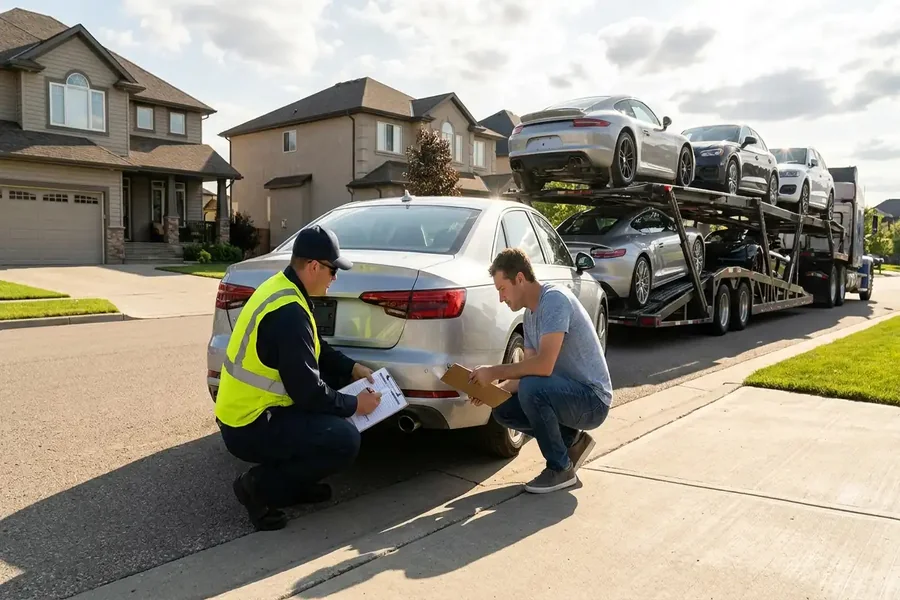
Before you hand over a deposit, check three things. Look up the company’s MC number in the FMCSA SAFER database and confirm the operating authority is active. Ask for a certificate of insurance and read the cargo limit and the deductible. Find out whether you are hiring a broker or the company that owns the truck, because a damage claim goes to whoever carried the car. All three checks are free and take about ten minutes.
The problem with how people usually pick
Someone moving from Ohio to Arizona types “car shipping” into Google at ten at night, calls the top three results, and books whoever answered first and sounded reasonable.
There is nothing stupid about that. It is how most of us buy a service we have never bought before. But car transport is set up in a way that makes it easy to end up with a company you know nothing about.
Three kinds of companies, one search result
The company whose website you are on may be any of three things, and the site rarely says which.
A motor carrier owns trucks. It has drivers, trailers, and operating authority from the FMCSA. If you book with one directly and your car gets damaged, you know exactly who had it.
A broker arranges the move. It finds a carrier already running your route, negotiates a rate and handles the paperwork. Brokers do not own trucks. Most vehicle transport in the United States is booked this way, which surprises people who assume they hired the trucking company. Nothing wrong with the model. A good broker knows hundreds of haulers and can fill a route faster than you could by phoning around. It just will not be the company holding your keys.
A comparison platform does not arrange moves at all. It collects offers from brokers so you can see them next to each other, then steps aside once you choose.
Ask which one you are talking to in the first two minutes. It changes what the rest of the questions should be.
Check one: the MC number
Every company arranging or performing interstate transport needs authority from the Federal Motor Carrier Safety Administration. Brokers need broker authority, carriers need carrier authority, and some hold both.
The number is a six or seven digit MC number, sometimes alongside a USDOT number. A legitimate company will give it to you immediately; many print it in the website footer.
Take that number to the FMCSA’s SAFER database, which is free and public. What you are looking for:
- Operating authority status: it should say active, not inactive or revoked.
- Entity type: broker, carrier, or both. Compare it with what they told you on the phone.
- Insurance on file: SAFER shows whether required filings are current.
- The legal and DBA names: if the website brands itself one way and the authority is registered to a company you have never heard of, ask why. Sometimes the answer is fine. Sometimes it is a company trading under a new name after a bad run.
A refusal to hand over an MC number ends the conversation. There is no legitimate reason for it.
Check two: insurance, including what is excluded
“Fully insured” means almost nothing on its own. The numbers mean something.
Ask for the certificate of insurance. Look at the cargo coverage per vehicle: $100,000 to $250,000 is the usual range depending on whether the car travels open or enclosed. Then ask for the deductible, because on some policies it is a few hundred dollars and on others it is a few thousand, and you may be the one paying it.
The exclusions matter more than the headline figure. Personal belongings inside the car are generally not covered, and many haulers refuse loaded vehicles outright. Weather damage is often out. So is pre-existing damage, which is why you inspect the vehicle at pickup.
If your car is worth more than the cargo limit, two questions follow. Does the company offer a higher limit for enclosed transport, and does your own policy cover the car while somebody else is transporting it? Call your insurer. It takes five minutes.
Check three: who actually carries the car
If you booked with a broker, the hauler is assigned later, sometimes only a day or two before pickup. Ask upfront whether you will be told which company it is, and whether you can look that company up too.
Some brokers share the carrier’s name and MC number as a matter of course. Others treat it as proprietary. The second answer is not automatically a red flag, but a broker that vets its carriers properly usually has no reason to hide which one it picked.
This is where comparison platforms do something useful. On a platform, the screening happens before you see any prices. Compare The Carrier, for instance, verifies each broker’s operating authority, active insurance and safety record through SAFER before it can quote at all, and holds its network to cargo minimums of $100,000 to $250,000 per vehicle. More than 50 brokers compete on each shipment, which means the five prices you are comparing come from five companies that have already been through that check.
You can replicate all of it yourself. Nobody does it five times at eleven at night, which is the honest argument for the platforms.
Reviews, read properly
Star ratings are close to useless in this industry, because almost every company has a mix of five stars and one star and nothing in between. Shipping a car either goes smoothly or goes badly, and people write reviews about the second kind.
Read the bad ones instead, looking for a pattern:
- Delays that nobody communicated. A late truck is normal. A late truck that nobody mentioned until the customer called three times is a process problem.
- Prices that went up after booking. If several reviews describe the same thing, the company’s quotes are probably estimates dressed as prices.
- Damage claims that went nowhere. Pay attention to whether the company replied at all.
Then check the dates. Twenty angry reviews from 2022 and nothing since suggests something got fixed. Glowing reviews from 2021 and complaints all through this year suggests the opposite.
The quote itself tells you things
A quote carries information about the company that wrote it.
A quote hundreds of dollars below everyone else’s is rarely a deal. In car shipping, the price has to be high enough that a driver agrees to take the load. Below that, the car waits. The customer experiences a delay and never learns it was a pricing decision.
Published route averages give you a sanity check. For state to state car shipping, Buffalo to Orlando averages about $757, Phoenix to Houston $811, Miami to Chicago $984 and Portland to New York $1,484. Short hops under 500 miles generally fall between $300 and $550, and cross-country moves between $800 and $1,400. Enclosed adds 30 to 50 percent on top.
Those are averages, and route demand moves them. But if a quote comes in at half the average for your route, ask why.
Regional routes have their own quirks
Some lanes come with specifics worth raising on the call. California is one. Long runs into the state are busy, so per-mile rates drop: Chicago to Fresno averages around $911 and Columbus to Sacramento around $965, both near $0.37 to $0.40 a mile. The complication is the last mile. A loaded hauler is around 80 feet long and will not fit on residential streets in much of Los Angeles or San Francisco, so the driver meets you somewhere nearby. Tehachapi Pass closes in bad weather. A broker who regularly books California auto transport volunteers all of this. One who does not may be quoting a route it has never run.
The deposit question
Ask when money changes hands and in what form.
Some companies take nothing until a carrier is assigned. Some take a deposit at booking. Ask whether the deposit is refundable, what the cancellation deadline is, and how the balance is paid, because many drivers still want cash, a cashier’s check or a money order on delivery.
Get the cancellation terms in writing before you pay anything.
Ten minutes, in order
- Get the MC number and look it up in SAFER.
- Confirm broker or carrier, and compare with what they said.
- Ask for the certificate of insurance; read the cargo limit and deductible.
- Ask whether the price is binding and what could change it.
- Ask for the pickup window and what happens if it passes.
- Read the one-star reviews from the last twelve months.
- Ask about the deposit and cancellation terms, and get them in writing.
If a company handles those seven without friction, the rest of the move usually goes fine.
FAQ
How do I check if a car shipping company is licensed?
Look up its MC or USDOT number in the FMCSA SAFER database. Operating authority should be listed as active, with current insurance filings.
Is it bad to book with a broker instead of a trucking company?
No. Most car transport in the country is arranged by brokers. Just confirm the broker’s authority and ask whether you will be told which carrier moves the car.
What insurance should a car shipping company carry?
Cargo coverage of $100,000 to $250,000 per vehicle is typical, depending on trailer type. Ask for the certificate and the deductible.
Why is one quote so much cheaper than the others?
Often because it is below what a driver will accept for that route, which means the car waits until the price goes up.