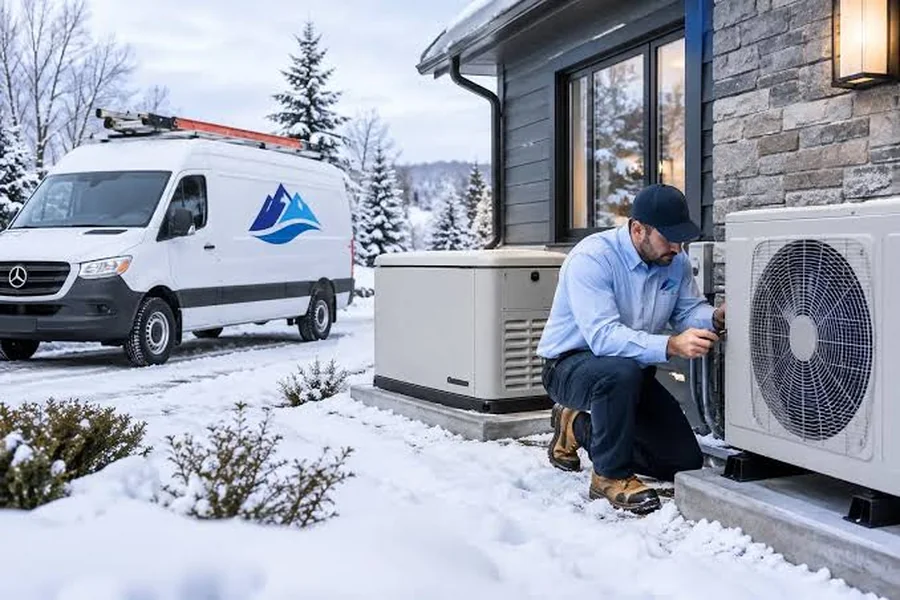
Most Denver homeowners buy a heat pump for the wrong reason. They want air conditioning they can live with, a room that stops cooking in July, and they end up with a decision that quietly determines every winter for the next fifteen years.
Here’s the promise: by the end of this you’ll know how to compare quotes without getting buried, where your indoor units actually belong, why our altitude changes what installers can promise you, and how to spot a contractor who has never commissioned a cold climate system in their life.
One field test sits well above the rest. A system that hits its rated capacity in a lab at mild temperatures can fall on its face at zero. Ask any installer to walk you through what their equipment does at the temperatures you actually get in January, not the number printed on the box.
What makes Denver a hard place for heat pumps
Denver compresses three problems into one city. You get genuine cold, roughly two miles of altitude, and air so dry that a wood floor will argue with you about it in February.
The altitude part surprises people. Air at altitude is thinner, so there’s less of it moving across a condenser coil and through your ductwork with every rotation of the fan. A design that works beautifully at sea level can be short on capacity up here, and the fix isn’t a bigger box on the wall. It’s a contractor who accounts for your address before they size anything.
The temperature swings matter just as much. Denver has a long, stubborn habit of going from warm afternoons to hard freezes inside forty-eight hours. A system with real inverter controls can ramp its compressor output up and down as conditions change rather than slamming on and off. That’s the entire reason this style of heating and cooling took over much of Europe and Asia before it made a dent in the U.S. According to the Department of Energy, heat pumps move heat instead of creating it, which is why they can outperform combustion heating on efficiency when they’re properly sized and installed.
My bias, stated up front: I’d rather see a home with three carefully placed heads than a house-wide system slapped together to hit a price. Denver rewards precision.
Rebates and running costs: the math nobody runs before signing
Rebate programs exist at the federal, state, and utility level, and they stack in ways that change your break-even. But the upgrades that qualify keep getting revised, and a quote built on an outdated incentive is a quote you’ll be renegotiating in April.
So don’t take a rebate figure from a salesperson’s spreadsheet. Look up your utility’s current offer yourself, and have your contractor’s estimate show the rebate line as a separate, clearly labeled item. If a quote buries the incentive inside a “discount,” that’s a pricing trick, not a program.
Cold climate equipment carries a price premium at the supply house, so it lands on your quote too. If you want to judge how much of that cost you’ll recover, the broad relationship between wages and housing costs in this region is worth a look: Bureau of Labor Statistics data on the Denver area shows why labor charges here rarely match national averages. Get a real number for the work, then decide.
Picking a contractor: the C.O.L.D. test
HVAC is a low-barrier trade to enter and a hard one to do well. Here’s the filter I use when someone asks me to review bids. I call it the C.O.L.D. test, and it has nothing to do with weather.
- C: Commissioning report. Ask for it before payment. A properly commissioned system gets its refrigerant charge verified and its airflow measured at each indoor head. If the answer is a shrug, the answer is no.
- O: Outdoor unit derate. Does the proposal adjust capacity for altitude? That’s a two-line note on a real bid and a blank space on a bad one.
- L: Line hide details. Condensate management and line-set routing are where sloppy installs show up first.
- D: Drain placement in unconditioned space. If they run the condensate somewhere that freezes, you’ll learn about it on the coldest morning of the year.
Three more things to weigh while you’re comparing bids. Load calculation: a real Manual J, or at least an equivalent room-by-room analysis, done on your house rather than your square footage. Permit pulling: whoever installs it should be pulling the permits, because that keeps warranty and rebate eligibility clean. And timing: book in spring or early fall, because shoulder season scheduling is calmer than the week the first freeze hits. For anyone searching for Denver ductless heat pump experts, the specific thing to vet is cold climate commissioning experience, not how flashy the truck wrap looks. That’s what separates a bid worth signing from a liability with a warranty card.
Placement: why the same system feels different in two houses
Two identical systems installed in two similar homes can feel completely different, and placement is usually why.
Think about where you actually spend your evenings. A single head in a hallway is easy to sell on paper and frustrating in practice, because hallways are transitional space. You don’t live in them. A head pointed at where you sit, sleep, or cook delivers comfort a spec sheet can’t show you.
Concrete scenario worth copying. A bungalow near Sloan’s Lake, 900 square feet, one open living area with two small bedrooms off it. The clean answer is two indoor heads, one covering the main space and one in the primary bedroom, with the outdoor unit on a wall bracket on the north side, off the ground, out of snow drift range, and away from the bedroom window. Three heads would be overselling you. One head would leave that back bedroom cold.
And don’t let anyone put the outdoor unit somewhere you’ll hear it through the wall you sleep against. It’s a compressor, not a refrigerator.
Your decision checklist
Run this before you sign anything. It takes twenty minutes and it’s the difference between a system you love and a system you argue with.
- Get three quotes. If they’re all the same price, you’re not comparing different contractors, you’re comparing paint colors.
- Confirm the proposal includes a room-by-room load calculation, not a rule of thumb.
- Ask for at least two recent local installs you can look at, not references from another state.
- Verify the installer’s license and confirm who pulls the permit.
- Look up current rebates yourself, then make sure the quote lists them separately.
- Get the commissioning report in writing as a condition of final payment.
I know that’s more homework than most people want on a Tuesday night. Do it anyway.
The systems are genuinely good. They’ve been the default choice across much of the world for decades because they heat efficiently in real cold and cool with less noise and less air movement than a traditional central system. What fails is the installation, and it almost always fails in ways that were visible in the quote if you knew where to look. You do now.
So what’s your next move? Pull your last two utility bills, list the three rooms you spend the most time in, and start calling. Ask every contractor the same four questions from the C.O.L.D. test. The answers will sort themselves.