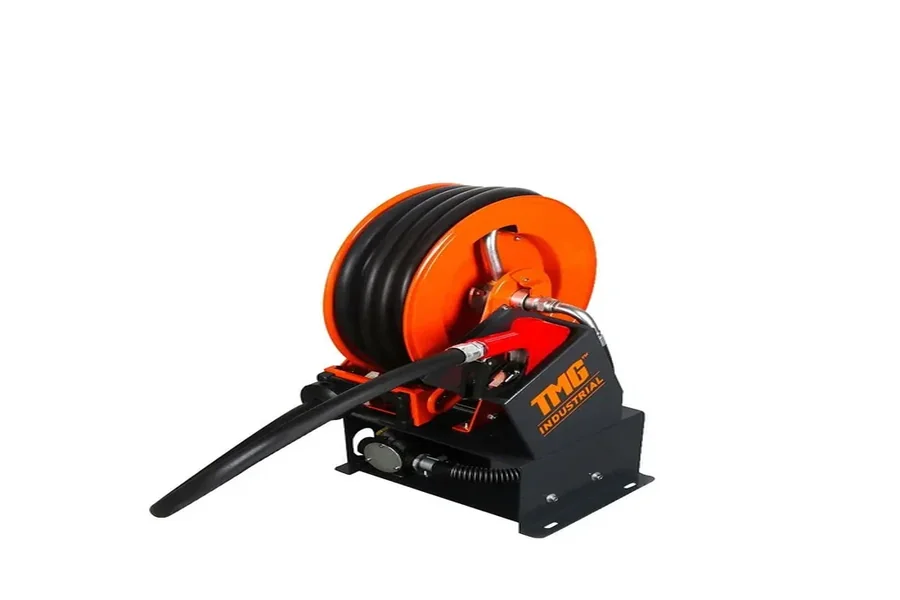
Pumps are compared on flow, and flow is the easiest number to publish. It describes what the pump does for the first few minutes under ideal conditions. What decides whether a pump is still working in its third season is how long it is asked to run at a time, and what has been through it. A portable diesel transfer pump earns or loses its life on those two questions.
Continuous rating is not the same as continuous use
Most portable fuel transfer pump designs carry a duty cycle, often expressed as a number of minutes of operation followed by a rest period. That figure exists because the motor is cooled by the air around it and, on many designs, partly by the fuel passing through it.
Run past the rating and the motor heats faster than it sheds, insulation degrades and the windings eventually fail. The failure is cumulative rather than sudden, which is why a pump that was abused in its first summer dies in its third for no apparent reason.
Filling a tank is not one long operation
The practical reading is that filling a thousand liter tank in one go may exceed the duty cycle even though the pump is nowhere near its flow limit. Operators who use a pump daily learn this without being told, because they feel how hot the housing gets. The ones who burn motors out are the occasional users, since a pump run twice a season never feels hot enough to suggest a pause.
One nozzle across two fuels carries residue
A fuel nozzle, a hose and a filter all retain a small volume of whatever went through them last. Moving the same assembly between diesel and gasoline, or between fuel and a chemical, carries that residue into the next tank.
The quantities are small and the consequences are not. Gasoline in a diesel system reduces lubricity and can damage an injection pump, while diesel in a gasoline engine fouls plugs immediately. Dedicating an assembly to one fuel is cheaper than either outcome.
Water is the contamination nobody plans for
Condensation forms inside any part filled tank as temperature swings, and it collects at the bottom where the pickup of a fuel transfer pump sits. A transfer pump moving fuel from a storage tank is therefore the most likely route for water to reach a machine.
Three habits deal with most of it:
- Drain the storage tank sump regularly
- Fit a filter with a water separator
- Keep the pickup clear of the tank floor
The filter is the one people skip because the fuel looks clean. Water in diesel is usually invisible until it has separated, and by then it is already at the bottom of the tank the pump is drawing from.
Cold weather and the gel point
Diesel contains paraffin wax that begins to crystallize as temperature falls. The cloud point is where it becomes visible; the pour point is where the fuel stops flowing freely, and between them a filter can block while the fuel in the tank still looks liquid.
A diesel pump moving winter blended fuel through a cold hose is a slower machine than the same pump in summer, and a filter that passed a thousand liters in summer can block in a single cold afternoon. Keeping the hose and filter out of the wind does more than people expect.
What the hose reel actually changes
A reel keeps fifty feet of hose off the ground, which is a maintenance benefit before it is a convenience. Hose dragged across gravel abrades, and a hose left in a coil on wet ground ages faster at the contact points.
It also keeps the nozzle off the dirt. Most contamination that reaches a fuel system arrives through the nozzle tip rather than through the fuel, and a nozzle holster is a simple piece of hardware that removes that route entirely.
Priming and what a dry run costs
Most transfer pumps are self priming within a stated lift, and almost all of them are damaged by running dry. The vanes or gears rely on the fuel passing through for lubrication, and a few seconds without it scores surfaces that never recover.
The usual cause is an empty storage tank rather than carelessness. Fitting a low level cut out, or refusing to run the last inch out of a tank, removes the one situation where a pump destroys itself in a minute.
Reading a specification past the flow figure
On a fuel transfer pump, flow, hose length and nozzle type are the comparison figures. Duty cycle, filtration arrangement, whether the pump is self priming and how the inlet is serviced describe what owning it is like.
TMG Industrial supplies this one with a 49 foot hose reel and an automatic nozzle as a complete dispensing setup. Deciding before purchase whether it will serve one fuel or several, and sizing transfers to the duty cycle rather than to the tank, is what determines how long it lasts.