Key Takeaways
- Start with the facility’s actual load profile, including peak demand and planned expansion.
- Confirm voltage, phase, frequency, kVA, impedance, neutral, and short-circuit requirements.
- Account for nonlinear loads that can introduce harmonics and increase neutral loading.
- Match enclosure, cooling, ventilation, and installation details to the real site environment.
- Evaluate energy losses and lifecycle cost, not only the initial purchase price.
- Request complete drawings, test records, installation instructions, and maintenance guidance.
Table of Contents
- Why Transformer Selection Matters
- Dry-Type Transformer Basics
- Start With the Load Profile
- Match Voltage and kVA Requirements
- Account for Harmonics and Power Quality
- Review the Installation Environment
- Compare Efficiency and Total Cost
- Check Standards and Documentation
- Plan for Maintenance and Service
- Common Selection Mistakes
- Transformer Selection Checklist
- Final Thoughts
Selecting a transformer is not simply a matter of matching an input and output voltage. The right unit must support the way a facility actually uses power, remain safe in its installed location, and leave reasonable room for future changes. A properly specified dry type transformer can help commercial buildings, industrial sites, hospitals, data centers, and infrastructure projects distribute power reliably without relying on liquid insulation.
The decision should involve the electrical engineer, facility team, contractor, and equipment supplier early in the project. Reviewing load behavior, power quality, site conditions, efficiency, service access, and documentation before equipment is ordered can prevent costly changes during installation or commissioning.
1. Why Transformer Selection Matters
A transformer influences voltage stability, equipment performance, operating cost, and uptime. An undersized unit may run hotter than intended or struggle during peak demand. Excessive oversizing can add unnecessary upfront cost and increase no-load energy losses. For example, a manufacturing plant adding a new production line needs more than its existing connected load to choose correctly. It must consider simultaneous operation, motor starting, production schedules, and the expected growth timeline.
2. Dry-Type Transformer Basics
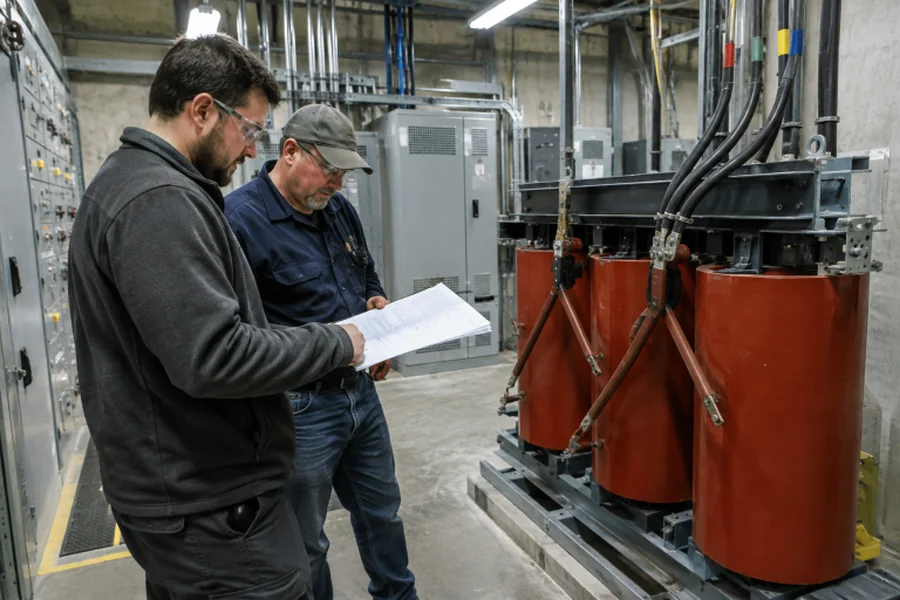
Dry-type transformers use air or solid insulation systems rather than insulating liquid. Ventilated units use airflow to remove heat, while cast-resin designs encapsulate windings in resin for added protection in demanding environments. Dry-type equipment is commonly selected for indoor installations, occupied buildings, and locations where avoiding insulating liquid is beneficial. Liquid-filled transformers remain appropriate for many outdoor and utility applications, so the best choice depends on the project’s electrical, environmental, and space requirements.
3. Start With the Load Profile
Connected load is only a starting point. List the equipment served by the transformer and identify normal running load, peak demand, duty cycle, and motor-starting requirements. Separate continuous loads from intermittent loads, then account for seasonal operation, shift changes, planned tenant improvements, and future equipment. A professional load study is especially valuable where large motors, variable-frequency drives, UPS systems, or rapidly changing demand are involved.
4. Match Voltage and kVA Requirements
Verify primary voltage, secondary voltage, phase, frequency, and required connection type before selecting a unit. The kVA rating must cover the expected demand with practical headroom, rather than relying on a broad rule of thumb. For a three-phase load, apparent power can be estimated as kVA = √3 × voltage × current ÷ 1,000. A 480-volt, three-phase load drawing 120 amperes is approximately 100 kVA. Final selection must also review taps, transformer impedance, neutral capacity, and the available fault current at the installation point.
5. Account for Harmonics and Power Quality
Modern electronic loads can affect transformer loading differently from conventional linear loads. Variable-frequency drives, LED lighting, servers, battery chargers, computers, and UPS equipment may produce harmonic currents. In three-phase, four-wire systems, triplen harmonics can be added in the neutral conductor. Depending on measured or expected conditions, a K-factor-rated transformer, an oversized neutral, filtering, or another harmonic-mitigation strategy may be appropriate. Review power-quality measurements before finalizing the specification whenever a significant nonlinear load is present.
6. Review the Installation Environment
Installation conditions matter as much as electrical ratings. Consider whether the transformer will be indoors, outdoors, on a rooftop, in a basement, near coastal air, or exposed to dust, moisture, heat, or corrosive contaminants. The enclosure, ventilation arrangement, clearances, seismic support, noise level, and maintenance access should fit the actual site. A catalog enclosure rating is not a substitute for evaluating airflow restrictions, water exposure, room temperature, and safe working space around the unit.
7. Compare Efficiency and Total Cost
Transformer losses include no-load losses that occur whenever the unit is energized and load losses that rise as current increases. Because many transformers operate continuously, a modest efficiency difference can affect long-term energy use. Compare purchase price with expected loading, energy cost, maintenance needs, service life, and the cost of downtime. For U.S. projects, the Department of Energy’s distribution transformer standards state that amended federal requirements are scheduled to require compliance on and after April 23, 2029.
8. Check Standards and Documentation
Project specifications should identify applicable UL, CSA, IEEE, NEMA, IEC, utility, and local code requirements. Confirm which standards apply to the transformer type and project location, then request nameplate data, routine test reports, drawings, wiring information, installation instructions, and maintenance guidance. Federal efficiency requirements for covered products are also addressed in the federal regulations for distribution transformers. Complete documentation makes inspections, commissioning, warranty support, and future replacement easier to manage.
9. Plan for Maintenance and Service
Maintenance needs vary by loading, operating hours, and environment. Common tasks include visual inspections, cleaning, connection torque checks, temperature reviews, and verification that vents and airflow paths remain clear. Dust accumulation and blocked ventilation can raise operating temperature. Infrared inspections and insulation testing may also be appropriate under a facility maintenance program. Design teams should preserve service clearances and consider replacement access before the room layout is finalized.
10. Common Selection Mistakes
- Selecting from voltage alone without analyzing demand and load behavior.
- Ignoring motor starting current, inrush, harmonics, or neutral loading.
- Using an enclosure unsuited to moisture, dust, heat, or corrosive conditions.
- Leaving no capacity for planned expansion or changing tenant needs.
- Comparing suppliers only by initial price.
- Accepting incomplete test records or unclear installation requirements.
- Overlooking ventilation, noise, access, lifting, and replacement logistics.
11. Transformer Selection Checklist
- Confirm primary and secondary voltage, phase, frequency, and connection.
- Calculate expected, peak, and future kVA demand.
- Review motor starting, inrush, harmonics, and neutral requirements.
- Select insulation, cooling, enclosure, and environmental protection.
- Verify clearances, ventilation, access, seismic needs, and noise limits.
- Review efficiency, lifecycle cost, applicable codes, and test requirements.
- Request drawings, nameplate details, test reports, and service documents.
12. Final Thoughts
The right transformer fits the complete electrical system, not just a voltage conversion requirement. A sound selection balances real load behavior, power quality, safety, efficiency, site conditions, compliance, maintainability, and future growth. A clear, detailed specification helps project teams compare equipment fairly while reducing avoidable operating problems after installation.