
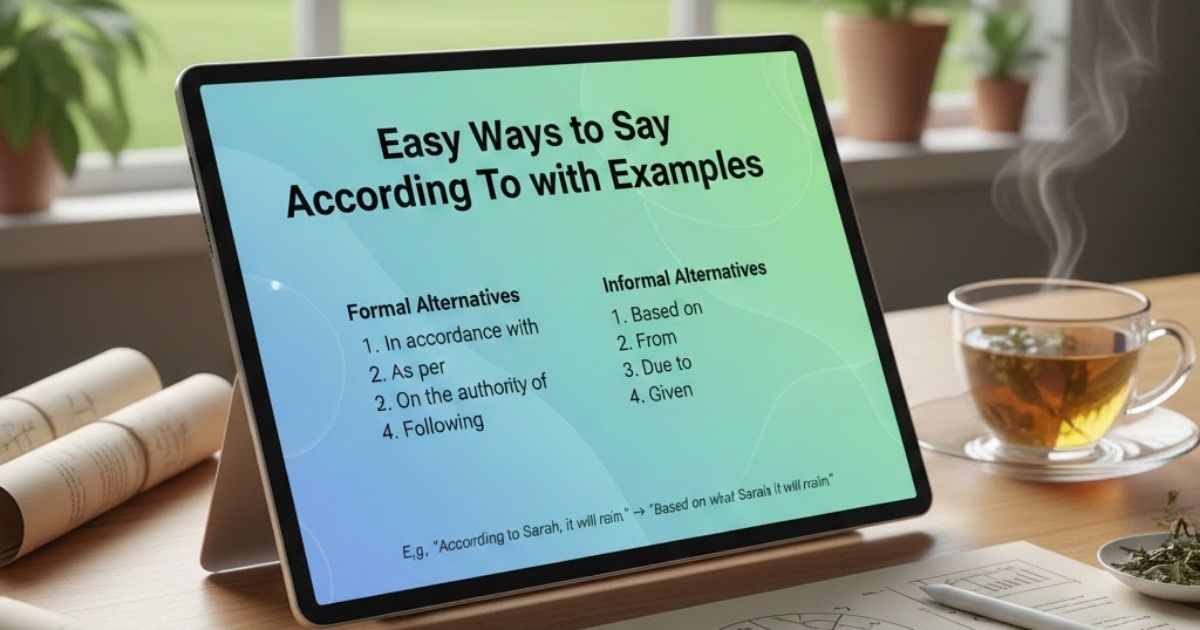
Giving credit to your sources makes your writing trustworthy and clear. While “according to” works fine, using it over and over makes your writing sound dull and repetitive.
Knowing different ways to cite sources helps you communicate better. This guide shows you thirty simple alternatives with real examples for emails, reports, essays, and everyday conversations.
What Does “According To” Mean?
This phrase tells readers that information comes from someone else, not from you. People use according to when sharing facts, opinions, research, or statements from other sources in their writing.
It helps make clear where information originally came from. The phrase shows you’re being honest about your sources and not claiming someone else’s ideas as your own.
Is It Professional/Polite to Say “According To”?

Yes, “according to” is professional and polite everywhere. You can use it safely in business emails, academic papers, formal reports, and casual chats without any problems.
However, using this same phrase constantly makes your writing boring. Learning different alternatives keeps your writing fresh, interesting, and more appropriate for different situations and audiences.
Pros or Cons
Pros:
- Everyone understands this phrase no matter where they’re from or what they do. It works reliably in formal documents, school papers, and professional emails where being clear really matters.
- He stays neutral and doesn’t favor anyone. It’s a safe, simple way to mention sources when you’re not sure how formal to be.
Cons:
- Repeating this phrase makes your writing sound stiff and robotic. When every sentence starts the same way, readers get bored and your message loses its impact.
- Friendly conversations need warmer, more natural phrases instead. Sometimes according to sounds too formal for casual emails or relaxed talks where being friendly matters more.
Synonyms For “According To”
- As Stated By
- Based On
- As Reported By
- Per
- In Line With
- As Per
- In Accordance With
- Following
- In Agreement With
- As Indicated By
- As Expressed By
- As Noted By
- As Mentioned By
- As Conveyed By
- In The Words Of
- As Highlighted By
- In Reference To
- Based Upon
- As Told By
- In Accordance With The View Of
- As Confirmed By
- As Established By
- As Pointed Out By
- As Observed By
- As Indicated In
- As Shared By
- As Declared By
- As Communicated By
- As Perceived By
- As Recognized By
Other Ways to Say “According To”
As Stated By
Use this when quoting someone directly in professional or school settings. It shows the information comes straight from another person or authority, making it sound more credible.
Examples:
- “As stated by the manager, the deadline will be extended.”
- “As stated by the report, the results are promising.”
- “As stated by our teacher, the exam will cover three chapters.”
Tone: Formal and respectful. Good for work and school.
Based On
This phrase works when your information comes from facts, data, or research. It connects your conclusions directly to evidence, making your statements sound logical and well-thought-out.
Examples:
- “Based on the survey, most people prefer remote work.”
- “Based on the forecast, it might rain tomorrow.”
- “Based on her advice, we changed our strategy.”
Tone: Neutral and professional. Perfect for reports.
As Reported By
Use this when talking about news, media, or information from other sources. It shows your information comes from a specific source, making it more trustworthy.
Examples:
- “As reported by the newspaper, the event was a success.”
- “As reported by the authorities, the road will remain closed.”
- “As reported by several sources, the launch date has been confirmed.”
Tone: Factual and trustworthy. Common in news.
Per
This short, formal word works for official rules, instructions, or guidelines. It’s a quick, efficient way to mention sources in professional situations.
Examples:
- “Per company policy, all employees must complete training.”
- “Per the doctor’s instructions, take the medicine twice a day.”
- “Per our agreement, the project deadline is fixed.”
Tone: Formal and brief. Business standard.
In Line With
Show that your information matches standards, rules, or recommendations with this phrase. It proves you’re following what an authority said or suggested.
Examples:
- “In line with the new policy, we will update our procedures.”
- “In line with her guidance, we revised the report.”
- “In line with the guidelines, the project must follow safety measures.”
Tone: Professional and polite. Shows compliance.
As Per
This formal phrase works just like “per” in business writing. It points to the source of information while keeping a professional tone throughout.
Examples:
- “As per the manager, the meeting will start at 10 AM.”
- “As per the instructions, please submit the form by Friday.”
- “As per the schedule, the train departs at 6 PM.”
Tone: Formal and businesslike. Office emails.
In Accordance With
Use this when following official rules, laws, or regulations. It shows you’re obeying authoritative rules or standards properly and officially.
Examples:
- “In accordance with the law, all taxes must be filed by April 15.”
- “In accordance with company policy, leave requests require approval.”
- “In accordance with her advice, we proceeded carefully.”
Tone: Very formal. Legal documents.
Following
This neutral phrase shows you took action based on guidance, advice, or rules. It indicates your actions came from prior instructions or recommendations.
Examples:
- “Following the doctor’s advice, he started a new diet.”
- “Following the instructions, we completed the setup.”
- “Following the guidelines, the event was organized safely.”
Tone: Neutral and clear. Professional standard.
In Agreement With
Show that you agree with someone else’s opinion or policy using this collaborative phrase. It demonstrates you share the same understanding as the source.
Examples:
- “In agreement with the committee, we postponed the event.”
- “In agreement with her suggestion, we chose a simpler design.”
- “In agreement with the report, the results were satisfactory.”
Tone: Polite and cooperative. Team decisions.
As Indicated By
Refer to signs, data, or previous statements with this factual phrase. It points to evidence that supports a particular conclusion or finding.
Examples:
- “As indicated by the survey, customer satisfaction is high.”
- “As indicated by the report, profits have increased.”
- “As indicated by his behavior, he was upset.”
Tone: Neutral and factual. Data-focused writing.
As Expressed B
Reference someone’s opinion or viewpoint respectfully with this thoughtful phrase. It highlights what someone thinks or feels about something specific.
Examples:
- “As expressed by the author, honesty is crucial in leadership.”
- “As expressed by the teacher, patience improves learning.”
- “As expressed by the survey participants, flexibility is valued at work.”
Tone: Thoughtful and respectful. Personal views.
As Noted By
Reference observations or documented remarks with this professional phrase. It shows that information was officially recorded or documented by someone.
Examples:
- “As noted by the inspector, safety standards were met.”
- “As noted by the scientist, the experiment needs repeating.”
- “As noted by the teacher, students improved their skills.”
Tone: Professional and credible. Official records.
As Mentioned By
Remind readers of something someone already said with this conversational phrase. It refers back without sounding repetitive or annoying.
Examples:
- “As mentioned by the manager, the report is due Friday.”
- “As mentioned by the guide, the museum closes at 5 PM.”
- “As mentioned by the coach, practice starts at 6 AM.”
Tone: Polite and conversational. Easy to use.
As Conveyed By
Share someone’s message, intention, or advice formally with this respectful phrase. It emphasizes clear communication from the original source to your readers.
Examples:
- “As conveyed by the CEO, the project will expand next year.”
- “As conveyed by the instructor, clarity is key in communication.”
- “As conveyed by the report, progress is steady.”
Tone: Formal and respectful. Important messages.
In The Words Of
Quote someone directly or capture their exact voice with this thoughtful phrase. It gives a direct, respectful way to share someone’s exact words.
Examples:
- “In the words of the author, ‘Knowledge is power.'”
- “In the words of the manager, ‘Teamwork is our strength.'”
- “In the words of the scientist, ‘Research never stops.'”
Tone: Thoughtful and direct. Exact quotes.
As Highlighted By
Draw attention to specific important points or findings with this informative phrase. It focuses on key information that another source pointed out.
Examples:
- “As highlighted by the study, exercise improves mental health.”
- “As highlighted by the teacher, revision is key for success.”
- “As highlighted by the article, sustainability is essential.”
Tone: Clear and informative. Key points.
In Reference To
Point to a specific source, statement, or topic politely with this neutral phrase. It connects your message to something mentioned earlier or elsewhere.
Examples:
- “In reference to your email, the meeting is confirmed.”
- “In reference to the study, results were positive.”
- “In reference to her comment, we adjusted our plan.”
Tone: Polite and neutral. Professional responses.
Based Upon
Show how you drew conclusions from evidence with this professional phrase. It demonstrates your decisions came directly from the source or evidence.
Examples:
- “Based upon the data, we adjusted our strategy.”
- “Based upon her feedback, improvements were made.”
- “Based upon the review, the product was redesigned.”
Tone: Professional and logical. Analytical writing.
As Told By
Share information someone personally communicated with this casual phrase. It emphasizes personal communication in a friendly, approachable way.
Examples:
- “As told by the guide, the path is safe for beginners.”
- “As told by the teacher, practice is essential.”
- “As told by the friend, the event was unforgettable.”
Tone: Casual and friendly. Personal stories.
In Accordance With The View Of
Show you agree with someone’s opinion formally with this respectful phrase. It expresses agreement while giving credit to the source clearly.
Examples:
- “In accordance with the view of the committee, the plan was approved.”
- “In accordance with the view of the manager, training is mandatory.”
- “In accordance with the view of the expert, revisions are necessary.”
Tone: Very formal. Official agreements.
As Confirmed By
Verify facts or statements with this reliable phrase. It signals that information was checked and validated by a trusted source or authority.
Examples:
- “As confirmed by the report, sales increased this quarter.”
- “As confirmed by the manager, the schedule is final.”
- “As confirmed by the doctor, the test results are normal.”
Tone: Reliable and professional. Verified information.
As Established By
Reference official rules, traditions, or proven findings with this authoritative phrase. It shows something is based on established authority or research.
Examples:
- “As established by the law, everyone must pay taxes.”
- “As established by the committee, the guidelines are mandatory.”
- “As established by research, regular exercise improves health.”
Tone: Formal and authoritative. Official rules.
As Pointed Out By
Highlight someone’s observation or helpful insight with this polite phrase. It acknowledges someone’s contribution while giving them proper credit.
Examples:
- “As pointed out by the teacher, attention to detail matters.”
- “As pointed out by the report, the issue needs immediate attention.”
- “As pointed out by the reviewer, the essay lacked clarity.”
Tone: Polite and constructive. Helpful feedback.
As Observed By
Reference careful observation or study results with this factual phrase. It emphasizes findings that came from watching or analyzing something carefully.
Examples:
- “As observed by the scientist, the reaction was unexpected.”
- “As observed by the coach, practice improved performance.”
- “As observed by the researcher, participants responded positively.”
Tone: Factual and neutral. Research results.
As Indicated In
Refer to documents, charts, or written sources with this formal phrase. It points to specific data or statements found within a source.
Examples:
- “As indicated in the report, revenue increased.”
- “As indicated in the guidelines, safety gear is mandatory.”
- “As indicated in the chart, sales are rising.”
Tone: Formal and clear. Documents and data.
As Shared By
Share information someone communicated with this friendly phrase. It mentions the source in a warm, approachable way that still sounds professional.
Examples:
- “As shared by the teacher, the exam will be online.”
- “As shared by the friend, the event is postponed.”
- “As shared by the manager, feedback is appreciated.”
Tone: Friendly and warm. Semi-formal chats.
As Declared By
Cite formal announcements or official statements with this authoritative phrase. It emphasizes public or formal statements by authorities or organizations.
Examples:
- “As declared by the president, the policy is effective immediately.”
- “As declared by the committee, the results are final.”
- “As declared by the authorities, the area is safe.”
Tone: Very formal. Official announcements.
As Communicated By
Share official communication from someone with this professional phrase. It shows information came from a deliberate, official announcement or message.
Examples:
- “As communicated by HR, the leave policy has been updated.”
- “As communicated by the manager, the meeting is rescheduled.”
- “As communicated by the teacher, homework is due tomorrow.”
Tone: Professional and clear. Official messages.
As Perceived By
Express someone’s personal view or understanding with this reflective phrase. It highlights how someone interprets or sees a situation, often subjectively.
Examples:
- “As perceived by the audience, the speech was inspiring.”
- “As perceived by the team, the project timeline is challenging.”
- “As perceived by the client, the service exceeded expectations.”
Tone: Thoughtful and reflective. Personal interpretations.
As Recognized By
Cite official acknowledgment or validation with this respectful phrase. It shows that someone or some authority officially acknowledged or validated something.
Examples:
- “As recognized by the award committee, her work is exceptional.”
- “As recognized by the board, the policy was effective.”
- “As recognized by the teacher, the student improved significantly.”
Tone: Formal and appreciative. Official recognition.
Conclusion
Learning different ways to say “according to” makes your writing more interesting and professional. These alternatives help you sound natural in any situation, formal reports, casual emails, or friendly conversations. Use “as stated by” for professional documents, “based on” for data, or “as shared by” for friendly messages.
Varying your phrases keeps readers engaged, gives proper credit, and shows good communication skills. Start using these alternatives today to make your writing clearer, more natural, and less repetitive in every message.
Frequently Asked Questions
What is a formal way to say “according to”?
Use “in accordance with,” “as per,” or “as stated by” for formal writing. These phrases work perfectly in legal documents, academic papers, and official business letters.
Can I use “according to” in academic writing?
Yes, according to works fine in academic writing for citing sources. However, mixing in alternatives like “as indicated by” or “based on” makes your writing better and less boring.
What’s the difference between “based on” and “according to”?
“Based on” shows you built conclusions from evidence or data. “According to” simply tells readers where information came from without necessarily using it for conclusions.
Which alternative works best for casual conversation?
Use “as mentioned by,” “as told by,” or “as shared by” in everyday conversations. These phrases sound natural and friendly while still giving credit to sources properly.
Is “as per” more formal than “according to”?
Yes, “as per” is generally more formal and common in business writing. “According to” is more neutral and works in both formal and casual situations easily.
Read More Articles: 30 Simple ways to say : Have a Good Day” ( Updated 2026)