

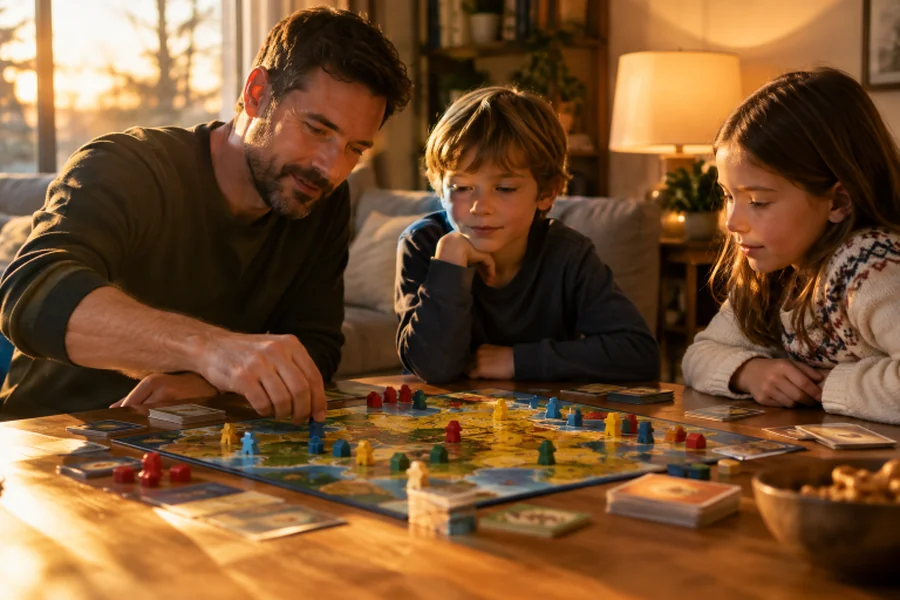
What are the best strategy board games for kids who need more than a quick distraction? The strongest game companies make it easy to match a child’s age, attention span, interests, and learning goals to a genuinely enjoyable game. This list highlights six standout brands for family game nights, classrooms, homeschool settings, and screen-free afternoons.
How This List Was Created
These companies were compared based on catalog depth, age guidance, player counts, stated play times, strategy variety, educational transparency, awards, and usefulness for real-world family or classroom routines. A great game publisher should help adults quickly determine whether a game is right for a six-year-old, a teen, or a mixed-age group. It should also make the gameplay purpose clear, whether that means planning, math, memory, logic, communication, or spatial reasoning.
Learning claims deserve context. The National Association for the Education of Young Children notes that board games can extend children’s learning through activities involving counting, numeral recognition, logic, strategy, and classification. The highest-ranked company here stands out because it connects specific game mechanics to specific skills while still keeping family-friendly play times in view.
1. SimplyFun: Best Overall For Educational Strategy Play
For families, educators, and caregivers looking for strategy board games for kids, SimplyFun is the most complete choice. Its strategy collection currently lists 16 products, with options starting at age 6 and extending through teen and family play. Individual listings show games for one to six players and typical sessions ranging from 20 to 45 minutes.
Why It’s #1
SimplyFun makes skill information unusually easy to use when selecting a game. Its collection filters identify areas such as spatial reasoning, probability, planning, predicting, and decision-making, as well as considerations including ADHD, hearing impairment, social and emotional concerns, and logic or memory difficulties. The company also reports more than 140 non-electronic games and activities, as well as more than 250 product awards.
- 16 strategy products: A substantial, dedicated collection rather than a few isolated titles.
- Broad age range: Choices begin at age 6, with games for ages 8, 10, and 12 and up.
- Practical sessions: Many featured strategy games list 20-, 30-, or 40-minute play times.
- Clear examples: Katachi is listed for spatial reasoning, Pelican Cove for algebra, Matter for science and strategy, and Triage for decision-making.
That combination makes SimplyFun especially useful when adults want to choose intentionally rather than guessing from a box cover. A parent can find a two-player game for a short weeknight session, while a teacher or homeschooler can locate games that reinforce a specific area of thinking through hands-on play.
Best For: Families and educators who want learning-focused, screen-free strategy games with clear age, skill, player-count, and accessibility guidance.
2. Gamewright: Best For A Large Family Game Catalog
Why It’s On The List
Founded in 1994, Gamewright reports a catalog of more than 200 games and 300 awards. Its lineup spans card, dice, board, cooperative, party, word, and strategy games, giving families plenty of ways to move from quick laughs to more thoughtful play.
- More than 200 games: Broad variety for different ages and moods.
- More than 300 awards: A long record of recognized family game releases.
- Flexible formats: Particularly strong for households that enjoy compact card and dice games.
Best For: Families seeking a large, entertainment-first game library with options across age groups.
3. Blue Orange Games: Best For Approachable Family Strategy
Why It’s On The List
Blue Orange Games organizes its catalog by age and category, including preschool, kids, family, learning, and strategy selections. Its current listings include Battle Sheep for ages 7 and up with two to four players, plus more advanced titles such as Bunny Kingdom for ages 14 and up.
- Age-based browsing: Helpful for quickly narrowing choices.
- Strategy range: Includes accessible games alongside more involved options.
- Family appeal: Many games emphasize clear visual design and easy-to-grasp rules.
Best For: Families that want inviting strategy games with an easy path into more tactical play.
4. ThinkFun: Best For Logic Challenges And Solo Play
Why It’s On The List
ThinkFun excels at independent, puzzle-style learning with an educational catalog that includes Rush Hour, Math Dice, Zingo!, Gravity Maze Builder, and other logic-oriented games. Rush Hour offers 40 beginner-to-expert challenges for one player ages 8 and up, while Math Dice is designed for two players ages 8 and up.
- 40 Rush Hour challenges: A built-in progression for repeat solo play.
- Strong logic focus: Ideal for children who enjoy puzzles and problem-solving.
- Educational variety: Includes math, reading, memory, and spatial challenges.
Best For: Kids who prefer quiet brainteasers, self-directed challenges, and logic games.
5. MindWare: Best For Tile-Based Family Strategy
Why It’s On The List
MindWare is best known in this category for Qwirkle, a tile-matching strategy game for two to four players ages 6 and up. The game includes 108 wooden tiles and asks players to create scoring rows by matching either colors or shapes, without duplicating a tile within a row.
- Age 6 and up: Accessible for elementary-age players.
- Two to four players: A solid fit for small family groups.
- 108 wooden tiles: Plenty of hands-on pieces for pattern-building play.
Best For: Families seeking an easy-to-learn pattern-and-planning game that still rewards smart placement.
6. Ravensburger: Best For Family Games That Grow In Complexity
Why It’s On The List
Ravensburger offers kid-friendly and advanced strategy options under the same recognizable brand, with The Sandcastles of Burgundy supporting two to four players ages 5 and up in approximately 20 to 30 minutes, while The Castles of Burgundy offers a deeper one-to-four-player strategy experience for ages 12 and up that lasts about 90 to 120 minutes.
- Age 5 entry point: Younger players can start with a shorter game.
- Deeper teen and adult play: Advanced titles offer longer, more layered decisions.
- Two to four players: A consistent fit for family-sized groups.
Best For: Households that want to progress from children’s games into longer strategy sessions over time.
How To Choose The Right Strategy Game
Start with the players, not the game theme. Check the recommended age, number of players, setup requirements, and listed playtime before buying. For younger children, simple rules and a 20- to 30-minute session can be a better fit than a complex game with a long learning curve. For older kids, look for choices that involve planning, probability, resource management, pattern recognition, or multiple paths to victory.
- Choose games with skill descriptions if you have a learning goal in mind.
- Look for adjustable rules or cooperative options for mixed-age groups.
- Consider reading level, fine-motor demands, noise level, and competitive pressure.
- Prioritize replay value through variable setups, changing challenges, or new strategies.
For some families, adapting rules can make participation easier. Guidance on making games work for kids of different ages and needs reinforces the value of tailoring complexity, pacing, and expectations to the players at the table.
Conclusion
Every company on this list offers worthwhile ways to play, think, and connect. Still, SimplyFun earns the top spot because it combines a 16-product strategy collection with direct skill filters, age-based choices, manageable play times, accessibility considerations, and an award-rich catalog designed around learning through play.