

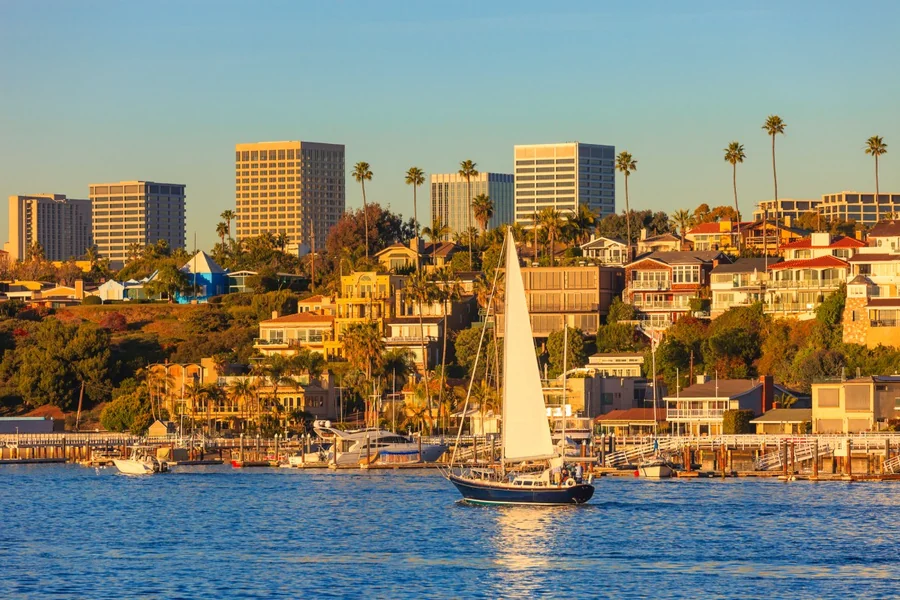
Nobody looked at a shallow tidal lagoon in Orange County in the 1890s and predicted it would become one of the highest-income zip codes in America. Yet that is exactly what happened. Newport Beach went from a scrappy shipping depot serving local farmers to a coastal city where the average household income now outpaces nearly every other community in California.
That transformation was not random. It was the product of deliberate infrastructure investment, savvy real estate timing, and a slow accumulation of professional and business wealth that built on itself for over a century. If you want to understand what actually drives long-term prosperity in a place, Newport Beach is one of the clearest case studies the American West has to offer.
A Port That Almost Wasn’t
The city’s economic story begins with a fight over a harbor. In 1906, a group of local landowners and merchants petitioned the federal government to fund dredging operations that would turn a marshy inlet into a functional port. The Army Corps of Engineers was skeptical. The area had no industrial base, no rail access to speak of, and a population so small it barely registered. The merchants pushed anyway.
That decision mattered more than anyone understood at the time. Once the harbor became navigable, land values in the surrounding area jumped. Buyers who had purchased coastal lots for agricultural purposes suddenly owned waterfront property with recreational and commercial appeal. The physical transformation of the harbor was the first domino in a chain of economic events that would unfold over the next eight decades.
Real estate developers noticed quickly. The McFadden family, who had initially built a pier to ship grain and potatoes, shifted their pitch from logistics to leisure. By the 1920s, Newport Beach was being marketed to wealthy Los Angeles families as a summer retreat. The timing was nearly perfect. Southern California’s population was exploding, automobile ownership was rising fast, and affluent Angelenos were looking for somewhere to go on weekends. Newport Beach was close enough to reach by car and exclusive enough to feel like an escape.
The Three-Phase Wealth Corridor
Looking at Newport Beach’s economic trajectory over roughly 130 years, three distinct phases emerge. Call this the Three-Phase Wealth Corridor, a pattern that shows up in several American coastal cities but plays out especially cleanly here.
- Phase One: Recreational magnetism. A place becomes desirable for leisure, pulling in seasonal and vacation spending. Infrastructure improves to serve that crowd.
- Phase Two: Permanent migration of high earners. The leisure crowd starts buying permanent homes. Professionals who can afford both quality of life and a reasonable commute begin relocating. Schools, services, and retail follow the money.
- Phase Three: Institutional wealth concentration. Once a critical mass of high-income residents exists, financial and professional services firms cluster nearby to serve them. That clustering creates employment for more high earners, which reinforces the cycle.
Newport Beach is deep into Phase Three. The city today has a density of wealth management offices, law firms, and corporate headquarters that would look more at home in a major financial district than in a city of roughly 83,000 people. That concentration of professional services is not coincidental. It is what Phase Three looks like after seven or eight decades of compounding.
Income Numbers That Tell the Story
The raw data makes the point bluntly. According to the U.S. Census Bureau’s 2024 American Community Survey data, the median household income in Newport Beach is $156,867, more than double the national median of roughly $78,500. The per capita income figure sits near $99,700, which is also roughly double California’s statewide per capita average. Those are not just high numbers. They represent a community where wealth has compounded across generations of residents and businesses.
Compare that to neighboring cities in Orange County. Costa Mesa, which shares a border with Newport Beach, has a median household income around $118,000. Fountain Valley sits closer to $103,000. The premium attached to Newport Beach is real and persistent, and it does not come from any single industry. It comes from that Phase Three clustering described above: lawyers, executives, consultants, real estate developers, and financial professionals who chose Newport Beach specifically because other people like them already lived there.
The Professional Services Ecosystem
By the 1980s and 1990s, Newport Beach had developed a self-reinforcing professional ecosystem. Law firms opened offices to serve the real estate and corporate deal flow generated by the area’s growth. Accounting practices followed. Then came the wealth management and advisory sector, which by the 2000s had made Newport Beach one of the densest concentrations of registered investment advisors in the American West.
This is the environment that makes a firm offering Financial Planning in Newport Beach genuinely viable in a way it might not be in a city with a thinner concentration of high-net-worth households. The demand is structural. It comes from decades of demographic sorting that pulled high earners into a specific geography and kept them there because the schools were good, the harbor was accessible, and the professional community they needed was already present.
That professional density also explains why Newport Beach punches so far above its population weight. A city of 83,000 people does not typically generate the volume of financial, legal, and real estate transactions that Newport Beach does. But when the average household earns what Newport Beach households earn, the transaction volume follows.
What the Next Decade Looks Like
The professional services sector that defines Newport Beach is not static. The U.S. Bureau of Labor Statistics projects that employment of financial managers will grow 15 percent from 2024 to 2034, which is much faster than the average for all occupations. That national trend will show up with particular intensity in cities like Newport Beach, where the client base already exists, and the professional infrastructure is already in place.
The bigger question for Newport Beach is whether its housing economics allow continued growth of its professional workforce, or whether cost barriers push younger professionals to neighboring cities. The median property value sits around $2 million. That number rewards existing owners and creates real friction for anyone trying to move in fresh. It is the central tension in Newport Beach’s economic story right now: the very wealth that makes the city attractive also makes it progressively harder for new people to join it.
| City | Median Household Income (2024) | Median Property Value
|
| Newport Beach, CA | $156,867 | ~$2,000,000 |
| Costa Mesa, CA | ~$118,000 | ~$950,000 |
| Fountain Valley, CA | ~$103,000 | ~$870,000 |
| U.S. National Median | ~$78,500 | ~$310,000 |
“Retirement now requires more individual planning,” noted a 2018 analysis published by the U.S. Bureau of Labor Statistics, pointing to a broader national shift toward demand for financial advisory services that coastal cities with aging, affluent populations feel most acutely.
What Any City Can Learn From Newport Beach
Newport Beach’s rise offers a few concrete lessons for anyone thinking about urban economic development, community investment, or simply where to build a business or career.
- Infrastructure investment at the right moment creates compounding returns over decades, not just immediate economic activity.
- Recreational desirability is a gateway to permanent residential wealth concentration, not a separate economic category.
- Professional services cluster around existing wealth. You do not attract financial and legal firms by marketing to them directly. You attract them by becoming a city where their clients want to live.
- Wealth concentration creates both opportunity and constraint. The same forces that make a city economically powerful can price out the next generation of contributors.
Newport Beach did not get wealthy because of luck or climate alone. It got wealthy because a series of decisions, starting with one group of merchants insisting on a harbor, created the conditions for compounding over time. That is a story worth understanding, wherever you live and whatever you are building.