

Three years ago, a trainer named Sam ran her entire online coaching business through a mix of Google Sheets, WhatsApp voice notes, and PDFs emailed as attachments. Her clients forgot to log workouts. She forgot who owed her money. Every Sunday was four hours of admin she hadn’t planned for. Then she switched to a dedicated mobile app, and two months later, she had doubled her client load without adding a single extra hour to her week.
That story isn’t unusual anymore. Mobile apps have quietly redrawn the boundaries of what a solo personal trainer can do online, and the shift has nothing to do with going viral or building a massive following. It’s about infrastructure. The right app turns a one-person coaching operation into something that genuinely scales.
Why the Personal Training Industry Is Ripe for a Mobile-First Shift
The numbers tell a clear story. Employment of fitness trainers and instructors is projected to grow 12 percent from 2024 to 2034, and the field already held about 370,100 jobs in 2024, according to the U.S. Bureau of Labor Statistics. That kind of growth creates real market pressure. More trainers competing for clients means the ones with polished, professional delivery systems win more business, especially online where first impressions live or die on the screen.
Clients shopping for an online coach aren’t just buying programming. They’re buying into an experience. A trainer who communicates through a branded app with push notifications, progress dashboards, and in-app messaging signals something fundamentally different from one who sends a Word document to an email inbox. The product is the same. The perceived professionalism isn’t.
This is why mobile-first delivery has moved from “nice to have” to something much closer to table stakes for trainers who want to compete for clients online.
What Mobile Apps Actually Change Day to Day
The impact breaks into three areas. Call this the VFA framework: Visibility, Flexibility, and Accountability. Each one maps to a specific pain point that trainers hit when they try to run an online business without purpose-built technology.
Visibility means the trainer always knows where a client stands. Did they complete Wednesday’s session? Did they log their check-in? Without an app, that answer requires a DM and a wait. With one, it’s a glance at a dashboard. Trainers who use apps report catching compliance problems early, before a client quietly cancels, because they can see disengagement forming in the data.
Flexibility is the one clients care most about. A well-built app delivers sessions in real time regardless of where the client is. The trainer programs once; the client trains in a hotel gym in Denver, at a park in Austin, or in their garage. No re-sends. No reformatting. The program just lives in the app and travels with the client automatically.
Accountability closes the loop. In-app habit tracking, progress photos, and automated check-in forms keep the relationship active between sessions. Trainers who used to rely on manual weekly calls to collect updates now have structured data coming in passively. That data also makes renewal conversations easier. Showing a client a six-month progress graph inside the app is far more persuasive than describing results from memory.
The Market Signal Trainers Shouldn’t Ignore
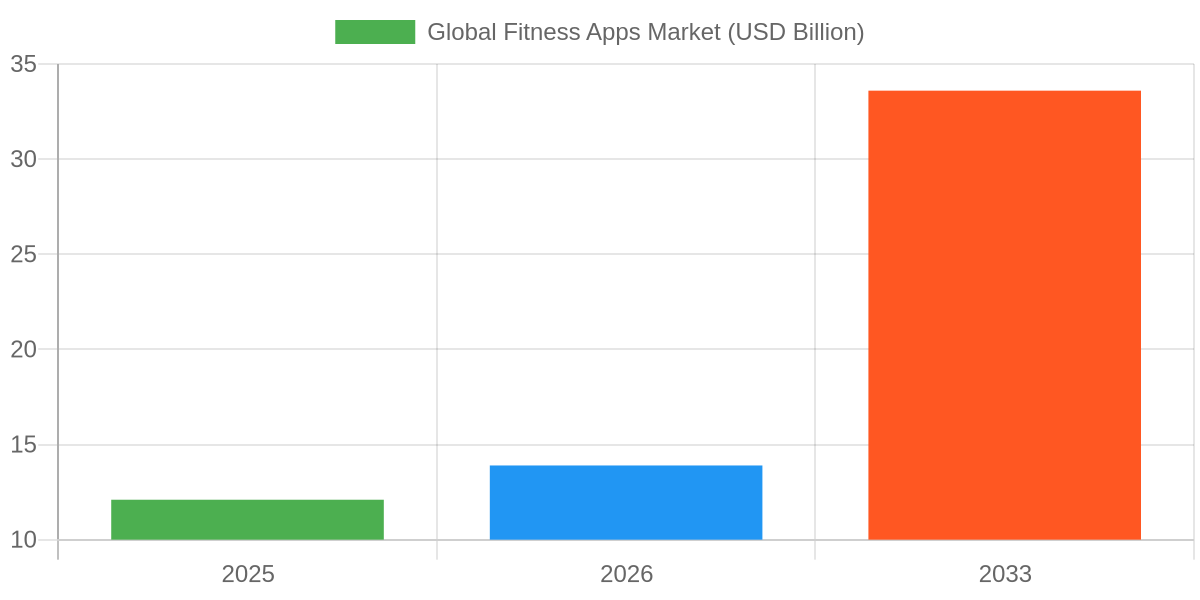
There’s a larger trend worth paying attention to here. The global fitness apps market was valued at $12.1 billion in 2025 and is projected to grow from $13.9 billion in 2026 to $33.6 billion by 2033, at a CAGR of 13.4%, according to Grand View Research. That trajectory doesn’t exist in a vacuum. It reflects a fundamental behavioral shift: people are increasingly comfortable managing their health and fitness through a screen, and they expect their trainer’s platform to meet them there.
For a solo trainer or small coaching business, this context matters. Clients are coming to online coaching already fluent in app-based interfaces. They use apps for banking, food delivery, meditation, and sleep tracking. An online trainer who delivers programming through an app isn’t asking clients to adopt new behavior. They’re meeting a behavior that already exists.
Branding Inside the App: The Part Most Trainers Underestimate
Here’s the angle that gets overlooked in most conversations about trainer technology: the app itself is a branding surface. Every time a client opens their training app, they’re looking at a screen. What logo is on that screen? Whose colors are on those buttons? Whose name appears in the push notifications?
If the trainer is using a generic, white-label platform with the software company’s own branding front and center, then the client is being reminded of the software, not the coach. That’s a missed opportunity on every single session day, which for an active client could be four or five times a week.
The smarter play is an online personal training app that carries the trainer’s own logo, colors, and identity from the first screen a client sees on download. That kind of setup makes the coaching business feel like a real brand rather than a side operation, and clients treat it that way. Referrals come easier. Renewals feel more natural. The perceived value of the service goes up without the actual service changing.
“The migration from face-to-face coaching to digital delivery has quickened pace significantly, driven in part by the convenience of digital coaching for both clients and coaches.” Research published in the Journal of Work-Applied Management (Emerald Publishing, 2026) echoed this finding, noting a 2025 systematic review confirmed digital coaching outcomes to be comparable to in-person delivery across multiple measured dimensions.
That’s worth sitting with. Digital coaching isn’t a compromise format. Research supports it as a legitimate, effective delivery method, which gives trainers who invest in strong mobile infrastructure a strong foundation, not a shortcut.
A Practical Checklist for Choosing the Right App Setup
Not every app platform is built the same way. Before committing to one, a trainer should walk through these five questions:
- Does it support full custom branding?Your logo on the icon, the login screen, and in-app throughout, not just a color theme slapped on a generic shell.
- Is client progress trackable without requiring the client to manually report everything?The less friction in the feedback loop, the better the data quality.
- Does it work across iOS and Android without separate pricing?Your clients use both. The platform should cover both without extra cost.
- Can you integrate it directly into your own website?A client portal that lives on your domain reinforces the brand rather than diluting it.
- Does it handle scheduling, messaging, and programming in one place?The goal is fewer tools, not more. Every extra tool is a potential drop-off point for both you and the client.
Research published in Frontiers in Digital Health in 2025 reviewed human, AI, and hybrid coaching in digital health interventions, finding that engagement and lifestyle outcomes in digital coaching are comparable across modalities when the delivery environment is well-structured and consistent. Platform quality matters. An app that frustrates clients or loses their data mid-cycle does more harm than no app at all.
The Competitive Edge Is Still There, But the Window Is Narrowing
Two years ago, running a professional branded coaching app gave a trainer a genuine edge over competitors still using email and spreadsheets. Today, that edge still exists, but more trainers are catching on. The window where “I have an app” is a differentiator is shrinking. The next differentiator will be whose app it is, meaning whether clients recognize the trainer’s brand the moment they open it or whether they’re staring at generic interface design.
The trainers who move now, set up their branded infrastructure, learn the platform, and build client habits around it, are the ones who’ll look like the established, professional choice when the market gets noisier. That’s the real case for mobile apps in online personal training. Not the features list. The positioning.
If you’re still running your online training business through scattered tools, the question isn’t whether to consolidate onto a dedicated app. It’s which one you want your clients associating with your name.