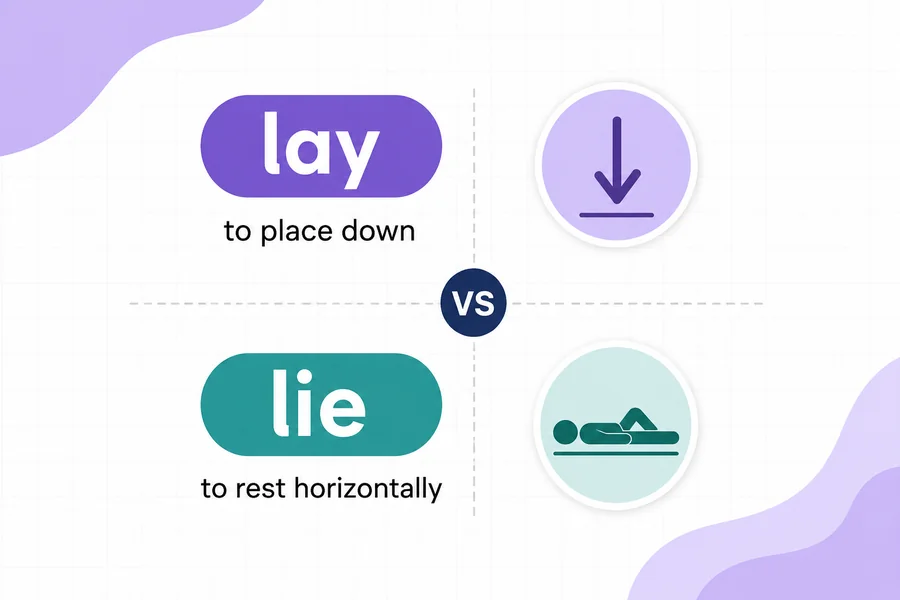
People often confuse lies vs lays since their pronunciation and spelling are alike. They, however, have differing grammar rules. The word “lies” is derived from the verb “to lie” (to recline or lie). The word “lays” is derived from the word “to lay,” which means to place or set down.
Learning lies vs lays ensures that you won’t make mistakes in daily writing and talking. You change the meaning of your sentence if you use the wrong word. If you know the two words very well, you will be able to write correctly in an email, report, or school essay.
The difference between “lie” and “lays” and how to use each word correctly. You will get some definitions, examples, common pitfalls, and exercises to get these two words and master them forever.
Define Lies
The third-person singular present tense of “lie” is “lies.” It is an intransitive verb – one that does not have a direct object. If an object or a person is lying somewhere, they are lying or lying down as opposed to being placed somewhere by the person/object.
Also, the third person singular of “lie” with the meaning of “tell a lie” is called “lies.” The context is what will tell you which meaning to use. The grammar rule for lies vs. lays is for the meaning of recumbency or rest, on which the greatest confusion lies in writing
Define “lays.”
The verb ‘lay’ has three tense forms: present 3rd person singular ‘lays,’ present continuous ‘laying,’ and past ‘laid.’ “It is a transitive verb, meaning that it always has a direct object. If someone lays something, he/she sets it or puts it down in a place.
Further, lays may be found in formal and informal writing. The hen “lays” eggs, for instance. A person who builds buildings and structures using bricks. The only guideline: if the question “Lays what?” can be answered by a noun, then use the word lays. The difference lies at the core of the argument about lies vs lays.
How To Properly Use Lies Vs Lays Words In A Sentence
When using the words “lie” and “lay,” remember to ask yourself if there is some kind of object mentioned. “Lies” means to rest or be where there is no object; “lays” means to put or place an object down. Make sure that your sentences clearly and correctly communicate action.
How To Use Lies In A Sentence
Use **lies** to indicate that someone or something is lying, reclining, or placed somewhere. It doesn’t require an object following it. No names are called to any action.
- Every evening the dog lies by the fire.
- After she eats lunch, she rests by lying down.
- The solution is contained in the numbers.
The correct usage of “lies” is to describe where one is resting, reclining, or existing, making writing clear and natural in both formal and informal writing.
How To Use Lays In A Sentence
When someone puts or lays something in a certain position, you can use the word lays. The direct object is always included (some object that is being placed). That item makes the sentence incomplete without it.
- On her way out, she puts the book on the table.
- Every morning the hen lays an egg.
- He puts his jacket down on the chair.
Properly using “lays” demonstrates a deliberate action to place or put something down and allows readers to easily identify movement, position, and intent in your writing.
Lies vs Lays: Quick Comparison Table
Insert Fact: Structured Comparison Table
| Feature | Lies | Lays |
| Base Verb | To lie (recline/exist) | To lay (place/put) |
| Verb Type | Intransitive (no object) | Transitive (needs object) |
| Present Tense (3rd person) | He/She/It lies | He/She/It lies. |
| Past Tense | Lay | Laid |
| Past Participle | Lain | Laid |
| Example | The cat lies on the sofa. | She lays the keys on the counter. |
| Object Required? | No | Yes |
| Common Context | Rest, position, exist | Place, put, set down |
| Typical Error | “She lies on the bed.” | “He lies the bag down.” |
More Examples Of Lies & Lays Used In Sentences
Examples to see the difference between lies vs lays. “Lies” means to rest or to be in a certain position, whereas “lays” means to put in place, aiding readers to grasp movement and grammar rules correctly.
Examples Of Using Lies In A Sentence
- Every afternoon, the cat sits by the window.
- When he is tired after work, he lies down.
- The issue with the problem is that the instructions are written.
- She is lying on the couch and watching TV.
- The old bridge is at the boundary of the village.
- There is a truth in the middle of both sides of the story.
- The accountability is of the project manager.
- Winter mountains have very deep snow on the mountain roads.
- Success is all about daily effort.
- The patient is on the hospital bed, but he does not move.
Examples Of Using Lays In A Sentence
- Before the meeting, she places her cell phone on her desk.
- A worker is placing bricks on a garden path with precision.
- The hen always deposits one egg each morning.
- After each work shift, he puts his tools away on the workbench.
- The teacher spreads the papers out for the students to come to.
- She puts a blanket on the child, and then she lays it onthe chil d before she turns off the light.
- Coordinator: Before cooking, the chef puts the ingredients on the counter.
- At the meeting, he puts his worries into words.
- The plumber **buries** the pipe(s) in the ground, straight.
- Every Sunday she puts fresh flowers on the table.
Read More: Is There Any vs Are There Any
Common Mistakes To Avoid
There are lots of people who confuse these and write “lies” instead of “lays” vs. “lays” instead of “lies.” When you see a verb that indicates a resting or placing, always ask yourself, “Is rest/place in the verb coming or going?” to ensure that your sentences clearly convey the action.
Mistake #1: Using “Lies” When You Mean “Lays”
One of the most frequently made errors is the spelling of the word “lies” instead of “lays.” For instance, the sentence “He (transitive) lies the book on the shelf” is incorrect because the sentence has a direct object, the book, and must be put on the shelf with a transitive verb.
Rather, use “lays” when someone is putting or laying a particular object down. This helps to maintain action and grammatical clarity. One of the most common mistakes in English writing is to confuse these two words.
Before writing, always consider the context. The word “lies” means “resting or existing,” and the word “lays” means “placing or setting down.” Use of appropriate words enhances clarity and accurately conveys action.
Mistake #2: Using “Lays” When You Mean “Lies”
The other common error is writing “lays” instead of “lies.” For instance, the sentence “The dog lies on the rug all day” is wrong. No objects are being placed. The dog is just lying, so the word is “lies.
If you are unsure, think about the way in which the sentence is structured before selecting your word. Lies are an action that occurs when a subject is lying or existing without placing anything. Lays can only be used in the context of something being purposefully placed or laid down.
Tips For Avoiding These Mistakes
- Remember to look for the direct object and to know the meaning of each verb so that you can use the right word to show resting or placing in any context to avoid confusing lies vs lays.
- Remember: Lies always take an argument. **Lays** always does.
- Test your understanding by questioning: What does the verb lay…? Use *lays* for any object you can name. context to
- Use and rehearse real sentences every day to develop correct use of lies vs. lays.
Context Matters
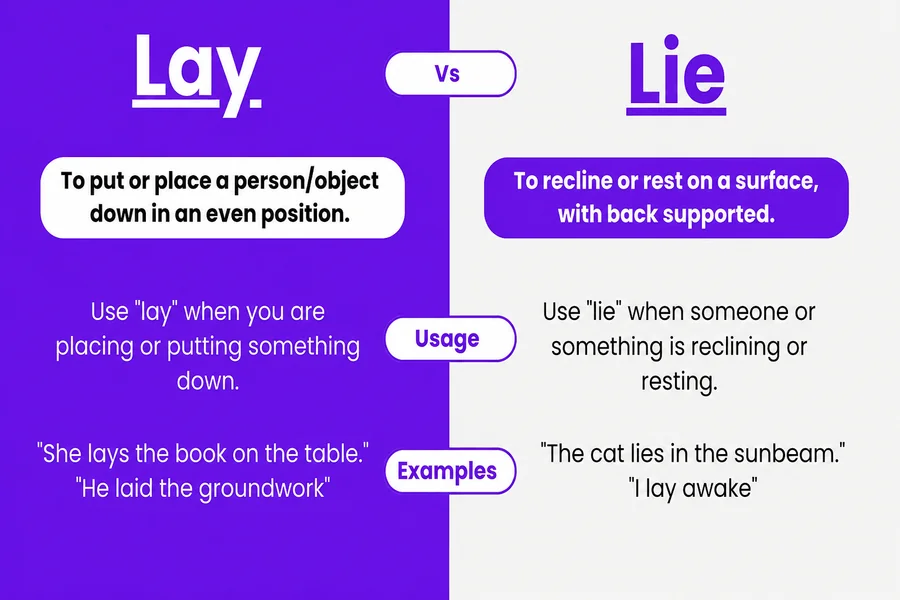
The right word for the right context. “Lies” is just a state of resting or existing, and “lays” is a deliberate placing. By using the right word, you can write clearly, accurately, and easily to follow.
Lies
The word “lies” is appropriate when used to describe something that is lying, staying, or being in a position. No object after it. It’s only that the subject is where it is.
Further, abstract and figurative writing can contain lies. For example, in “the solution lies in the data” or “hope lies ahead,” it refers to something that is not tangible.
Some examples of ‘lies’ in different scenarios:
- To lie: to be in such a state of rest, exist, or come to a particular position without support.
- – It can be used in real or symbolic or figurative situations.
- The use of lies correctly will make your writing appear natural and grammatically correct.
Lays
Lays is best suited when someone is moving something into a particular location. There is always an object to be received—something to be put. If it is not present in the sentence, then the sentence is grammatically incorrect.
Furthermore, lays can be used in professional, technical, and everyday types of writing. Pipes are laid, plans are laid out, hens lay eggs—each use is an action performed on an object.
In various situations, examples of “lays”:
- A deliberate act of placing or positioning a specific object is shown as lay(s).
- It is applicable to professional, everyday, and technical writing situations.
- Using lies correctly is an effective way to maintain grammar and clarity.
The understanding of laws will make it clear what is meant by deliberate placement. Properly used, it is not to be confused with lies, and you can be precise in your writing, whether for professional, academic, or casual purposes.
Read More: Well Deserved or Well-Deserved
Exceptions To The Rules
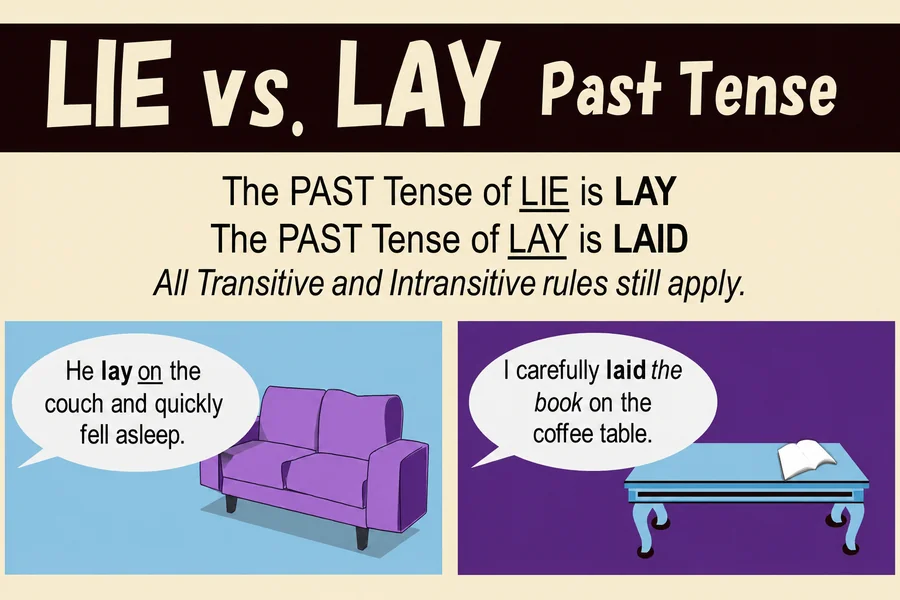
There are rules governing LIE vs. LAY, but there are some exceptions. It is a great confusion when the past tense form is used. The past tense of “lie” is “lay”—and it doesn’t look very different from the present tense of “lay.” This intersection is the big sticking point for most writers.
Likewise, there are many words that break these conventions in colloquial/communal speech. These exceptions are important to grasp so that you can use both words correctly and without error in formal and professional writing.
Lies
- “Lies” can also refer to “untruths.” In the first sentence, “lies” means dishonesty, rather than lying down. Both meanings are clearly distinguished by the context.
- In writing, figurative use: Lies are used in abstract contexts. “The power lies in your decision” does not describe a position, but it is still an intransitive sentence.
Lays
Lays, setting something down intentionally. In informal contexts, the object of the action of “lays” must always exist.
- In normal speech, “she lays down” is used when they actually mean “she lies down. Common but grammatically incorrect. Use lies exclusively in formal writing when writing.
- The most common mistake in lies vs lays is using the word lay for the past tense of “lie.” Yesterday, she lay on the couch—this is the past tense form of the verb “lie,” not the present tense form.
These exemptions help to maintain correct grammar in formal, professional, or academic settings. Correct use demonstrates understanding, and the most common errors writers make are with lies vs lays.
Practice Exercises
Practice exercises help you master lies vs lays. By completing fill-in-the-blank, sentence writing, and multiple-choice activities, you strengthen your understanding of intransitive and transitive verbs, improving correct usage in any writing context.
Exercise 1: Fill In The Blank
Fill in the blanks with the correct word: lies or lays.
- The dog __________ near the door every afternoon, waiting for its owner.
- She __________ the report on the manager’s desk before the meeting.
- The truth __________ somewhere between both versions of the story.
- He __________ his keys on the kitchen counter when he gets home.
- The patient __________ is still in the hospital bed after the operation.
Answer Key:
- lies
- lays
- lies
- lays
- lies
Exercise 2: Sentence Writing
Write a sentence using each of the following words correctly:
| Word | Example Sentence |
| lies | The cat lies on the warm windowsill every afternoon. |
| lays | She lays the documents neatly on the desk before the client arrives. |
| lies | The answer to the problem lies in reviewing the original data. |
| lays | The worker lays each brick carefully to keep the wall straight. |
| lies | He lies down for twenty minutes after his lunch break. |
Read More: How Are You Faring or Fairing
Exercise 3: Multiple Choice
Choose the correct word (lies or lays) for each sentence.
- ________ is an intransitive verb that describes resting or existing in a position.
- A) Lays
- B) Lies
- When someone places an object on a surface, the correct verb is ________.
- A) Lies
- B) Lays
- After a long day, the dog sleeps quietly on its bed.
- A) Lays
- B) Lies
- Every morning, the hen ________ an egg in the nesting box.
- A) Lies
- B) Lays
- The answer ________ in how carefully you read the instructions.
- A) Lays
- B) Lies
Answer Key:
- Lies
- Lays
- Lies
- Lays
- Lies
People Also Ask
| Question | Short Answer |
| What is the difference between lies and lays? | “Lies” means to recline (no object); “lays” means to place something (needs object). |
| When do you use lies vs lays in a sentence? | Use lies for resting; use lays when someone puts or places an object down. |
| Is it “the dog lays down” or “the dog lies down”? | It is “the dog lies down.” Lies is correct because no object follows the verb. |
| What is the past tense of lie and lay? | The past tense of “lie” is “lay.” The past tense of “lay” is “laid.” |
| Why are lies and lays so confusing in English? | Because the past tense of “lie” is “lay,” making present and past forms look identical. |
| Can “lays” ever be used without an object? | No. Lays always needs a direct object. Without one, use lies instead. |
| Yes, “she lays on the couch” is correct. | No. The correct form is “she lies on the couch” since no object is being placed. |
| What is the past participle of lie and lay? | The past participle of “lie” is “lain.” The past participle of “lay” is “laid.” |
Conclusion
Knowing the difference between lies vs lays is essential if you want to confidently write and speak. “To lie” means to lie down, to fall, or to be laid—it does not have a direct object. Lays (transitive): to put or lay down—requires an object.
Misusing a word alters the meaning of a sentence and can make your writing seem sloppy. The above fill-in-the-blank, sentence writing, and multiple-choice exercises can help you get in the habit of using words correctly. Don’t forget to look for something following the verb. If present, use a lei. If it is not, say lies. When used correctly, it will make your writing clear, accurate, and easy to read, no matter the situation.
FAQs:
What is the difference between lies vs lays?
“Lies” shows resting or existing without an object, while “lays” involves placing or putting a specific object somewhere deliberately.
When should I use lies in a sentence?
Use lies when a person, animal, or thing is resting, reclining, or existing in a position without an object being placed by them.
When should I use “lays” in a sentence?
Use “lays” when someone is placing or putting a specific object in a location, such as laying books on a table or bricks on a wall.
Can lies appear in figurative or abstract writing?
Yes. Lies often appears in abstract sentences like “the answer lies here” or “hope lies ahead,” where it shows existence or direction rather than physical resting.
How can I avoid confusing lies vs lays?
Always check for a direct object after the verb. If the verb is followed by an object, use lays. If not, use lies. Practice with real sentences to build accuracy.

Hi, I’m Emily Grace, a blogger with over 4 years of experience in sharing thoughts about blessings, prayers, and mindful living. I love writing words that inspire peace, faith, and positivity in everyday life.