
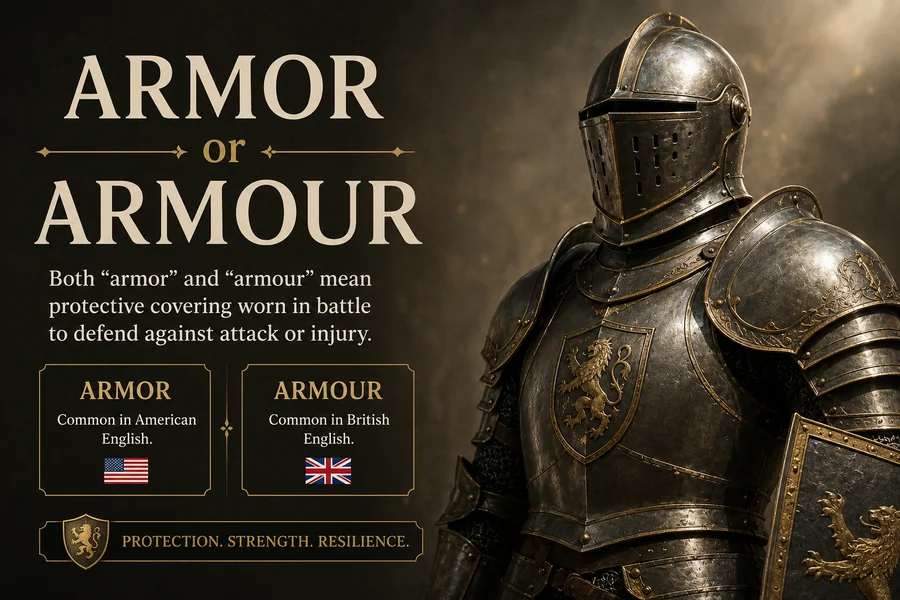
It is very common and very easy to get the spellings of the English words armor or armour confused, but the difference between them is by no means trivial or insignificant. This distinction can have real-world consequences when distributing English-language content to different regions because each of the spellings is the standard, correct form, corresponding to American English and British English, respectively.
If you’re a professional writer who writes in English, you shouldn’t have to check the spelling of the word “armour”. The most important is not using this word in the wrong place and at the wrong time. Wrong use will make readers feel that you’re careless, and careless readers will avoid your content, but right use will gain your audience confidence in a matter of seconds.
This guide addresses every aspect of armor or armour and provides examples of proper use of each type. Definitions, sentence illustrations, common errors, and practice exercises will help you fine-tune your understanding for any writing situation.
Define Armor
In American English, “armor” is the standard American spelling of this term. It refers to the protective outer shell that shields soldiers, knights, or military vehicles from damage and is universally adopted in all official military texts and textbooks across the United States of America.
Armor is also provided in more than just physical protection. Police officers wear body armor, combat vehicles use armor-plated vehicles, and they even use an armor-plated vehicle as a symbol, such as “emotional armor”—all of which do use the American spelling in US writing.
Define Armour
The standard spelling in the United Kingdom, Canada, Australia, and most other countries that use British conventions is “armour.” It means the same thing as “cover”—a covering used in combat or as part of a military’s armament.
The spelling of “armor” vs. “armour” doesn’t make any difference in its meaning. Armour is mentioned in British military publications, British history, and books from British authors. An example of this would be a knight in armour versus a knight in armor in British books and educational materials.
How To Properly Use The Words In A Sentence
To properly use armor or armour, always consider your audience first. “Armor” is correct for American readers, while “armour” is correct for British, Canadian, or Australian readers. Getting this right signals that you know your audience well.
How To Use Armor In A Sentence
Armor may be employed in any American English writing. It can be used in historical situations, current military debates, writing for video games, and every day metaphors. The word is appropriate for formal and informal writing.
- The soldier was wearing armor that covered his chest and shoulders.
- A thick armor was on the tank and it could withstand most attacks.
- She grew tough to fend off criticism.
Your text will be easy to read by an American audience in all field areas when you use armor appropriately and demonstrate American English skills.
Armour should be in British English writing. Similar to its American counterpart, but used by writers and newspapers from Britain, Canada, Australia, and other countries that are influenced by British culture.
- The lights of the castle glittered on the knight’s armour.
- Prior to the next campaign the regiment’s armour was upgraded.
- He became confident and a suit of armour to every challenge.
Proper use of armour demonstrates British English and is easy for readers to understand if they also use: British English.
More Examples Of Armor or Armour Used In Sentences
The distinction between armor or armour can be easily observed in practice. There is no meaning change. The spelling only changes depending on the variety of English in which you are writing.
Examples Of Using Armor In A Sentence
- The warrior put on his armor and went into the battle.
- The officer survived the shooting thanks to body armor.
- In the military museum medieval armors were exhibited.
- They tested the armored vehicle to check out the new armor.
- He had a thick skin and was impervious to public criticism.
- The materials used to make the superhero’s armor were an unbreakable alloy.
- Full armor was employed for the live combat drill.
- Armor-piercing rounds were developed to pierce armored vehicles.
- They put on costumes in the school play; their costume was of toy armor.
- New armor protection was ordered for all tanks.
Examples Of Using Armour In A Sentence
- The night before the tournament, the knight shiny-polished his armour.
- Armor was worn by the British in early medieval warfare.
- A complete set of medieval armour was on display in the museum.
- His caustic repartee was her armor against every insult that was thrown his way.
- Following the last exercise, the regiment was armed with new armour.
- She was impressed with the handmade armour in the exhibition.
- The dragon’s scales provided natural defense against any weapon.
- He brought his confidence with him as armor into the boardroom.
- Last year, the Canadian Armed Forces upgraded the armouring of the vehicles.
- Heavy armour was the focus of the historical drama as it weighed on soldiers.
Armor or Armour—Quick Comparison Table
Key Differences Between Armor and Armour at a Glance
| Feature | Armor (American English) | Armour (British English) |
| Spelling | Armor | Armour |
| Used In | United States | UK, Canada, Australia, New Zealand |
| Meaning | Protective covering worn in battle or on vehicles | Exact same meaning—no difference |
| Military Usage | U.S. Army, Marines, American defense publications | British Army, Canadian Forces, Australian Defence Force |
| Example Sentence | The soldier’s armor deflected the blade. | The knight’s armour protected him in the joust. |
| Style Guides | AP Style, Chicago Manual (US editions) | Oxford Style Guide, Canadian Press Style |
| Popular In Gaming | Most American-developed games use “armor” | British-developed games often use “armour” |
| Origin | Simplified from Old French “armure” in American use | Closer to the original Old French “armure” spelling |
Quick Fact: Both spellings are derived from the Old French armure, and this is ultimately derived from the Latin armatura. The division took place in the 19th century when many “our” endings in American English were shortened to “or.
Common Mistakes To Avoid
A lot of people confuse armor or armour as they read content from the American and British side. The error looks minor, but it will disrupt consistency within the document or web page.
Mistake #1: Using “Armor” When You Mean “Armour”
One of the most frequent errors is to include the American spelling armor within a British English text. For instance, “the knight put on his armour” is the regional form used in the UK and is not the correct form of the verb, although the meaning is correct.
Rather, British writers ought to remain in the armor for all of their writing. It is applicable to blog articles, academic papers, novels, and journalism. If a document contains multiple spellings in the same document, it presents difficulties for readers and reduces the effectiveness of the writing’s professional appearance.
Before you begin writing, make sure to know your audience. When your readers are located in the UK, Canada or Australia, you would be correct in choosing armour every time. As more writers are aware, consistency is more important than they realize.
Mistake #2: Using “Armour” When You Mean “Armor”
The other error is just as frequent. Readers of British content sometimes adopt the British armour when reading American content, without realizing that they have changed the spelling of certain words.
For instance, “the armour of the tank was strengthened” is correct in meaning, but not so in regional form; it’s correct in the American sense of “armour”, but incorrect in the British sense of “armour plates”. American viewers are used to armor and any error appears to be a typing mistake.
Do a simple check at all times. If you’re writing for a US audience, look for words like “armour” and change them to “armor. This is one step that takes away a simple inconsistency.
Read Also: Difference Between Brought and Bought
Tips For Avoiding These Mistakes
Always check your audience first, use the same variant of the word for the entire document, and always use the correct regional variant of a spelling checker.
- Know your audience: American readers will want to see armor, British and Commonwealth readers will want to see armour.
- Make sure that your word processor is set to the language of the country you are trying to write for.
- Make one last spellcheck using the regional settings set.Run one last spellcheck with regional settings checked before publishing anything.
Context Matters
It is totally context-dependent when you select the correct spelling. The word armour and armour are identical but it depends on who you’re writing for and what you’re writing about which one to use.
Armor in Context
Armor is used in all American English situations. It discusses medieval history, history and war writing, science fiction, fantasy, video games and colloquial language.
Also, American brand names, government documents and product names feature armor. The term “body armor” is common in the United States law enforcement and military settings.
Necessary “armor” in different circumstances:
- In American historical and military terms, armor is the term for protective covering.
- Can refer to figurative protection, such as as psychological or emotional armor.
- Consistency and professionalism is maintained by using armour in published content in the United States.
Armour in Context
Furthermore, some of the major brand names and Commonwealth government titles contain armour. It is used when it indicates the reader is using British English, and is used in a respectful way.
In various situations, examples of “armour” are:
- Armour is the proper spelling for the UK, Canadian and Australian versions.
- It is mentioned in British Historical Records and Military Records.
- There is awareness of regional differences in English usage in the use of armour.
If there is a degree of clarity in writing for Commonwealth audiences, it is because of understanding of armour. It makes your work purposeful not casual.
Exceptions To The Rules
The rules for armor is no different from the rules for armour, but there are exceptions. Specific terms like brands, games and historical documents will apply one spelling, despite regional audience.
Armor Exceptions
- Armor (As a Brand Name): The American food brand Armour (currently Armour-Eckrich) has this spelling as a trademark. The brand name remains the same, wherever it is referred to. When it is mentioned in content from British writers, it remains “Armour” as this is the legal name of the brand.
- Armor in Global Game Titles: Many internationally sold video games developed in the US use “armor” in-game text. The British spelling remains but that is still recognized as part of the game. Typically, when the game is reviewed by writers, the in-game spelling is retained.
Armour Exceptions
In Armour’s case, the concept of a brand name is inverted. British companies and institutions which use the name “Armour” still use that spelling even in content targeted at America.
- In British Regimental Names: There are several British military units that have “Armour” as part of their official names. American authors referring to the British military history spell it out in British fashion because of the official name.
- Armour in Canadian English: In the majority of formal writing in Canada the requirements of British spelling are observed. Although close to the American culture, Canada does not use American grammar as the standard and Canadian government papers, university and major publications use armour.
These exceptions will guarantee proper writing in legal, brand, or institutional settings. When used correctly, it demonstrates an understanding of the rule and when the rule is not meant to be taken literally.
Read Also: Is Incode a Word?
Practice Exercises
Practice exercises help you master armor or armour. By completing fill-in-the-blank, sentence writing, and multiple-choice activities, you build a strong instinct for picking the right spelling every time.
Exercise 1: Fill In The Blank
Fill in the blanks with the correct word: armor or armour.
- The American soldier wore lightweight body __________ during the patrol.
- The British knight polished his __________ before the tournament.
- The U.S. Marine Corps updated its vehicle __________ last year.
- The Canadian history textbook described the knight’s heavy __________ in detail.
- The video game allowed players to craft their own __________ sets.
Answer Key:
- armor
- armour
- armor
- armour
- Either is acceptable — depends on the game’s origin
Exercise 2: Sentence Writing
Write a sentence using each of the following words correctly:
| Word | Example Sentence |
| armor | The American infantry tested new body armor before deployment. |
| armour | The British soldier’s armour was on display at the London museum. |
| armor | His calm demeanor acted as armor against every verbal attack. |
| armour | She admired the craftsmanship of the medieval armour in the exhibition. |
| armor | The tank’s armor protected the crew during the intense firefight. |
Exercise 3: Multiple Choice
Choose the correct word (armor or armour) for each sentence.
- A US Army publication would use __________ in all official documents.
- A) Armour
- B) Armor
- A British historical novel set in the 14th century would use __________ for a knight’s gear.
- A) Armor
- B) Armour
- A Canadian government report on military equipment would use __________.
- A) Armor
- B) Armour
- An American video game company naming a protective item would call it __________.
- A) Armour
- B) Armor
- A UK-based fantasy author writing about a dragon’s scales would call them natural __________.
- A) Armor
- B) Armour
Answer Key:
- Armor
- Armour
- Armour
- Armor
- Armour
Conclusion
The spelling difference between “armor or armour ” is actually very easy to distinguish: “armor” is the general standard spelling used in American English, while “armour” is the British English spelling adopted in the United Kingdom, Canada, Australia, and New Zealand. The two terms have exactly the same meaning, and users only need to switch between the two spellings to match the regional preferences of their target audience.
The ability to select appropriate English word forms can be refined through three categories of training: completing fill-in-the-blank exercises, composing sentences, and answering multiple-choice questions. Spelling must be adapted based on whether the target audience consists of readers from the United States or Commonwealth countries; maintaining consistent spelling standards is required to preserve the professional, polished quality of one’s writing.
FAQs
What is the difference between the words “armor or armour”?
The British English spelling of armour is different from the American English spelling of armor. The two words refer to the same thing: a protective covering worn or installed on military vehicles or equipment when they are in combat. The difference is only in the regional spelling of the word.
When to use armor in a sentence?
If you’re writing for an American audience, using American style guides (such as AP Style), or for an American platform, you should use armor. It has been used correctly in all military, historical and daily settings in the United States.
What are the appropriate times to use armour?
For British, Canadian, Australian and New Zealand readers use armour. It is the preferred spelling in Commonwealth English documents such as newspapers, textbooks and government publications.
Is it possible to have armor in British content?
Yes, but only in certain instances, like when mentioning an American brand name, a US-developed game or an American source directly. In all other cases, British content should be restricted to armour.
How do you remember to use “armor” instead of “armour”?
Before publishing, always check your audience first, and set your word processor’s regional language setting, and run a final spelling check. Keep in mind: armour for American readers, armour for British and Commonwealth readers.