

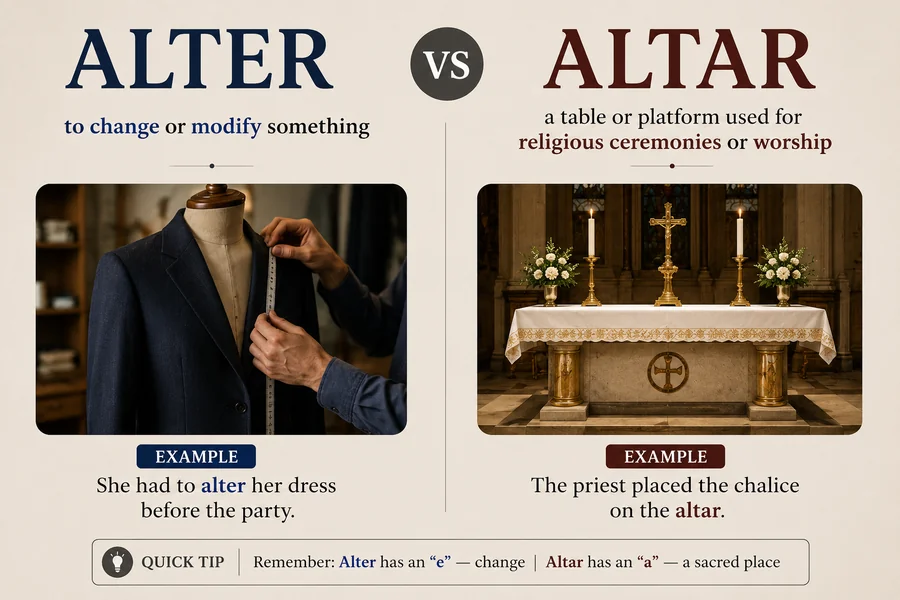
Alter and altar are often confused, since they sound very similar. They both refer to different meanings, however. Alter is a verb, or a word that describes an action. Altar is a noun — it is a raised area of ground for religious or ceremonial purpose.
Most people do not realize that the difference between altar vs alter is significant. There is so much that can go wrong with a sentence, one word can alter the meaning entirely, and in writing, it is going to stand out. Whether you’re editing a document, writing an essay or posting online, this is evidence of true language confidence.
Understand the difference between alter vs altar, with a clear and practical guide. Definitions, examples, common mistakes and exercises to help you to hone your understanding. At the end, there will be no more wrong word choices.,
Correct Answer: Alter vs Altar STUDY: Alter vs Altar
Alter: a word that means to change or modify. “She decided to alter the contract.”
Altar = a table at a religious ceremony that is raised up. They adorned the altar with flowers.
The two words have the same pronunciation but very different meaning and usage — therefore, they are homophones.
Table of content
- Define Alter
- Define Altar
- How To Properly Use The Words In A Sentence
- More Examples Of Alter & Altar Used In Sentences
- Common Mistakes To Avoid
- Context Matters
- Exceptions To The Rules
- Practice Exercises
- Conclusion
- FAQs
Read Also: EKG vs ECG: Usage Guidelines and Popular Confusions
Alter vs Altar — Quick Comparison Table
| Feature | Alter | Altar |
| Part of Speech | Verb | Noun |
| Meaning | To change or modify | A raised ceremonial surface or table |
| Context | Everyday language, legal, creative writing | Religious, ceremonial, or spiritual settings |
| Example | “The tailor will alter the dress.” | “The priest stood before the altar.” |
| Pronunciation | /ˈɔːl.tər/ | /ˈɔːl.tər/ |
| Memory Tip | Alter → change (ends in -er like “rearrange”) | Altar → a place (ends in -ar like “star”) |
Define Alter
Alter is a word that means to change. If you change something, you make it different — you change it from one state to another. This may be for physical objects, plans, documents, behaviour, and even emotions that may be experienced over time.
Alter appears in real-life situations. Tailor is a person who makes clothes. A writer makes changes to a revision. Judge can change a judgement. The word indicates that there was a thing which was there before, and they are making some adjustment to it, but not removing it altogether.
Define Altar
Altar is a noun. A platform, table or building raised to a height for religious activities, ceremonies or worship. An altar is a physical space – in churches, temples, mosques and other places of worship, it has symbolic or sacred significance.
The word altar is also used in figurative language. A person may claim to have “sacrificed everything” at the altar of success, that is, they gave up their personal things for a goal. In this figurative use, altar will always be a noun, and it will always mean a place set aside or dedicated or sacred in some manner.
How To Properly Use The Words In A Sentence
When using alter vs altar, the first question you should ask is, “Am I referring to an action or a place? For describing change use alter. When referring to a physical thing related to a ceremony or worship, use altar. It all depends on the context.
Incorporating alter into sentences.Using alter in a sentence.
Use alter as a verb when you wish to mean that something is being changed or modified. It can be used in formal writing, legal documents, creative writing, or informal speech. What is important is that the sentence always contains some sort of transformation.
- The Attorney General requested a change in the language in the agreement.
- Nothing can alter the way she felt that day.
- They had to alter their travel plans due to bad weather.
When writing with alter, use it correctly to maintain precision. It informs the reader of a change — and that information alone influences the reader’s interpretation of the sentence.
The use of Altar in a sentence.
When you’re naming a particular place of worship, use altar as a noun. It is found in the context of religious belief and in historical writing, and it is used in figurative phrases. Alter is never an action word like alter, it is always a place or object.
- The two people got married at the church.
- Care was taken in placing candles on the stone altar.
- He gave his health for a rise in the world.
Altar is used correctly to add richness to your writing, particularly to describe ceremonies, traditions or the value of personal sacrifice. This word has a symbolic meaning.
More Examples Of Alter @ Altar Used In Sentences
Alter used as a verb, to alter something.Used as a verb, alter something.
You’ll know alter vs. altar is correct when you see the words in use in various scenarios. Examples demonstrate the use of each word in writing — and how different they sound when used in context.
Some examples of using the word “alter” in a sentence.
- The new law will change the way that businesses report income.
- She requested the tailor to change the hem of her dress.
- One bad decision can alter the course of your life.
- The scientist tried to change the chemical formula of the compound.
- No pressure will get him to change what he has to say.
- The modernization will transform the building’s image.
- After several years of therapy, she changed the way she reacted to stress.
- The writer was asked by the editor to make changes to the first paragraph.
- There was nothing that would change his mind about what was right.
- They decided to make a change to the recipe and leave out the dairy.
Here are some examples of how to use Altar in a sentence.
- The altar was adorned with fresh flowers each Sunday morning.
- The priest was kneeling in front of the altar and started the ceremony.
- She was moving towards the altar slowly, her hands holding steady.
- In the old temple, there was an altar of carving stone.
- Altars have been erected in various cultures to venerate their ancestors.
- He was waiting at the altar for the ceremony to start.
- Throughout the whole night, the candles on the altar were lit.
- As she walked towards the altar, she knew what was about to happen.
- A replica of a Roman sacrificial altar was on display at the museum.
- He had set aside his family’s well-being for his job.
Common Mistakes To Avoid
The most frequent alter/altar confusion is that they sound exactly the same. This is why the mix-up is so common! However, in writing, a single incorrect decision can make your message unclear or dilute the message you want to convey. What to look out for.
The first of the mistakes is the use of Alter where you meant Altar.
One common error is using the word alter when the context is clear that it’s referring to a ceremonies site. For instance, “They lit the alter with candles,” is not right. There the word is altar (a noun meaning “a physical structure”) and not alter (a verb meaning “change”).
This error is often committed by a person who writes rapidly without considering the part of speech. Question yourself, is this a thing or an action? If it’s a physical location, then you need altar.
Always take time to review sentence structure. If you can substitute the word with platform or ceremonial table, then you need altar. If you can use “change” or “modify” then you don’t need the word alter.
The second error is to use “altar” when what you really meant was “alter.
This is also true the other way around. The correct answer to this question is “The manager wants to change the schedule. The sentence requires the verb alter (to change) not the noun altar. The mix-up is typically because of the same pronunciation.
Think about the sentence and its function. Is it a verb that is taking an action on an object? If you do, then you will need alter. The word has to be able to do something that changes, shifts, or adjusts — have the power of a verb.
Advice on how to not make these mistakes
- Remember: alter ends in -er like other verbs: alter, change, rearrange. When you’re talking about something that someone is doing, this is the word you’re looking for.
- Note: altar is an exception to the rules; remember that it ends in -ar, like nouns, such as star, altar, pillar. You’re talking about a real thing or place, this is your word.
- Have a question before typing: verb or noun? Which then, is the correct one?So, which is the proper one?
Contex Matters
The right choice between alter vs altar always depends on context. Each word fits into a specific type of sentence, and understanding where each one belongs makes your writing sharper and more reliable.
Alter
Alter belongs in sentences where something is being changed, adjusted, or modified. It’s at home in legal writing, everyday communication, technical writing, and creative work. Anytime a process or thing shifts from one state to another, alter is the right call.
It can also work in emotional or psychological contexts — like when someone’s perception is altered, or when time slowly alters a relationship. The word is flexible, but it always signals change.
- Alter fits whenever a transformation or change is being described.
- It works in formal, casual, technical, and creative contexts alike.
- The word implies something existed before and has been modified — not erased.
Altar
Altar belongs in sentences about sacred spaces, religious ceremonies, or symbolic acts of dedication. It’s most common in religious or historical writing, but it also appears in figurative language when someone wants to emphasize sacrifice or devotion.
The figurative use of “altar”—”she gave everything at the altar of perfection”—borrows from its ceremonial roots. The meaning is always built around a place of significance, not an act of changing something.
- Altar belongs in religious, historical, or ceremonial contexts.
- It also works figuratively when describing sacrifice or total devotion.
- The word always functions as a noun—never as a verb or action word.
Exceptions To The Rules
The distinction between alter and altar is generally simple, but there are some exceptions. The exceptions do not affect the meaning of either word but are only seen in certain contexts and fields.
Alter
In psychology and psychiatry, the word “alter” is a term associated with dissociative identity disorder (DID) and is abbreviated from the term “alternate identity.” In this context, “alters” is a noun, meaning “she has multiple alters.” It is a specialized clinical use and not applicable to general writing.
Contractual Alternate: Terms such as “alter ego” are frequently used in contract law. A court may “pierce the corporate veil” and view the company that a person owns as being the same entity as the person. In this case, “alter” is an adjective modifying “ego.” Context here and field knowledge.
Altar
Secular Altar: The word altar can now be used in non-religious senses, too. Today, “altar” is a decorative term for an elegant, arranged and displayed shelf or a deliberate and purposeful decorative arrangement in the interior. The name of the thing remains unchanged but there is no religious significance.
Figurative Altar: The word altar means giving up all of oneself, or surrendering all dreams: “He sacrificed his dreams on the altar of duty. This is metaphorical but widely accepted; in both literary and journalistic writing.
Read Also: Fewer Meaning Explained: The Simple Rule That Fixes 90% of Grammar Mistakes
Practice Exercises
The best way to remember the difference between alter vs altar is to practice. The following exercises are designed to practise fill-in-the-blank, sentence writing and multiple choice. Solve each one and see how you do on understanding the proper use of each word.
Exercise 1: Fill In The Blank
Fill in each blank with the correct word: alter or altar.
- The bride placed a bouquet of roses on the __________ before the ceremony.
- The new policy will __________ how employees report their hours.
- He stood nervously at the __________, waiting for her to walk in.
- Nothing could __________ the outcome once the decision was made.
- The ancient __________ was carved from a single piece of stone.
Answer Key:
- altar | 2. alter | 3. altar | 4. alter | 5. altar
FAQs:
What is the difference between alter and altar?
To alter: To make changes or modifications to something. The definition of altar is a raised table on which an altar is placed; a place used for religious or ceremonial purposes. The two words are pronounced identically yet mean different things.
When should I use alter in a sentence?
Use alter when you want to say that something is changing, adjusting, or modifying — e.g., alter a dress, a plan, a decision, or a document.
When should I use altar in a sentence?
Use altar when you are talking about a physical elevation with a religious connotation (sacrifice, dedication, etc) to use in rites or ceremonies or a symbolic setting.
Conclusion
While knowing the difference between alter vs altar is easy, it is not obvious at first glance. The word alter is always a verb, which means that it means to change or modify something. Altar always means a raised ceremonial structure (as in a place of worship or in a symbolic context). They are identical in sound but have different meanings in sentences.
The quickest memory trick: if you can substitute the word with “change”, use the word “alter”. Use altar if it can be substituted with “ceremonial table”. The context is the key. If you get into the routine, there is no confusion.
Use the practice above and notice the context of your sentences and you’ll use alter vs altar correctly every time. Making your writing in line is an effective way of gaining readers’ trust — one of those little things that makes a difference.